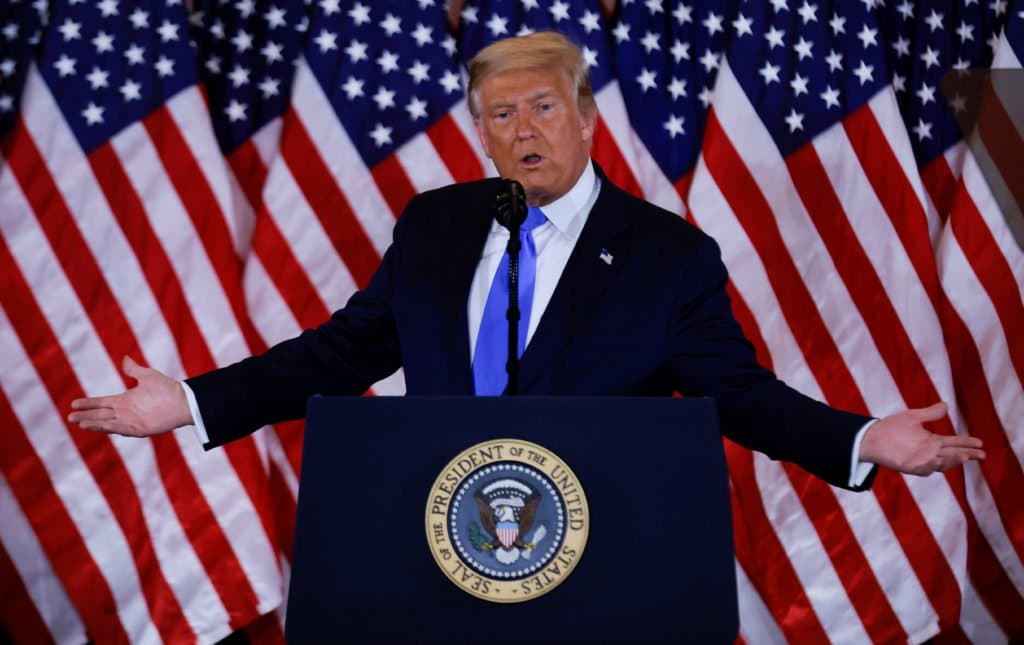
Will any court rule that the 2020 election was fraudulent?
PM $25.2K · K 67.6K contracts
2
2
Will any court rule that the 2020 election was fraudulent?
PM $25.2K · K 67.6K contracts
2
2
Polymarket vs Kalshi
Snapshot from
As of Oct 28, 2026, 9:00 PM UTC, Yes is priced at 8% on Polymarket and 6.4% on Kalshi.
| Outcome (Yes price) | Polymarket | Kalshi | Gap |
|---|---|---|---|
| YesSame question, fine print differs | 8% | 6.4% | 1.6 pts |
Yes prices for outcomes an automated review found to ask the same question on both platforms. They are not order quotes; check each platform's rules, fees and live prices before trading.
AI Analysis
Trader mode: Market mechanics, assumptions and risks
PM $25.2K · K 67.6K contracts
Reported volume · provider units
2
Saved contracts
1
Same-question pairs
Source snapshot: Oct 28, 2026, 9:00 PM UTC
About This Event
Before 2027 If any federal or state court finds that widespread fraud, fraudulent conduct, or illegal manipulation of ballots or vote counts occurred in connection with the 2020 U.S. presidential election in one or more states before Jan 1, 2027, then the market resolves to Yes. For clarity, the following do not satisfy this judgment criterion: findings of procedural irregularities, administrative errors, statutory violations related to election administration procedures (e.g., ballot curing deadlines, signature matching standards, observer access), or violations of election law that do not involve intentional fraud or deliberate manipulation of votes. Individual criminal prosecutions or guilty pleas for isolated acts of voter fraud (e.g., a single individual casting an illegal ballot) do not satisfy this criterion, even if the conduct occurred in connection with the 2020 election. This market will close and expire early if the event occurs.
Snapshot observed 2026-10-28T12:00:06.236Z. This analysis describes that snapshot and is not a live news update.
What the contract measures
Both contracts ask whether a court will find that fraud or vote manipulation occurred in the 2020 U.S. presidential election, but the wording differs in ways that matter for comparison. The Kalshi contract resolves Yes if any federal or state court finds that "widespread fraud, fraudulent conduct, or illegal manipulation of ballots or vote counts occurred" in one or more states before January 1, 2027 [1]. It explicitly excludes procedural irregularities, administrative errors, and isolated prosecutions for individual voter fraud [1].
The Polymarket contract requires a ruling by "December 31, 2026, 11:59 PM ET" that finds "widespread, intentional voter fraud or vote-manipulation" [2]. It defines a ruling as a finalized written order, judgment, opinion, or decision, and excludes oral, tentative, or settlement outcomes [2]. Polymarket's primary source is the relevant court's official information, though "a consensus of credible reporting may also be used" [2].
Reading the snapshot
The saved provider observation for both markets is dated 2026-10-28T12:00:06.236Z, while the source retrieval time is 2026-10-28T20:08:18.101Z. The prices below describe the observation, not live trading at the time of reading.
- Kalshi: Yes at 0.0635 and No at 0.9365 [1].
- Polymarket: Yes at 0.085 and No at 0.915 [2].
These are snapshot prices, not executable quotes or verified probabilities. Each platform has one market in this sample, and the coverage record marks both as complete rather than partial. Because the two contracts differ in wording, cutoff, and listed close time, their prices should not be averaged or treated as a single consensus. The gap between them does not by itself indicate an arbitrage opportunity. The saved data also does not include volume or trader counts, so it cannot speak to liquidity or how many people hold each view.
Close times differ as well. Kalshi lists an end date of 2027-01-08T15:00:00.000Z [1], while Polymarket lists 2027-01-01T04:59:00.000Z [2]. The Kalshi contract text refers to rulings before January 1, 2027, and notes it "will close and expire early if the event occurs" [1]. The listed close field is not an announced resolution date.
What remains uncertain
The evidence does not explain why either price is where it is, and no recent news or court activity is included. It does not show whether any court has issued or will issue a qualifying ruling. Readers should check each contract's full rules and the current market page before drawing conclusions.
References
- Kalshi: Will any court rule that the 2020 election was fraudulent?. Provider data observed 2026-10-28T12:00:06.236Z.
- Polymarket: Will a US court rule that the 2020 election was fraudulent?. Provider data observed 2026-10-28T12:00:06.236Z.
AI-generated analysis based on market data. Not financial advice.
Saved Oct 28, 2026 UTCOverview
This PredictPedia topic covers two prediction market contracts that ask whether a court will rule that fraud affected the 2020 United States presidential election. The Kalshi contract asks whether any federal or state court will find that widespread fraud, fraudulent conduct, or illegal manipulation of ballots or vote counts occurred in connection with the 2020 election in one or more states before January 1, 2027, and it resolves Yes if so [1]. The Polymarket contract asks whether a US court will issue a ruling that widespread fraud, fraudulent conduct, or illegal manipulation of votes occurred in at least one US state during the 2020 election by December 31, 2026, 11:59 PM ET, and resolves No otherwise [2]. The wording of each contract matters. The Kalshi rules say that findings of procedural irregularities, administrative errors, and statutory violations related to election administration, such as ballot curing deadlines, signature matching standards, or observer access, do not satisfy the criterion. Violations of election law that do not involve intentional fraud or deliberate manipulation of votes also do not count. Individual criminal prosecutions or guilty pleas for isolated acts of voter fraud do not count either, even when the conduct relates to the 2020 election [1]. The Polymarket rules similarly require a qualifying ruling to find widespread, intentional voter fraud or vote manipulation, and they exclude procedural irregularities, administrative errors, and isolated rulings on individual cases of voter fraud [2]. The Polymarket rules define a ruling as a written order, judgment, opinion, or decision, including per curiam opinions, summary orders, and sua sponte rulings. Unwritten oral rulings, tentative rulings, settlements, orders to show cause, and other procedures that do not constitute a finalized ruling do not count [2]. The Kalshi rules state that the market will close and expire early if the event occurs [1]. The two contracts also use different dates. The Polymarket rules name December 31, 2026, 11:59 PM ET as the ruling deadline, and its listed end time is January 1, 2027 at 04:59 UTC [2]. The Kalshi rules refer to rulings issued before January 1, 2027, and the saved market record lists an end date of January 8, 2027 at 15:00 UTC [1]. These are dates written in contract rules or market records. They do not describe an announced court schedule or a scheduled event.
Historical Context
The 2020 United States presidential election was held on November 3, 2020. The Democratic ticket of Joe Biden and Kamala Harris defeated the incumbent Republican ticket of Donald Trump and Mike Pence, and Biden received more than 81 million votes [3]. The same article reports that the election had the highest voter turnout by percentage since 1900 [3]. A Wikipedia article on an FBI investigation describes a criminal inquiry into the 2020 elections conducted during the second Trump presidency [4]. The sources supplied do not describe any court ruling on whether fraud occurred, so this history does not indicate how either contract will resolve.
Why It Matters
Both contracts measure whether a court, not a campaign, commentator, or investigation, will issue a qualifying finding that widespread or intentional fraud affected the 2020 election. The Kalshi rules require a finding that fraud, fraudulent conduct, or illegal manipulation of ballots or vote counts occurred in one or more states [1]. The Polymarket rules require a finalized, written ruling that widespread, intentional voter fraud or vote manipulation occurred in at least one state [2]. Because both contracts exclude procedural problems and isolated individual cases, a court ruling on a narrower issue would not meet either standard [1][2]. The prices shown on the market page reflect trading in these specific contracts and are not verified probabilities of a court ruling.
Snapshot context
The latest published provider snapshot for this topic was observed on 2026-10-28 at 21:00 UTC. It contains listings from Kalshi and Polymarket. Market descriptions and listed closing times define the contracts; they do not establish that the real-world outcome has occurred. This article does not include a separately verified news update. [1]
Frequently Asked Questions
Would a single criminal case against one voter resolve either contract?
No. The Kalshi rules state that individual criminal prosecutions or guilty pleas for isolated acts of voter fraud do not satisfy the criterion, even when the conduct occurred in connection with the 2020 election [1]. The Polymarket rules similarly exclude isolated rulings on individual cases of voter fraud [2].
Do procedural irregularities or election law violations count?
Not by themselves. The Kalshi rules exclude findings of procedural irregularities, administrative errors, and statutory violations related to election administration procedures, as well as violations that do not involve intentional fraud or deliberate manipulation of votes [1]. The Polymarket rules exclude procedural irregularities and administrative errors [2].
What counts as a ruling under the Polymarket contract?
A ruling is any written order, judgment, opinion, or decision, including per curiam opinions, summary orders, and sua sponte rulings issued by a relevant court. Unwritten oral rulings, tentative rulings, settlements, orders to show cause, and other procedures that do not constitute a finalized ruling do not count [2].
Are the Kalshi and Polymarket contracts identical?
No. The two contracts use different wording and different dates. The Kalshi rules refer to rulings before January 1, 2027 [1], while the Polymarket rules refer to a ruling by December 31, 2026, 11:59 PM ET [2]. Differences in their prices do not on their own establish any opportunity, because the rules differ.
AI-written background. References identify the evidence used; Wikipedia links under Learn More are additional reading. Prices and provider rules are dated snapshots. This is not financial advice.
Related prediction markets
Prices are catalog snapshots and may have changed. Check each market's rules and observation time.

Will any court rule that the 2024 election was fraudulent?
K 49.4K contracts
LA Mayoral Election: Court Rules 1st Round Fraudulent?
PM $1.1K
Will SCOTUS allow Arizona’s citizenship-proof and pre-election noncitizen-removal rules?
K 151.35 contracts
Michigan Supreme Court election winners?
K 215.08 contracts
Will a court block paid early access to Trump's Truth Social posts?
K 21.2K contracts
North Carolina Supreme Court Election Winner
PM $4.9KMarket Insights
Price gaps of 2 pp+
0
Same-question pairs
1
Largest saved gap: 1.6 percentage points.
Price differences do not establish arbitrage. Check each pair's review, current order prices, fees and settlement rules.