Event GroupPOLYMARKETSports
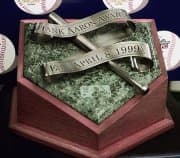
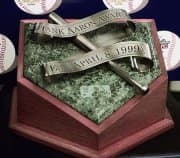
Pro Baseball: 2026 NL Hank Aaron Winner
Total Volume
$110.65K
Events
1
Markets
10
Pro Baseball: 2026 NL Hank Aaron Winner
Vol
$110.65K
|
Events
1
|
Markets
10
$110.65K
1
10
$110.65K
1
10
Trader mode: Actionable analysis for identifying opportunities and edge
This market will resolve to the player who wins the 2026 National League Hank Aaron Award. In the event of a tie, this market will resolve according to the official winner as determined by MLB rules. If multiple winners are announced then this market will resolve to the player whose listed last name comes first alphabetically. If the 2026 MLB season is cancelled, postponed after December 31, 2026, 11:59 PM ET, or there is otherwise no winner declared within that timeframe, this market will res
Right now, prediction markets see the 2026 National League Hank Aaron Award as a two-player race. Traders give Shohei Ohtani, now with the Los Angeles Dodgers, about a 40% chance to win it. That’s roughly a 2 in 5 shot. The only other player with significant odds is Atlanta Braves outfielder Ronald Acuña Jr., who is given about a 1 in 4 chance. The market essentially views this as a coin flip between two superstars, with a slight edge to Ohtani.
Two main factors explain these odds. First, Shohei Ohtani is a unique force. Even though he won’t pitch in 2025, his offensive numbers as a designated hitter are historically great. Voters for the Hank Aaron Award, which honors the best offensive performer in each league, may be eager to give it to him now that he’s a full-time hitter in the National League.
Second, Ronald Acuña Jr. is the reigning winner and a proven favorite. He won the award in 2023 after a historic 40-home run, 70-stolen base season. If he returns fully healthy from his 2024 knee injury and posts similar numbers, he will be very hard to beat. The market odds reflect the tension between Ohtani’s sheer talent and Acuña’s recent dominance and recovery timeline.
The main event is the entire 2026 MLB season, which will start in late March or early April. Watch for early season performance, especially Acuña’s health and power numbers in the first few months. The award is voted on after the regular season ends, typically in late September or October, so sustained excellence matters more than a hot streak. A significant, season-ending injury to either frontrunner would immediately reshape the market.
Prediction markets are generally decent at forecasting sports awards with clear statistical benchmarks, like this one. However, they can be volatile over long timeframes. A lot can change in two baseball seasons, including injuries, slumps, or the emergence of a new star like the Phillies’ Bryce Harper. These prices are a snapshot of current expectations, not a guarantee. For context, markets correctly identified Acuña as the heavy favorite for the 2023 award well before the season ended.
Prediction markets assign Shohei Ohtani a 40% chance to win the 2026 National League Hank Aaron Award. This price indicates Ohtani is the clear favorite, but the market views his victory as far from assured. The remaining 60% probability is distributed among other contenders, with significant gaps between them. The next closest players, like Fernando Tatis Jr. and Mookie Betts, are priced between 10-15%. With $111,000 in total volume, the market has moderate liquidity, suggesting informed traders are actively shaping these odds.
Ohtani’s dominant pricing reflects his unique status as a hitter. Even without pitching in 2025, his offensive production for the Los Angeles Dodgers, measured by metrics like OPS+ and home runs, projects to be among the league's best. The award honors the best overall offensive performer, and Ohtani’s power-speed combination is unmatched. Historical precedent also matters. Since joining the NL, he has consistently been the betting favorite for MVP and offensive awards, a pattern markets expect to continue. The 40% price essentially bets that if Ohtani stays healthy, his baseline performance is enough to outpace a crowded field of elite NL hitters.
Player health is the primary variable. A significant injury to Ohtani would immediately redistribute probability to players like Tatis, Betts, or Ronald Acuña Jr. Performance regression is another risk. If Ohtani’s power numbers decline in his age-31 season while a rival like Acuña returns to his 2023 MVP form, the odds will tighten rapidly. The award’s voting body, a combination of fans and a panel of Hall of Famers, can introduce volatility. A narrative-driven season from a player on a playoff-bound team could sway sentiment against Ohtani, especially if the Dodgers underperform. Key moments to watch are the 2026 All-Star break for early statistical leaders and the final month of the season for late surges.
This contract is trading exclusively on Polymarket. The absence of a comparable market on Kalshi prevents a direct cross-platform analysis. This exclusivity concentrates all trading activity and price discovery on Polymarket. The 40% price for Ohtani is therefore the consensus view of that specific platform's user base. Traders should monitor for the creation of a parallel market elsewhere, which could reveal pricing discrepancies based on differing trader demographics or liquidity.
AI-generated analysis based on market data. Not financial advice.
The National League Hank Aaron Award is presented annually to the best offensive performer in the National League, as voted on by a panel of Hall of Fame players and broadcasters. The award was established in 1999 to honor the 25th anniversary of Hank Aaron breaking Babe Ruth's home run record. It is distinct from the Most Valuable Player award, focusing solely on offensive production. The winner is typically a player who has demonstrated exceptional hitting prowess over the course of the regular season, with statistics like batting average, home runs, runs batted in, and on-base plus slugging percentage being key factors. This prediction market specifically concerns the winner of the 2026 National League Hank Aaron Award. Interest in this market stems from baseball's statistical nature and the ability to analyze player performance trends. Bettors and analysts examine player age, team lineups, ballpark factors, and historical voting patterns to forecast potential winners. The market resolves based on the official MLB announcement, typically made during the World Series. The award's history shows it often goes to established superstars, but breakout seasons from younger players can also capture the honor. The 2026 season is far enough in the future that it allows for speculation on the continued dominance of current stars versus the emergence of new talent. Player development, potential trades, and free agency between now and 2026 will significantly alter the landscape of contenders.
The Hank Aaron Award was created in 1999 by Major League Baseball to commemorate the 25th anniversary of Aaron's 715th home run. It was originally awarded to a single player across both leagues. In 2000, the format changed to honor one player from each league. The award is voted on by a special panel of Hall of Famers, including past winners like Johnny Bench, Roberto Alomar, and Craig Biggio, along with fan voting which counts as one collective vote. Historically, the award has strongly correlated with high home run totals and slugging percentage. From 2000 to 2023, the NL winner also led the league in home runs in 13 of those 24 seasons. Recent winners like Paul Goldschmidt (2022) and Ronald Acuña Jr. (2023) have also excelled in other offensive categories like stolen bases and on-base percentage, reflecting a broader view of offensive value. The award has never ended in a tie in its history. Past winners are a who's who of offensive stars, including Barry Bonds (who won four times), Albert Pujols, Ryan Howard, and Bryce Harper. The voting body's composition of Hall of Fame players gives it a distinct perspective compared to the Baseball Writers' Association of America, which votes on the MVP.
The Hank Aaron Award matters because it is a direct measure of the most valuable offensive commodity in baseball: consistent, high-level run production. It carries the name of one of the game's most revered figures, lending it significant prestige. For players, winning the award can enhance legacy, trigger contract incentives, and increase marketability. For teams, having the award winner often correlates with postseason success, as elite offense is a primary driver of wins. The award also reflects broader trends in how baseball values offensive contributions. The rise of players like Acuña, who combine power with speed and on-base ability, winning the award signals a shift from the pure slugger model of the past. This influences how teams scout and develop players, prioritizing multifaceted offensive threats. For fans and the betting community, the award race provides a season-long narrative focused on individual excellence, creating engagement beyond team standings.
The 2024 MLB season is underway, providing the first major data points that will inform 2026 predictions. Early performances from key players like Mookie Betts, Fernando Tatis Jr., and Matt Olson are being scrutinized for signs of sustained excellence or decline. The 2025 season will be the most immediate precursor, where breakout candidates will solidify their status. Player movement through free agency and trades between now and 2026 will dramatically reshape the list of potential contenders. Speculation already centers on whether Ronald Acuña Jr. can maintain his historic pace and if younger stars like Corbin Carroll or Gunnar Henderson can elevate their games to award level.
The Hank Aaron Award recognizes the best offensive performer in each league. The Most Valuable Player award, voted on by baseball writers, considers a player's overall value, which includes offense, defense, baserunning, and his contribution to his team's success. A player can win both in the same season, as happened with Paul Goldschmidt in 2022.
The award is voted on by a special panel of Hall of Fame players. This panel has included legends like Hank Aaron himself, Roberto Alomar, Johnny Bench, and past award winners. Fan voting on MLB.com also contributes one collective vote to the final tally.
Yes, this has occurred multiple times. For example, Christian Yelich won both the NL Hank Aaron Award and the NL batting title in 2018 with a .326 average. Luis Arraez won the AL batting title in 2022 but did not win the AL Hank Aaron Award, which went to Aaron Judge.
Since 2000, the National League home run leader has also won the Hank Aaron Award in approximately 54% of seasons (13 out of 24). While home runs are significant, voters also heavily weigh other metrics like slugging percentage, OPS, and RBI, meaning the leader is not guaranteed to win.
There has never been a tie in the history of the Hank Aaron Award. The official MLB rules for the award do not publicly detail a tie-breaking procedure. For the purpose of this prediction market, the rules specify that if multiple winners are officially announced, the market resolves to the player whose last name comes first alphabetically.
Educational content is AI-generated and sourced from Wikipedia. It should not be considered financial advice.
10 markets tracked
No data available
| Market | Platform | Price |
|---|---|---|
| Poly | 40% |
| Poly | 36% |
| Poly | 35% |
| Poly | 35% |
| Poly | 35% |
| Poly | 34% |
| Poly | 24% |
| Poly | 16% |
| Poly | 8% |
| Poly | 3% |
No related news found
Add this market to your website
<iframe src="https://predictpedia.com/embed/0sfTez" width="400" height="160" frameborder="0" style="border-radius: 8px; max-width: 100%;" title="Pro Baseball: 2026 NL Hank Aaron Winner"></iframe>