This event has ended. Showing historical data.
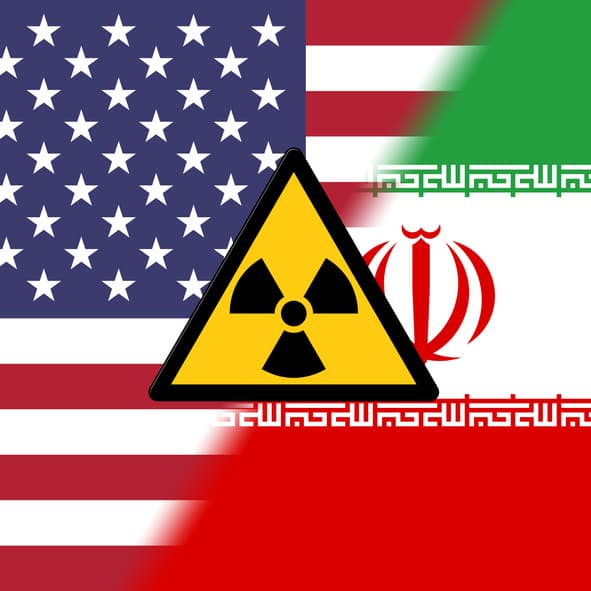
US-Iran nuclear deal by June 30?
$1.47M
1
1
US-Iran nuclear deal by June 30?
$1.47M
1
1
AI Analysis
Trader mode: Actionable analysis for identifying opportunities and edge
About This Event
This market will resolve to "Yes" if an official agreement over Iranian nuclear research and/or nuclear weapon development, defined as a publicly announced mutual agreement, is reached between the United States and Iran by June 30, 2026, 11:59 PM ET. Otherwise, this market will resolve to “No”. If such an agreement is officially reached before the resolution date, this market will resolve to "Yes", regardless of if/when the agreement goes into effect. Agreements that include the United States
This saved analysis is awaiting a background update. Its prices and claims may be outdated; compare them with the dated market data above.
US-Iran nuclear deal by June 30?
Current Market Outlook
The market is pricing a 32% chance of a US-Iran nuclear agreement by June 30, 2026. This is a low probability but not a dismissal. The market sees a deal as possible but unlikely within this timeframe. With $1.5 million in volume, this is a well-funded market with serious money behind both sides. A 32% price means the crowd thinks failure is roughly twice as likely as success.
Key Factors Driving the Odds
The core problem is the gap between what each side wants. Iran wants sanctions relief and economic normalization. The US, under any administration, wants verifiable limits on Iran's enrichment capacity, specifically the 60% enrichment level Iran has reached, which is weeks from weapons-grade.
The Biden administration attempted indirect talks through 2022-2023 but walked away after Iran added conditions like removing the IRGC from the terror list. The 2015 JCPOA collapsed because it didn't address ballistic missiles or sunset clauses, and neither side trusts the other to honor terms.
Iran's breakout time has shrunk from 12 months under the JCPOA to roughly 1-2 weeks today. Any deal would require Iran to ship out or dilute its enriched uranium stockpile, dismantle centrifuges, and accept intrusive IAEA inspections. Iran's supreme leader has publicly stated that nuclear weapons are forbidden, but the regime has also threatened to withdraw from the NPT if pressured.
What Could Change These Odds
The biggest wildcard is who wins the 2024 US presidential election. A second Trump term would likely kill the diplomatic track entirely, pushing odds below 10%. Trump withdrew from the JCPOA in 2018 and has signaled he prefers maximum pressure over negotiation. A Harris or Biden continuation keeps the door open but doesn't guarantee progress.
Iran's internal politics matter. The June 2025 presidential election could bring a more pragmatic candidate, but the supreme leader retains final say on nuclear policy. If Iran accelerates enrichment to 90% weaponization, the diplomatic window slams shut.
Key dates: The IAEA Board of Governors meets quarterly, with the next snap inspection deadline in November 2025. A US-Iran prisoner swap or frozen asset release would signal renewed backchannel talks and push odds toward 45-50%.
Cross-Platform Analysis
This market trades exclusively on Polymarket. No Kalshi or Metaculus equivalent exists. The single-platform pricing limits arbitrage opportunities but also means the market reflects a concentrated pool of traders, mostly US-based and politically engaged. The 32% price may be slightly depressed by Trump victory expectations in Polymarket's presidential market, which currently shows Trump at 52%. A Harris win in that market would likely push this deal market toward 40-45%.
AI-generated analysis based on market data. Not financial advice.
Saved Jul 16, 2026 UTCThis saved content is awaiting a background update. It may contain outdated claims; use the dated market data and provider rules for the latest available information.
Overview
The US-Iran nuclear deal, formally known as the Joint Comprehensive Plan of Action (JCPOA), was an international agreement signed in 2015 between Iran and the P5+1 (the United States, United Kingdom, France, Russia, China, and Germany) along with the European Union. The deal limited Iran's nuclear program in exchange for relief from economic sanctions. The United States unilaterally withdrew from the JCPOA in 2018 under President Donald Trump, who cited concerns over Iran's ballistic missile program and regional activities. The withdrawal led Iran to begin violating the deal's nuclear restrictions starting in 2019, including enriching uranium to 60% purity and operating advanced centrifuges. The current prediction market asks whether a new agreement between the US and Iran will be reached by June 30, 2026. This market resolves to "Yes" if a publicly announced mutual agreement on Iranian nuclear research or weapons development is officially reached, regardless of when it takes effect. The market does not require the agreement to include other P5+1 nations, only the United States and Iran. Since 2021, the Biden administration has pursued diplomatic efforts to revive the JCPOA through negotiations in Vienna. Those talks stalled in late 2022, with both sides blaming each other for failing to reach a compromise. Key sticking points include Iran's demand for guarantees that future US administrations cannot unilaterally withdraw, the scope of sanctions relief, and the status of Iran's advanced nuclear research and development. Iran currently enriches uranium to 60% purity, close to the 90% threshold for weapons-grade material. The International Atomic Energy Agency (IAEA) has reported that Iran possesses enough enriched uranium to produce several nuclear weapons if further enriched. This makes the timeline for a potential agreement urgent. In 2023, there were indirect talks via Oman and Qatar, but no breakthrough occurred. In early 2024, a prisoner swap and the release of $6 billion in frozen Iranian assets for humanitarian purposes temporarily eased tensions. However, the broader nuclear issue remains unresolved. The election of a new Iranian president in 2024 and the possibility of a change in US administration in 2025 could shift the negotiating landscape. The market's resolution date of June 30, 2026, falls after the next US presidential election and inauguration, adding uncertainty about US policy continuity. Interest in this market stems from the high stakes involved: a new deal could prevent an Iranian nuclear weapon and reduce Middle East tensions, while failure could lead to a nuclear arms race, increased sanctions, or military conflict. Traders are watching diplomatic signals, IAEA reports, and political developments in both countries. The market captures the probability that the two governments can overcome deep mistrust and reach a formal agreement within a specific timeframe.
Historical Context
The US-Iran nuclear dispute dates back to the 1950s when the US provided Iran with its first nuclear reactor under the Atoms for Peace program. After the 1979 Islamic Revolution, the US cut off nuclear cooperation. During the Iran-Iraq War in the 1980s, Iran began covert nuclear activities, which were exposed in 2002 by an opposition group. The IAEA found undeclared enrichment facilities in Natanz and Arak. From 2003 to 2005, Iran suspended enrichment under a voluntary agreement with the EU-3 (UK, France, Germany), but talks collapsed. In 2006, the UN Security Council imposed sanctions on Iran. Over the next decade, Iran expanded its enrichment capacity, and the US and allies applied escalating economic pressure. The election of Hassan Rouhani in 2013, a relative moderate, opened diplomatic space. After two years of negotiations, the JCPOA was signed on July 14, 2015. It limited Iran's enrichment to 3.67% purity, capped its stockpile at 300 kg of UF6, and reduced centrifuges to 5,060 IR-1 machines. Inspections by the IAEA were extensive. President Trump withdrew the US from the JCPOA on May 8, 2018, calling it a "horrible one-sided deal." The US reimposed sanctions, and Iran gradually violated the deal starting in 2019. By 2021, Iran was enriching to 60% and using advanced centrifuges like IR-6 and IR-9. The IAEA reported in 2023 that Iran had enough enriched material for multiple bombs. The Biden administration's efforts to revive the deal have not succeeded, with talks stalling in August 2022.
Why It Matters
A new US-Iran nuclear deal would directly affect global oil markets, as Iran holds the world's fourth-largest oil reserves. Lifting sanctions could add 1-2 million barrels per day to global supply, lowering oil prices. The deal would also reduce the risk of a military conflict between the US and Iran or between Israel and Iran. An Iranian nuclear weapon would likely trigger a regional arms race, with Saudi Arabia, Turkey, and Egypt potentially seeking their own nuclear capabilities. For the US, a deal would remove a major foreign policy crisis and allow the administration to focus on other priorities like Ukraine and China. For Iran, sanctions relief could boost its economy, which has been hit by inflation above 40% and unemployment. However, critics argue that a deal may not address Iran's ballistic missile program or its support for proxy groups in Yemen, Syria, and Lebanon. The outcome affects millions of people in the Middle East and beyond, shaping security, energy costs, and nuclear nonproliferation efforts.
AI-written background. References identify the evidence used; Wikipedia links under Learn More are additional reading. Prices and provider rules are dated snapshots. This is not financial advice.
Market Insights
Price gaps of 2 pp+
0
Saved price pairs
0
No exact saved pairs with both binary Yes prices are available.
Price differences do not establish arbitrage. Check each pair's review, current order prices, fees and settlement rules.