$3.06K
1
1

1 market tracked

No data available
| Market | Platform | Price |
|---|---|---|
![]() | Poly | 7% |
Trader mode: Actionable analysis for identifying opportunities and edge
This market will resolve to "Yes" if Russia officially rejoins the Group of Seven (G7) by December 31, 2026, 11:59 PM ET. Otherwise, this market will resolve to "No". If the title of the group changes (e.g., to "G8"), this market will still resolve to "Yes" so long as that group remains functionally similar to the G7. A formal rejoining must be acknowledged by a consensus of G7 member states to qualify for a "Yes" resolution. The primary resolution source for this market will be official info
AI-generated analysis based on market data. Not financial advice.
$3.06K
1
1
This prediction market addresses whether Russia will officially rejoin the Group of Seven (G7) before the end of 2026. The G7 is an intergovernmental political forum consisting of Canada, France, Germany, Italy, Japan, the United Kingdom, and the United States. Russia was suspended from the group, then known as the G8, in 2014 following its annexation of Crimea. The market resolves based on a formal, consensus-based acknowledgment by the current G7 members that Russia has rejoined the group, even if the group's name changes, provided its core function remains similar. The topic sits at the intersection of geopolitics, international diplomacy, and economic policy, reflecting the ongoing realignment of global alliances in the wake of Russia's full-scale invasion of Ukraine in 2022. Interest stems from its implications for global security architecture, energy markets, and the potential normalization of Russia's standing among major industrialized democracies. Recent developments, including continued Western sanctions and military support for Ukraine, make the prospect of rejoining before 2027 a significant geopolitical question with high stakes for international order.
Russia's involvement with the group began in 1994 with the 'Political 8' forum, leading to its formal inclusion and the creation of the G8 in 1997. This period represented a high point of post-Cold War integration, with Russia participating in summits from 1998 onward. The relationship deteriorated following Russia's war with Georgia in 2008, but the group remained intact. The pivotal event occurred in March 2014, when Russia annexed Crimea from Ukraine. In response, the other seven members suspended Russia's participation in the G8, effectively dissolving the forum and reverting to the G7. The 2014 summit in Brussels was held without Russia for the first time in 16 years. This suspension was a landmark decision, marking Russia's expulsion from the premier club of advanced democracies. The full-scale invasion of Ukraine in February 2022 solidified this division, transforming the suspension from a temporary measure into a seemingly permanent feature of the geopolitical landscape, with the G7 becoming a core coordinating body for sanctions and military aid to Ukraine.
The question of Russia's return to the G7 is a proxy for the broader future of East-West relations. A 'Yes' outcome would signal a dramatic de-escalation of the conflict in Ukraine and a potential recalibration of the global order, possibly indicating Western acceptance of revised borders or spheres of influence. It would have significant economic implications, likely preceding or accompanying the lifting of major sanctions, thereby affecting global energy, fertilizer, and grain markets. Conversely, a sustained 'No' reinforces a bifurcated world order, with Russia further aligned with China and other non-Western powers, cementing a new era of strategic competition. It matters deeply to the security of Eastern Europe, the credibility of international law, and the stability of the global economy. The outcome will also test the cohesion and long-term resolve of the Western alliance, revealing whether geopolitical and moral considerations permanently override earlier patterns of economic engagement with Russia.
As of late 2024, there is no active diplomatic initiative for Russia to rejoin the G7. The consensus among member states remains firmly against readmission while Russia's war against Ukraine continues. The G7 has instead focused on strengthening support for Ukraine, including using frozen Russian asset revenues for Ukrainian aid, and enhancing coordination on sanctions enforcement. Recent statements from leaders, including at the 2024 summit in Italy, have reiterated that Russia must end its illegal war and withdraw from Ukrainian territory as a precondition for any discussion of normalized relations. Russia has dismissed the G7 as an 'irrelevant' forum, though it has historically sought the prestige of membership.
Russia was suspended from the G8 in March 2014 following its annexation of Crimea from Ukraine. The other seven members (Canada, France, Germany, Italy, Japan, the UK, and the US) condemned this act as a violation of international law and Ukraine's sovereignty, leading to the group's reversion to the G7 format.
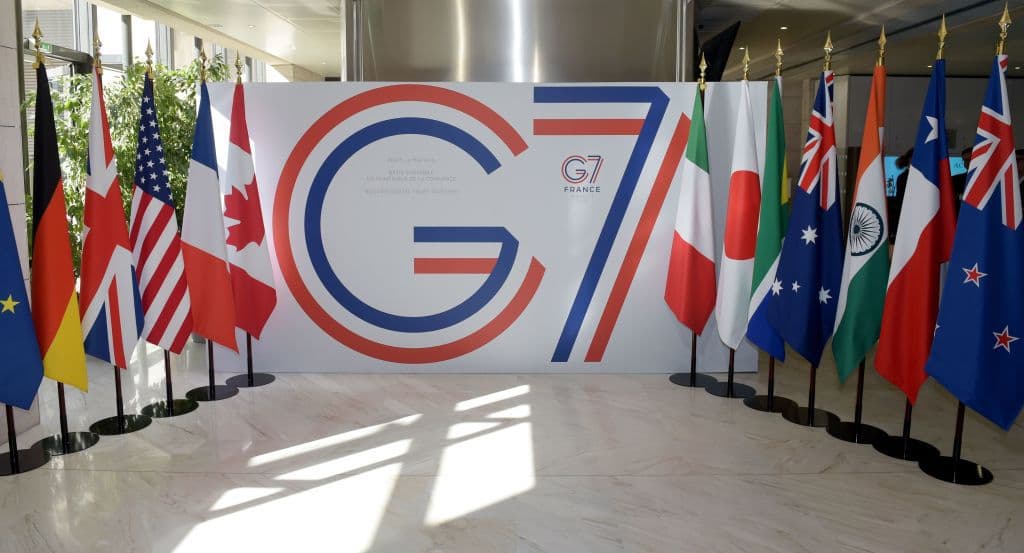
The G7 refers to the group of seven major advanced economies. The G8 was the same group including Russia from 1997 to 2014. The 'G8' name is currently dormant, with the forum operating exclusively as the G7 since Russia's suspension.
It is highly improbable. All current G7 members have publicly stated that an end to Russia's war of aggression against Ukraine, based on respect for Ukraine's sovereignty and territorial integrity, is an absolute prerequisite for any consideration of normalizing relations, including G7 membership.
No leading G7 government has formally proposed readmitting Russia under current circumstances. Isolated comments from former leaders or opposition figures are not reflective of official policy, which remains unified in linking readmission to a fundamental change in Russia's actions in Ukraine.
Russia participates in other international forums, most notably the BRICS grouping (Brazil, Russia, India, China, South Africa, and new members as of 2024), the Shanghai Cooperation Organisation (SCO), and the Commonwealth of Independent States (CIS). These groups lack the consolidated economic power or political alignment of the G7.
Educational content is AI-generated and sourced from Wikipedia. It should not be considered financial advice.
Share your predictions and analysis with other traders. Coming soon!

No related news found
Add this market to your website
<iframe src="https://predictpedia.com/embed/4XhXit" width="400" height="160" frameborder="0" style="border-radius: 8px; max-width: 100%;" title="Will Russia rejoin the G7 before 2027?"></iframe>