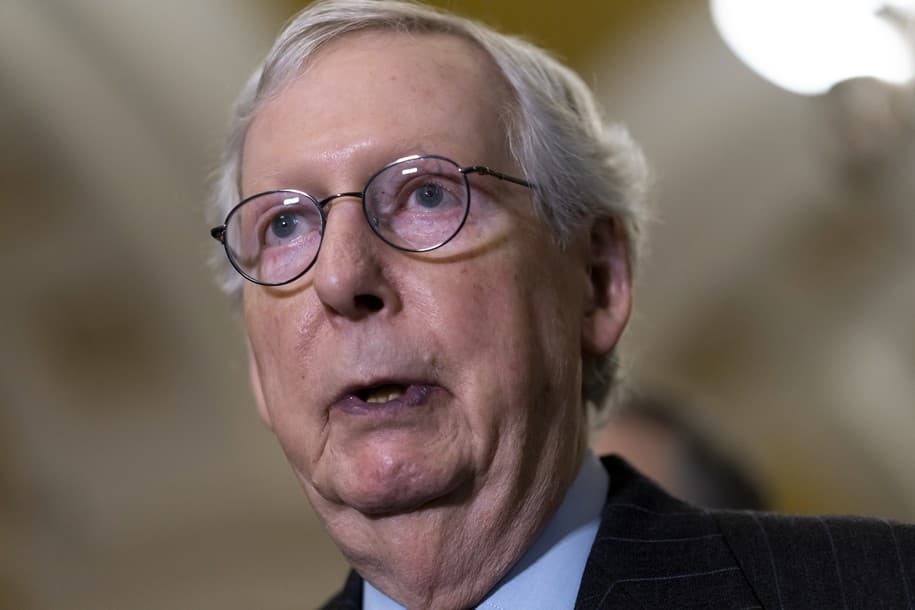
Will Mitch McConnell resign his office before the midterms?
$5.65M
2
2
Will Mitch McConnell resign his office before the midterms?
$5.65M
2
2
AI Analysis
Trader mode: Actionable analysis for identifying opportunities and edge
About This Event
Before election day 2026 If Mitch McConnell has resigned, retired, or otherwise voluntarily stepped down from their Congressional office, or announced their intent to resign, retire, or otherwise voluntarily step down from their office prematurely, after Issuance and before Nov 3, 2026, then the market resolves to Yes. This market will close and expire early if Mitch McConnell retires.
Snapshot observed 2026-10-13T06:00:05.665Z. This analysis describes that snapshot and is not a live news update.
What the contract measures
The question is whether Senator Mitch McConnell will leave his office early, but the two platforms define the event differently. Kalshi's contract resolves "Yes" if McConnell "has resigned, retired, or otherwise voluntarily stepped down" or "announced their intent" to do so prematurely, "after Issuance and before Nov 3, 2026" [1]. Polymarket's contract resolves "Yes" if he "formally announces an intention to step down or otherwise vacates" his Senate seat before his term ends on January 3, 2027 [2]. Polymarket also states that "Statements reaffirming an existing plan to retire at the end of his term will not qualify" [2].
The windows therefore differ. Kalshi's window closes before the midterm election, while Polymarket's runs to the end of the current term.
Reading the snapshot
The snapshot was observed at 2026-10-13T06:00:05.665Z and retrieved at 2026-10-13T08:22:50.206Z. It records one market from each platform, and both samples are complete, with no partial sampling noted [1][2].
Kalshi's "Yes" price was 0.0225 and its "No" price was 0.9775 [1]. Polymarket's "Yes" price was 0.065 and its "No" price was 0.935 [2]. These are prices at the observation time, not executable quotes or verified probabilities. Because the two contracts ask different questions over different windows, their prices should not be averaged or treated as a single estimate. The gap between them also does not, by itself, indicate an opportunity, since the wording and closing times differ.
Kalshi's market record lists an end date of 2026-11-03T15:00:00.000Z [1]. Polymarket's listed end time is 2027-01-04T04:59:00.000Z [2]. The Kalshi excerpt says its listed end time was "not supplied," so the end date in the market record is the only closing time available for that contract. The Polymarket closing time is a listed time, and the rule text refers to January 3, 2027, at 11:59 PM ET.
What remains uncertain
This snapshot does not explain why either price is where it is, and no recent news or trader activity is included in the evidence. Volume and trader counts are not provided here, so the snapshot says nothing about liquidity or how many people hold each view. Because the data was captured at a specific moment, it should not be read as current prices or as a forecast of what will happen.
References
- Kalshi: Will Mitch McConnell resign his office before the midterms?. Provider data observed 2026-10-13T06:00:05.665Z.
- Polymarket: Mitch McConnell steps down from Senate before his term ends?. Provider data observed 2026-10-13T06:00:05.665Z.
Snapshot observed 2026-10-13T06:00:05.665Z. This analysis describes that snapshot and is not a live news update.
What the contract measures
The two contracts ask related but different questions. The Kalshi contract resolves to Yes if Mitch McConnell "has resigned, retired, or otherwise voluntarily stepped down from their Congressional office, or announced their intent to resign, retire, or otherwise voluntarily step down from their office prematurely, after Issuance and before Nov 3, 2026" [1]. It also states that the market "will close and expire early if Mitch McConnell retires" [1]. The provider's listed end time is not supplied in the excerpt, though the market record shows an end date of 2026-11-03T15:00:00.000Z [1].
The Polymarket contract resolves to Yes if McConnell "formally announces an intention to step down or otherwise vacates his U.S. Senate seat before his current term is scheduled to end (January 3, 2027, 11:59 PM ET)" [2]. It specifically excludes "statements reaffirming an existing plan to retire at the end of his term" [2]. Its listed end time is 2027-01-04T04:59:00.000Z [2].
Because the windows, triggers, and end times differ, the two prices do not describe the same event.
Reading the snapshot
The saved prices were observed at 2026-10-13T06:00:05.665Z. Kalshi's Yes outcome was 0.0225 and its No outcome was 0.9775 [1]. Polymarket's Yes outcome was 0.065 and its No outcome was 0.935 [2]. These are snapshots from that observation time, not executable quotes, and they should not be read as verified probabilities.
Each event contains one saved market, and the coverage records mark both as complete with no partial sample [1][2]. This means the Yes and No outcomes are both included for each contract. The sample still does not establish that the providers list every possible outcome.
Because the contracts differ in wording and closing time, a reader should not average the two prices or treat the gap between them as an arbitrage opportunity. Volume is not supplied in this evidence, so it cannot be used to judge liquidity.
What remains uncertain
The evidence does not explain why either price is where it is, and it contains no recent news or trader counts. It also does not show how often prices in this kind of market have matched later outcomes. Future snapshots could differ, and the excerpts do not state any upcoming announcement beyond the closing terms quoted above.
References
- Kalshi: Will Mitch McConnell resign his office before the midterms?. Provider data observed 2026-10-13T06:00:05.665Z.
- Polymarket: Mitch McConnell steps down from Senate before his term ends?. Provider data observed 2026-10-13T06:00:05.665Z.
AI-generated analysis based on market data. Not financial advice.
Saved Oct 13, 2026 UTCOverview
This contract asks whether Senator Mitch McConnell will resign or otherwise leave his Senate seat early, before the 2026 midterm elections. Two separate platforms list versions of this question, and their rules differ. Kalshi's contract resolves to Yes if McConnell has resigned, retired, or otherwise voluntarily stepped down from his Congressional office, or has announced an intent to do so prematurely, after issuance and before Nov 3, 2026 [1]. The contract also states that it will close and expire early if McConnell retires [1]. Polymarket's contract is broader in time. It resolves to Yes if McConnell formally announces an intention to step down or otherwise vacates his Senate seat before his current term is scheduled to end on January 3, 2027 [2]. The platforms draw the line differently on announcements. Kalshi's rule refers to premature departure, so it targets a stepping down before the midterms [1]. Polymarket states that an announcement qualifies only if it indicates McConnell will leave office before the scheduled end of his term, and that statements reaffirming an existing plan to retire at the end of the term do not qualify [2]. A reader comparing the two should therefore check each rule's wording rather than assuming the questions are identical. The Kalshi record in the saved data lists an end date of November 3, 2026 [1]. That date is the contract's own resolution cutoff and does not indicate that any election or announcement is scheduled for that day. The Polymarket record lists an end time of January 4, 2027 at 04:59 UTC [2], which reflects the platform's listed closing time rather than the end of McConnell's term. McConnell's background helps explain why a question about his departure is being asked. A Wikipedia article retrieved for this contract describes him as an American politician and attorney who has been a United States senator from Kentucky since 1985 and Kentucky's senior senator since 1999 [3]. The same article describes him as a Republican in his seventh Senate term and says he led the Senate Republican Conference from 2007 to 2025 [3]. Wikipedia is a background reference and does not confirm current events, so any statement about his present status should come from a dated primary source.
Historical Context
The Wikipedia article on McConnell says he served as Senate majority leader from 2015 to 2021 and as minority leader twice, and that his leadership of the Senate Republican Conference made him the longest-serving Senate party leader in U.S. history [3]. The article also states that he is the longest-serving senator in Kentucky history [3]. The contract's timing relates to midterm elections in general. A Wikipedia article on the 2018 United States elections describes those midterms as held on November 6, 2018, when all 435 House seats and 35 of the 100 Senate seats were contested [4]. The article describes the 2018 midterms as occurring during Donald Trump's first term and notes that the Democratic Party won control of the House [4]. This background explains the midterm framing of the question but does not describe the 2026 election itself.
Why It Matters
The contract measures whether a sitting senator will leave office early in a defined window, which makes it a question about a specific departure rather than about the outcome of an election. The Kalshi rule counts a resignation, a retirement, a voluntary stepping down, or an announcement of intent to step down prematurely, and it applies only before November 3, 2026 [1]. The Polymarket rule counts a formal announcement or an actual vacancy before the scheduled end of the term on January 3, 2027 [2]. Because the platforms define qualifying events differently, the same public news could resolve one contract and not the other. A statement that reaffirms a planned retirement at the end of the term would not satisfy the Polymarket rule [2], and the Kalshi rule's premature-departure language suggests it would not satisfy that contract either [1]. Each contract should be read on its own terms.
Snapshot context
The latest published provider snapshot for this topic was observed on 2026-10-13 at 06:00 UTC. It contains listings from Kalshi and Polymarket. Market descriptions and listed closing times define the contracts; they do not establish that the real-world outcome has occurred. This article does not include a separately verified news update. [1]
Frequently Asked Questions
Does a plan to retire at the end of the term count as a Yes on the Polymarket contract?
No. The Polymarket rule states that statements reaffirming an existing plan to retire at the end of his term will not qualify [2]. The contract requires a formal announcement of an intention to step down or an actual vacancy before the term is scheduled to end on January 3, 2027 [2].
What is the cutoff for the Kalshi contract?
The Kalshi rule covers resignations, retirements, voluntary stepdowns, or announcements of premature departure made after issuance and before Nov 3, 2026 [1]. The saved market record lists November 3, 2026 as its end date [1].
Why do the two contracts have different end dates?
Each platform sets its own rules. Kalshi's contract focuses on the period before the midterm elections [1], while Polymarket's contract runs until McConnell's scheduled term ends on January 3, 2027 [2].
Does a displayed price confirm the likelihood of this outcome?
No. The displayed figures are market snapshots from the provider data and are not executable quotes or verified probabilities. Each platform's contract rules determine how the market resolves.
AI-written background. References identify the evidence used; Wikipedia links under Learn More are additional reading. Prices and provider rules are dated snapshots. This is not financial advice.
Market Insights
Price gaps of 2 pp+
1
Saved price pairs
1
Largest saved gap: 4.5 percentage points.
Price differences do not establish arbitrage. Check each pair's review, current order prices, fees and settlement rules.