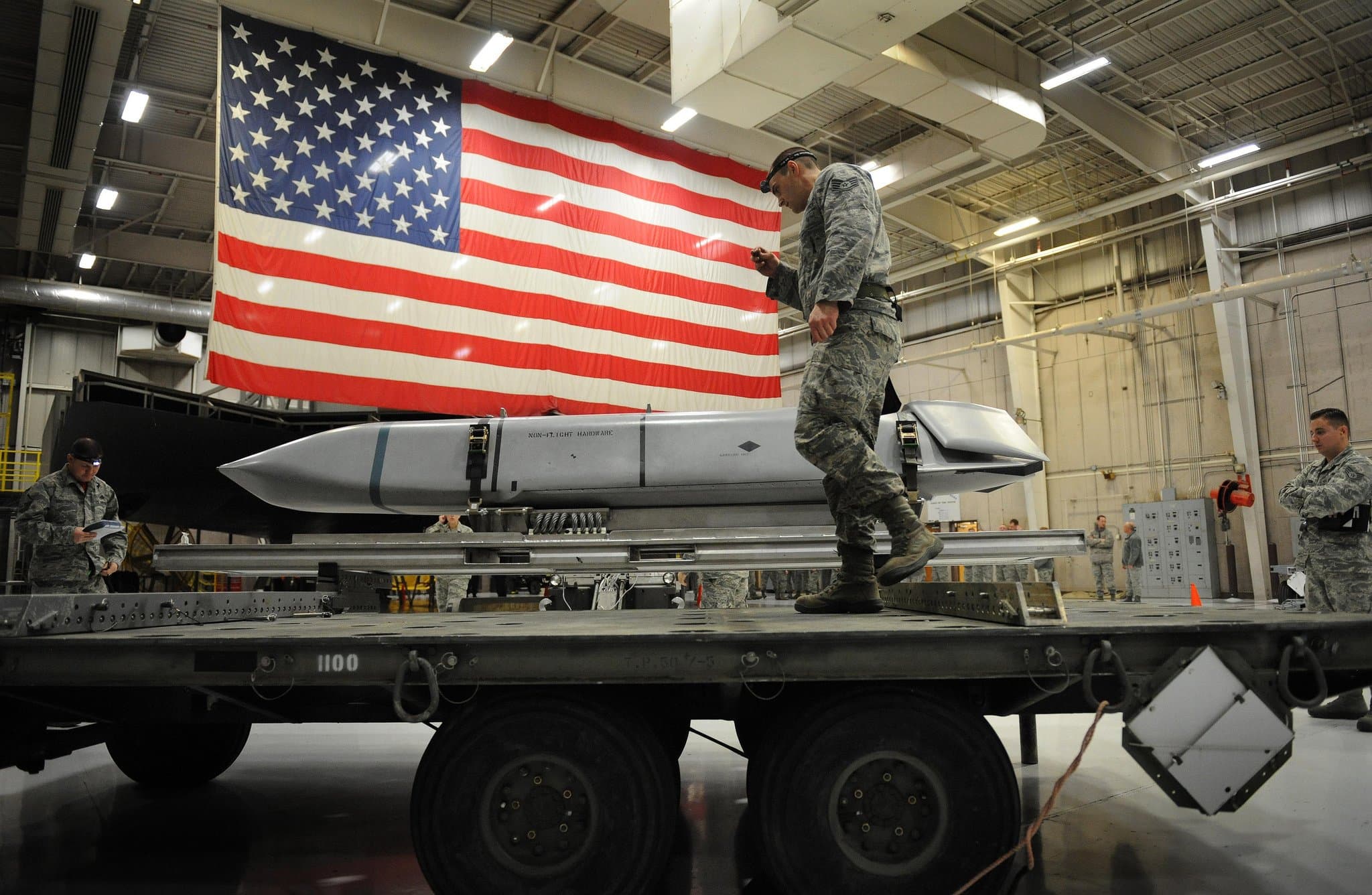
How many different countries will the US conduct military action against in 2026?
PM $1.72M
1
8
How many different countries will the US conduct military action against in 2026?
PM $1.72M
1
8
Current odds
Snapshot from
As of Oct 26, 2026, 12:00 PM UTC, the highest-priced outcome on Polymarket is 8 at 60.4%.
Polymarket
- 860.4%
- 931.4%
- 106.1%
- 111.1%
- 120.9%
Yes prices. They are not order quotes; check each platform's rules, fees and live prices before trading.
AI Analysis
Trader mode: Market mechanics, assumptions and risks
PM $1.72M
Reported volume · provider units
8
Saved contracts
0
Same-question pairs
Source snapshot: Oct 26, 2026, 12:00 PM UTC
About This Event
This market will resolve according to the total number of different countries' soil that the United States initiates a drone, missile, or air strike on between January 1, 2026, 12:00 AM ET and December 31, 2026, 11:59 PM ET. Strikes on embassies or consulates will count towards the country the embassy or consulate is located in, not towards the country they represent. Strikes within the territory controlled by the United States as of December 31, 2025, 11:59 PM ET will not be counted towards this market's resolution. For the purposes of this market, a qualifying "strike" is defined as the use of aerial bombs, drones, or missiles (including cruise or ballistic missiles) launched by US military forces that impact another country's ground territory that is officially acknowledged by the US government or a consensus of credible reporting. Missiles or drones that are intercepted and surface-to-air missile strikes will not count towards the resolution of this market, regardless of whether they land on another country's territory or cause damage. Actions such as artillery fire, small arms fire, FPV or ATGM strikes directly, ground incursions, naval shelling, cyberattacks, or other operations conducted by US ground operatives will not qualify. The resolution source will be a consensus of credible reporting.
Snapshot observed 2026-10-25T18:00:06.091Z. This analysis describes that snapshot and is not a live news update.
What the contract measures
This Polymarket event asks how many different countries the United States will conduct military action against in 2026. The rules state that the market "will resolve according to the total number of different countries' soil that the United States initiates a drone, missile, or air strike on between January 1, 2026, 12:00 AM ET and December 31, 2026, 11:59 PM ET" [1].
The wording sets several limits. A qualifying strike must use "aerial bombs, drones, or missiles (including cruise or ballistic missiles)" that impact another country's ground territory. Intercepted missiles, surface-to-air missile strikes, artillery, small arms fire, ground incursions, naval shelling, and cyberattacks do not count [1]. Strikes on embassies or consulates count toward the country where the building is located, not the country it represents [1]. Strikes within territory the US controlled as of December 31, 2025 are excluded [1]. Resolution depends on "a consensus of credible reporting" [1].
The listed end time is 2027-01-01T04:59:00.000Z [1]. That is the close time in the provider record, and it corresponds to the ET window end in the rules. It is not an announced event date.
Reading the snapshot
The saved provider observation time is 2026-10-25T18:00:06.091Z, and the source was retrieved at 2026-10-25T18:23:13.852Z [1]. These prices describe that observation only and are not live quotes.
The sample includes all 8 saved markets for this event, with no partial sample flagged [1]. The Yes prices were: 8 countries at 0.6035, 9 at 0.323, 10 at 0.069, 11 at 0.0115, 12 at 0.0095, 13 at 0.004, 14 at 0.0015, and 15 or more at 0.003 [1]. The markets for 0 to 7 countries are not in the saved set, so this snapshot says nothing about their prices.
The listed Yes prices sum to about 1.015, so they are not a clean probability distribution. Prices are snapshot indicators, not verified probabilities, and they are not executable quotes. The saved volume figures are not in this evidence, so this comparison makes no claim about liquidity or trader participation.
What remains uncertain
The evidence does not explain why prices are where they are. It also does not show how "credible reporting" consensus will be applied to specific strikes, and the rules do not settle every edge case beyond the listed exclusions [1].
Because this evidence includes only one platform's event, there is nothing here to compare against other providers' wording or close times. Any cross-platform comparison would require separate contract rules and separate observation times before prices could be read against one another.
References
- Polymarket: How many different countries will the US conduct military action against in 2026?. Provider data observed 2026-10-25T18:00:06.091Z.
AI-generated analysis based on market data. Not financial advice.
Saved Oct 25, 2026 UTCOverview
This PredictPedia contract asks how many different countries the United States will conduct military action against during calendar year 2026. Under the listed rules, the market resolves according to the total number of different countries' territory that the United States strikes with a drone, missile, or air strike between January 1, 2026, 12:00 AM ET and December 31, 2026, 11:59 PM ET [1]. The count is by country, so several strikes on one country add only one to the total. The rules define a qualifying strike narrowly. It must be the use of aerial bombs, drones, or missiles, including cruise or ballistic missiles, launched by US military forces that impact another country's ground territory. The strike must be officially acknowledged by the US government or reflected in a consensus of credible reporting [1]. Missiles or drones that are intercepted do not count, and surface-to-air missile strikes do not count, whether or not they land on another country's territory or cause damage [1]. Artillery fire, small arms fire, FPV or ATGM strikes, ground incursions, naval shelling, cyberattacks, and other operations by US ground operatives are also excluded [1]. Strikes on embassies or consulates count toward the country where the embassy or consulate is located, not the country it represents [1]. Strikes within territory controlled by the United States as of December 31, 2025 are not counted [1]. The resolution source is stated as a consensus of credible reporting [1]. The saved event lists the contract's end time as January 1, 2027 at 04:59 UTC, which corresponds to the rule window's close [1]. That end time is the listed closing time of the contract, not a separately announced event date.
Historical Context
The contract's window opens on January 1, 2026. One event in that year is described in a Wikipedia article on the 2026 United States intervention in Venezuela. According to that article, on 3 January 2026 the United States launched a military strike in Venezuela and captured Nicolas Maduro and his wife, Cilia Flores. The operation, codenamed Operation Absolute Resolve, began around 2 a.m. local time, and US forces bombed infrastructure across northern Venezuela to suppress air defenses [2]. The article reports that approximately 80 people died and seven American soldiers were wounded, and that Maduro and Flores were taken to New York City and indicted on drug trafficking charges, to which they pleaded not guilty [2]. This is a historical account drawn from a retrieved encyclopedia article. It is not a verified current-events update, and the supplied material does not establish how that operation would be treated under the contract's rules.
Why It Matters
The contract measures breadth rather than frequency. A country hit once and a country hit many times each contribute one to the total, so the question tracks how many distinct countries' territory receive qualifying US strikes in 2026 [1]. Because the rules exclude intercepted projectiles, ground operations, and cyber activity, the count depends on a specific type of aerial strike reaching foreign ground territory [1]. Traders following the market are therefore reading a question about the spread of qualifying strikes across countries, with the exact outcome decided under the rules and the resolution source named in the contract [1]. The market structure and prices shown on this page are a dated snapshot, and they are not executable quotes.
Snapshot context
The latest published provider snapshot for this topic was observed on 2026-10-25 at 18:00 UTC. It contains listings from Polymarket. Market descriptions and listed closing times define the contracts; they do not establish that the real-world outcome has occurred. This article does not include a separately verified news update. [1]
Frequently Asked Questions
Does a strike that is intercepted count toward the total?
No. Missiles or drones that are intercepted do not count, and surface-to-air missile strikes do not count, regardless of whether they land on another country's territory or cause damage [1].
How are strikes on embassies counted?
A strike on an embassy or consulate counts toward the country where that embassy or consulate is located, not toward the country it represents [1].
Does the count include ground operations or cyberattacks?
No. The rules list artillery fire, small arms fire, FPV or ATGM strikes directly, ground incursions, naval shelling, cyberattacks, and other operations by US ground operatives as non-qualifying [1].
Is a strike on territory the United States already controlled counted?
No. Strikes within the territory controlled by the United States as of December 31, 2025, 11:59 PM ET are not counted toward resolution [1].
Is the January 2026 Venezuela operation part of this contract's window?
The Venezuela operation described in a Wikipedia article took place on 3 January 2026, which falls after the contract window opens on January 1, 2026 [2]. Whether it qualifies under the contract's definition of a strike is a resolution question that the supplied rules address only through their general criteria [1].
What source determines the resolution?
The rules state that the resolution source will be a consensus of credible reporting [1].
AI-written background. References identify the evidence used; Wikipedia links under Learn More are additional reading. Prices and provider rules are dated snapshots. This is not financial advice.
Related prediction markets
Prices are catalog snapshots and may have changed. Check each market's rules and observation time.

Russia military action against EU country by...?
PM $303.8K
US SPR level for the week ending October 23, 2026
K 696.44 contracts
Number of Honey Deuces sold at the US Open
K 118.5K contracts
US active housing listings in October
K 1.1K contracts
US-Iran nuclear deal?
PM $20.38M · K 4.01M contractsUS-Iran Final Nuclear Deal by December 31, 2026?
Kalshi: Will the US agree to a new Iranian nuclear deal this year? (Before Jan 1, 2027)
Related contracts
US-Iran Final Nuclear Deal by November 30, 2026?
Kalshi: Will the US agree to a new Iranian nuclear deal this year? (Before Dec 1, 2026)
Related contracts
US-Iran Final Nuclear Deal by October 31, 2026?
Kalshi: Will the US agree to a new Iranian nuclear deal this year? (Before Nov 1, 2026)
Related contracts
Related or unreviewed contracts may settle differently. Their gap is not an equivalent-contract comparison.
Saved prices; check contract rules.

Which countries will have their US Travel Advisory downgraded in 2026?
K 81.1K contractsMarket Insights
Price gaps of 2 pp+
0
Same-question pairs
0
No outcomes on this page have been reviewed as the same question on both platforms yet.
Price differences do not establish arbitrage. Check each pair's review, current order prices, fees and settlement rules.