
$599.67
1
10
Trader mode: Actionable analysis for identifying opportunities and edge
This market will resolve to the player who wins the 2026 American League Most Valuable Player Award. In the event of a tie, this market will resolve according to the official winner as determined by MLB rules. If multiple winners are announced then this market will resolve to the player whose listed last name comes first alphabetically. If the 2026 MLB season is cancelled, postponed after December 31, 2026, 11:59 PM ET, or there is otherwise no winner declared within that timeframe, this marke
AI-generated analysis based on market data. Not financial advice.
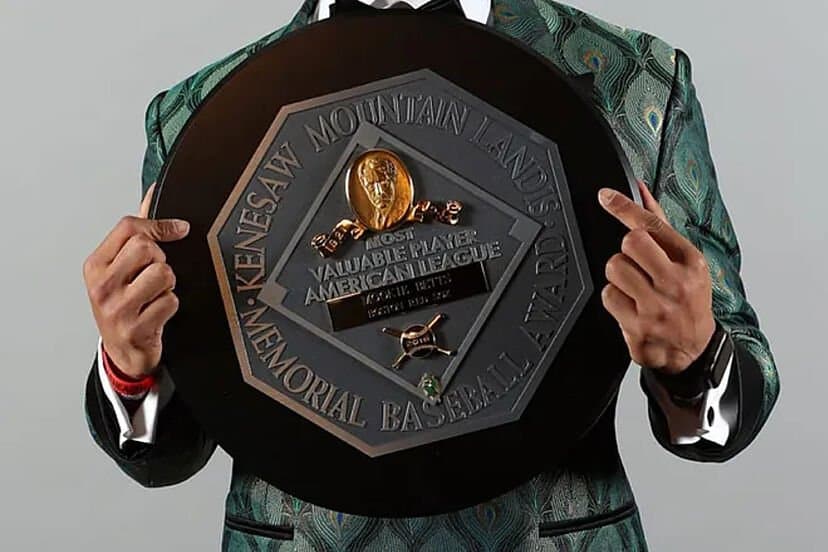
This prediction market focuses on identifying the player who will win the 2026 American League Most Valuable Player Award, one of Major League Baseball's most prestigious individual honors. The MVP award is voted on annually by members of the Baseball Writers' Association of America (BBWAA) and recognizes the player deemed most valuable to his team's success during the regular season. The market resolves based on the official MLB announcement, with specific rules for ties and season cancellations. Interest in this market stems from baseball's status as a major professional sport with a massive following, the award's historical significance, and the speculative nature of forecasting player performance two seasons into the future. Bettors and analysts must evaluate a combination of established superstar trajectories, emerging young talent, and potential breakout candidates who could dominate the league by 2026. The market acts as a collective intelligence gauge on which American League player is projected to have a career-defining season. Factors influencing predictions include current player contracts, team competitiveness, ballpark effects, and historical voting trends that sometimes favor players on playoff-bound teams. The long-term horizon adds complexity, as it requires anticipating player development, health, and potential team changes through free agency or trades.
The American League Most Valuable Player Award was first presented in 1931, though the BBWAA later retroactively recognized awards back to 1911. The voting process has evolved, but the core principle of valuing a player's overall contribution to his team's success has remained. Historically, the award has favored everyday position players, with pitchers winning far less frequently; the last pitcher to win the AL MVP was Justin Verlander in 2011. A significant precedent is the 'Triple Crown' rule, where leading the league in batting average, home runs, and runs batted in virtually guarantees the award, as seen with Miguel Cabrera in 2012. The rise of advanced analytics like Wins Above Replacement (WAR) since the early 2000s has profoundly influenced voting. Voters now regularly consult WAR leaders, which has benefited well-rounded players who excel at defense and baserunning, not just hitting. This shift helped Mike Trout win three AL MVPs (2014, 2016, 2019) despite his Los Angeles Angels team often missing the playoffs, challenging the older notion that the MVP must come from a contender. The award has also seen younger winners recently, with Shohei Ohtani winning at age 27 in 2021 and 2023, reflecting the influx of elite talent reaching the majors at a younger age.
The AL MVP award has substantial financial implications for players. Winning the award can trigger performance bonuses in contracts, sometimes worth millions of dollars. More significantly, it dramatically boosts a player's market value in free agency and strengthens their case for the Baseball Hall of Fame, as nearly every multiple-MVP winner has been inducted. For franchises, having an MVP winner drives ticket sales, merchandise revenue, and national media attention, enhancing the team's brand and financial outlook. Beyond economics, the MVP race is a central narrative of the baseball season, generating extensive media coverage and fan debate. It focuses attention on individual excellence within a team sport, creating heroes and defining eras. The award also reflects broader trends in how baseball is understood, from the traditional counting stats of the past to the current embrace of comprehensive value metrics. The outcome influences player legacies and shapes historical comparisons across generations.
The landscape for the 2026 award is taking shape during the 2024 and 2025 seasons. Player performances, injuries, and team trajectories in these intervening years will solidify the frontrunners. As of late 2024, the conversation is led by established superstars like Juan Soto and Julio Rodríguez, who are expected to be in their athletic prime in 2026. Speculation also surrounds the potential impact of top prospects who may debut by then, such as the Baltimore Orioles' Jackson Holliday. The market is currently in a speculative phase, with odds shifting based on early-season performances, contract extensions, and trades.
Two writers from each American League city, members of the Baseball Writers' Association of America (BBWAA), submit a ballot with their top 10 players. A points system is used (14 for first place, 9 for second, down to 1 for tenth), and the player with the highest total wins.
Yes, but it is rare. The last pitcher to win was Justin Verlander in 2011. Voters have historically favored everyday position players, as they contribute in every game. A pitcher would need an extraordinarily dominant season to overcome this bias.
They are identical awards given to the most valuable player in each respective league. The voting process is the same, conducted by BBWAA writers assigned to that league. The key difference is the pool of players and the fact that the American League uses the Designated Hitter rule.
Yes, but only once. Fred Lynn of the Boston Red Sox won the award in 1975 as a rookie. This extreme rarity means it is highly unlikely for a true rookie to win the 2026 award, barring a once-in-a-generation debut season.
No, the award is explicitly for regular season performance only. The ballots are submitted before the postseason begins. Voters are instructed to consider only games played from Opening Day through the end of the regular season.
Educational content is AI-generated and sourced from Wikipedia. It should not be considered financial advice.
10 markets tracked

No data available
| Market | Platform | Price |
|---|---|---|
![]() | Poly | 36% |
![]() | Poly | 21% |
![]() | Poly | 10% |
![]() | Poly | 9% |
![]() | Poly | 8% |
![]() | Poly | 7% |
![]() | Poly | 7% |
![]() | Poly | 6% |
![]() | Poly | 6% |
![]() | Poly | 4% |


No related news found
Add this market to your website
<iframe src="https://predictpedia.com/embed/Ail4qb" width="400" height="160" frameborder="0" style="border-radius: 8px; max-width: 100%;" title="MLB: 2026 AL MVP "></iframe>