$10.60K
1
1

1 market tracked

No data available
| Market | Platform | Price |
|---|---|---|
![]() | Poly | 62% |
Trader mode: Actionable analysis for identifying opportunities and edge
This market will resolve to "Yes" if any country not already a part of the Abraham Accords formally signs a normalization agreement with Israel under the framework of the Abraham Accords by December 31, 2026 11:59 PM ET. Otherwise, this market will resolve to "No". A formal signing refers to an official agreement between Israel and another country that is publicly acknowledged by both governments and clearly attributed to the Abraham Accords or their continuation. Countries already part of the
Prediction markets currently assign a 53% probability that a new country will join the Abraham Accords by March 31, 2026. This price, trading at 53¢ on Polymarket, indicates the market views the event as essentially a coin flip, with a marginal lean toward expansion. The thin liquidity, with only $59,000 in total volume, suggests this consensus is tentative and highly sensitive to new information. A 53% chance reflects significant uncertainty, pricing in both diplomatic momentum and substantial geopolitical hurdles.
The modest bullish pricing is primarily driven by sustained, public diplomatic efforts by the United States and Israel to expand the normalization framework. Recent administrations have consistently targeted nations like Saudi Arabia, Indonesia, and Mauritania for potential inclusion. The prospect of a U.S.-brokered defense pact with Saudi Arabia, which has been linked to Riyadh normalizing relations with Israel, provides a concrete pathway for a "Yes" resolution.
However, the probability is capped near 50% due to one overwhelming countervailing factor: the ongoing war in Gaza. The conflict has dramatically raised the regional and domestic political cost for any Arab or Muslim-majority nation to pursue public normalization with Israel. It has frozen most overt diplomacy and made any near-term agreement politically untenable for many potential signatories.
The odds are likely to remain volatile and closely tied to developments in the Gaza conflict and U.S. electoral politics. A decisive ceasefire and a credible post-war governance plan for Gaza could rapidly improve the diplomatic environment, potentially boosting the "Yes" probability. Conversely, an escalation in regional conflict, such as a major Hezbollah-Israel war, would likely drive the price toward "No."
The U.S. presidential election in November 2024 is a critical catalyst. A second Trump term could see a renewed, aggressive push for normalization deals, possibly shifting odds higher. A second Biden term would likely continue current efforts, but the timeline for a breakthrough before the March 2026 deadline would tighten. The market will closely watch any high-level diplomatic meetings, especially involving Saudi, U.S., and Israeli officials, for signals of progress.
AI-generated analysis based on market data. Not financial advice.
$10.60K
1
1
This prediction market focuses on whether any additional country will formally join the Abraham Accords, a series of bilateral agreements normalizing diplomatic relations between Israel and Arab states, by March 31, 2026. The Accords, first announced in August 2020, represent a significant geopolitical realignment in the Middle East, moving away from the long-standing Arab League position of non-recognition of Israel without a resolution to the Palestinian issue. The market specifically resolves to 'Yes' if a country not already part of the Accords signs an official normalization agreement publicly acknowledged by both governments and attributed to the Abraham Accords framework. The core interest stems from monitoring the potential expansion of this diplomatic initiative, which has already reshaped regional alliances and economic partnerships. Observers are closely watching several nations, particularly in the Gulf and North Africa, for signs of impending negotiations. The outcome is seen as a barometer for the durability and appeal of the normalization model championed by the United States under the Trump administration and continued, albeit with different emphasis, by the Biden administration. The deadline of March 2026 provides a concrete timeframe to assess the momentum of this foreign policy endeavor.
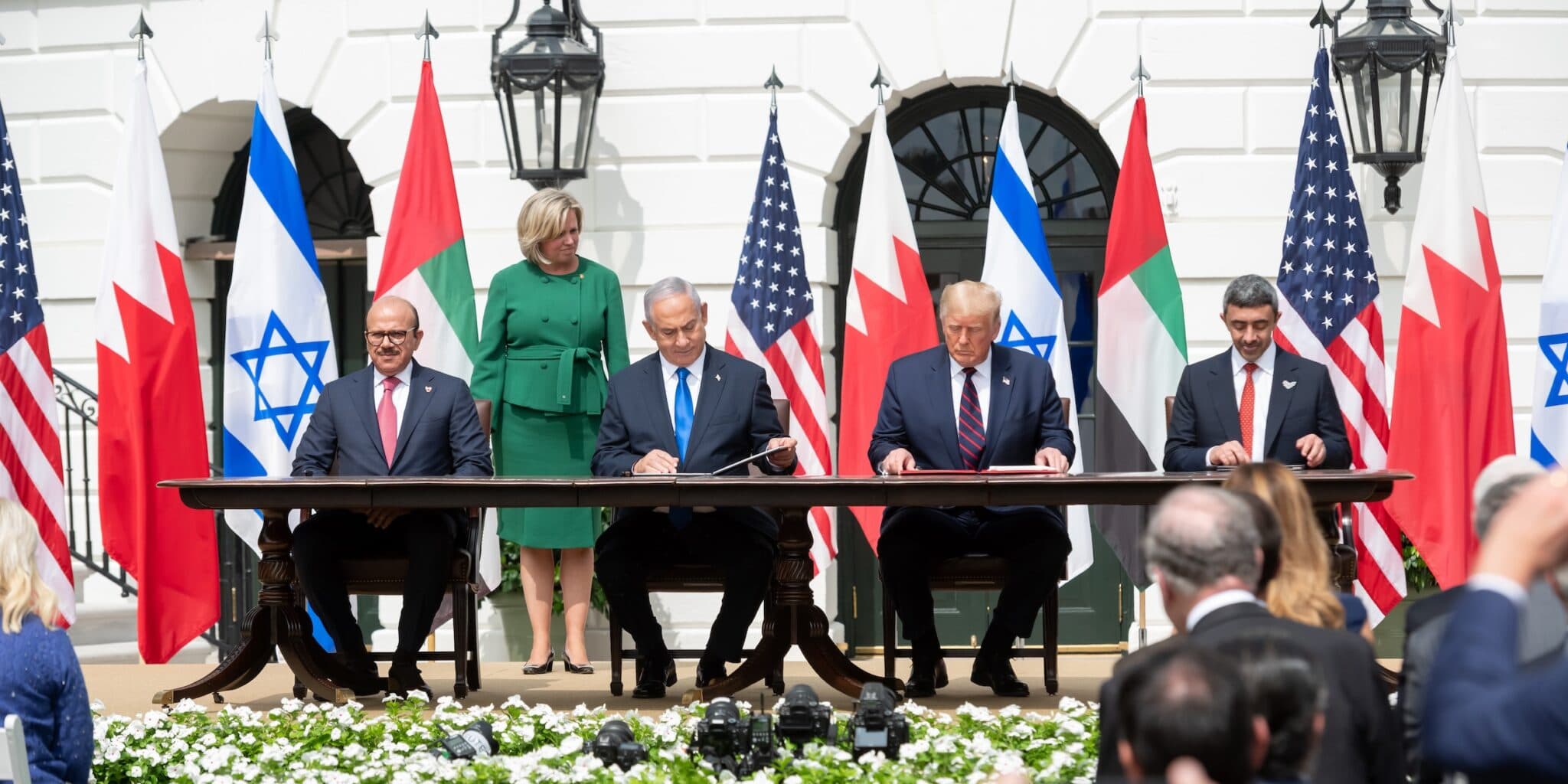
The Abraham Accords emerged from a decades-long backdrop of incremental, often secret, cooperation between Israel and some Arab states, primarily focused on shared security threats. The foundational peace treaties were Egypt in 1979 and Jordan in 1994, which remained isolated exceptions for over 25 years. The geopolitical landscape began shifting in the 2010s due to the perceived rise of Iranian influence, the decline of the Palestinian issue as a unifying Arab cause, and growing economic and technological opportunities with Israel. The formal breakthrough came on September 15, 2020, when the United States brokered the signing of normalization agreements between Israel and the United Arab Emirates and Bahrain at the White House. Sudan and Morocco followed suit in late 2020, though their agreements differed in scope and context. These Accords marked a historic departure from the 2002 Arab Peace Initiative, which made normalization contingent on a Palestinian state. The success of these initial signings created a new diplomatic template and immediate speculation about which nations might be next in line, setting the stage for the current prediction market question.
The expansion of the Abraham Accords carries profound implications for Middle Eastern geopolitics and global economics. Politically, each new signatory further erodes the longstanding Arab consensus on isolating Israel, potentially marginalizing the Palestinian Authority and reshaping regional power dynamics. It strengthens an informal alliance between Israel and Sunni Arab states against Iran, altering security calculations across the region. Economically, normalization unlocks direct trade, investment, tourism, and technological cooperation, with estimates suggesting the existing Accords could add over $1 trillion to regional GDP in the next decade. New members would integrate into this growing economic network, gaining access to Israeli innovation in fields like water technology, agriculture, and cybersecurity. For the United States, expansion validates a foreign policy approach that decouples Israeli-Arab peace from the Israeli-Palestinian conflict, though it also risks inflaming tensions without a parallel political process for Palestinians. The social impact is mixed, fostering people-to-people exchanges in some sectors while facing significant public opposition in countries where populations remain broadly sympathetic to the Palestinian cause.
As of late 2024, diplomatic efforts to expand the Accords are active but face headwinds. The war in Gaza, which began in October 2023, has complicated and in some cases paused public normalization talks, as Arab governments are sensitive to domestic public opinion sympathetic to Palestinians. The most significant ongoing negotiations involve Saudi Arabia and the United States, discussing a complex package that could include a US-Saudi defense pact, Saudi civilian nuclear assistance, and Israeli concessions to Palestinians. While these talks continue, a final agreement before the March 2026 deadline is uncertain. Other countries like Indonesia and Mauritania are periodically mentioned as longer-shot possibilities, but no other nation appears to be in advanced, public negotiations. The momentum from the 2020 signings has slowed, making the prediction market a test of whether the Accords' model can overcome the current regional tensions.
Saudi Arabia is widely considered the most significant and likely candidate for next joining the Abraham Accords, given its advanced negotiations with the United States and Israel. However, a deal is contingent on a complex set of US security guarantees, nuclear energy cooperation, and Israeli political concessions, making the timing and certainty uncertain, especially before the March 2026 deadline.
The primary obstacles are the ongoing Israeli-Palestinian conflict, particularly heightened by the war in Gaza, which fuels public opposition in potential member states. Other hurdles include domestic political instability in candidate countries, the need for substantial US incentives or security guarantees, and in some cases, pre-existing diplomatic recognition of Palestine that complicates establishing ties with Israel.
The war has significantly slowed public momentum for expansion and made immediate new signings politically difficult for Arab leaders. While it has not formally stopped back-channel diplomacy, notably with Saudi Arabia, it has increased the political cost of normalization and linked any future progress more tightly to tangible improvements in the situation for Palestinians.
While theoretically any nation can join, non-Arab Muslim-majority countries like Pakistan and Indonesia face even greater domestic political and religious hurdles than Arab states. Their populations have historically strong pro-Palestinian sentiments, and their governments have maintained a consistent policy of non-recognition until a Palestinian state is established, making them less likely candidates in the near term.
Signatory countries typically gain enhanced security cooperation with Israel and the US, access to advanced Israeli technology in agriculture, water, and cybersecurity, increased foreign investment, and boosted tourism. They also strengthen their strategic relationship with the United States, which often provides diplomatic support and, in some cases, tangible incentives like arms sales or removal from terrorism lists.
Educational content is AI-generated and sourced from Wikipedia. It should not be considered financial advice.
Share your predictions and analysis with other traders. Coming soon!

No related news found
Add this market to your website
<iframe src="https://predictpedia.com/embed/BAJz-a" width="400" height="160" frameborder="0" style="border-radius: 8px; max-width: 100%;" title="Will a new country join the Abraham Accords before 2027?"></iframe>