$492.20K
1
2

$492.20K
1
2
Trader mode: Actionable analysis for identifying opportunities and edge
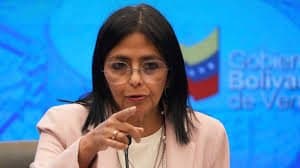
This market will resolve to "Yes" if Venezuela’s current leader, Acting President Delcy Rodríguez, is removed from power for any length of time by the specified date, 11:59 PM ET. Otherwise, this market will resolve to "No". Rodríguez will be considered to be removed from power if she resigns, is detained, or otherwise loses his position or is prevented from fulfilling his duties as Acting President of Venezuela within this market's timeframe. The primary resolution source for this market wi
AI-generated analysis based on market data. Not financial advice.
This prediction market focuses on whether Delcy Rodríguez will remain as Acting President of Venezuela through the specified deadline. Rodríguez assumed the role on April 19, 2024, following the disqualification of President Nicolás Maduro from seeking re-election by the Venezuelan Supreme Court. The market resolves to 'Yes' if she is removed from power for any length of time before the deadline, whether through resignation, detention, or any other means that prevents her from fulfilling her duties. The question reflects deep political instability in Venezuela, where leadership changes often occur through judicial and political maneuvers rather than standard electoral processes. Interest in this market stems from Venezuela's ongoing constitutional crisis, international pressure regarding the legitimacy of its government, and the country's strategic importance as a major oil producer. Observers are watching whether Rodríguez can maintain control amid economic collapse, international sanctions, and internal factional disputes within the ruling United Socialist Party of Venezuela (PSUV). The situation is complicated by the scheduled presidential election on July 28, 2024, where Maduro is again a candidate despite his earlier disqualification, creating a confusing overlap of executive authority.
Venezuela has experienced repeated political crises since the death of Hugo Chávez in 2013. His successor, Nicolás Maduro, won a disputed election in 2013 and has maintained power through control of state institutions, the military, and the Supreme Court. In 2015, the opposition won a parliamentary majority, but the Supreme Court stripped the National Assembly of its powers in 2017. That same year, Maduro created a loyalist Constituent Assembly, effectively replacing the legislature. A major turning point came in January 2019, when National Assembly president Juan Guaidó declared himself interim president, gaining recognition from over 50 countries including the United States. However, Guaidó's movement lost momentum by 2023, and his interim government was dissolved in December 2022. The current crisis stems from an agreement signed in Barbados in October 2023 between the government and opposition, which promised electoral guarantees. The government subsequently violated the agreement by blocking opposition candidates. The Supreme Court's disqualification of Maduro in January 2024, followed by his reinstatement and Rodríguez's appointment, continues a pattern of using judicial bodies to manipulate political outcomes, a tactic employed since the Chávez era.
The stability of Venezuela's leadership directly impacts 28 million citizens facing one of the world's worst economic crises. Hyperinflation has destroyed savings, and over 7.7 million people have fled the country since 2015, creating a regional migration crisis. A change in acting presidency could signal either a consolidation of Maduro's authoritarian system or a fracture within the ruling party, with implications for potential political negotiations. Internationally, the outcome affects global oil markets. Venezuela holds the world's largest proven oil reserves, estimated at 303 billion barrels. Its production has collapsed from over 3 million barrels per day in the 1990s to around 800,000 barrels per day in 2024, but any shift toward a more internationally accepted government could alter global supply dynamics. The situation also tests the durability of authoritarian regimes that use legalistic maneuvers to maintain power, serving as a case study for similar governments worldwide.
As of late April 2024, Delcy Rodríguez remains Acting President. The presidential campaign is underway with Maduro officially campaigning despite the earlier disqualification. The opposition candidate Edmundo González Urrutia is registered but faces severe restrictions on campaigning. The United States has begun reinstating some oil sanctions after the Maduro government failed to fully implement the Barbados agreement. Key institutions like the National Electoral Council and the Supreme Court remain firmly under government control. No public moves against Rodríguez have been reported from within the ruling party, but the period before the July election is considered highly volatile.
The Venezuelan Supreme Court disqualified Nicolás Maduro from the presidential ballot in January 2024. On April 19, 2024, Rodríguez, who was Executive Vice President, was appointed Acting President. This allowed Maduro to remain the ruling party's candidate while technically complying with electoral rules that prevent sitting presidents from campaigning.
Yes. Maduro remains the presidential candidate for the United Socialist Party of Venezuela in the July 2024 election. The acting presidency is a temporary arrangement during the campaign period. If Maduro wins the election, he would presumably resume the full presidency.
The Venezuelan constitution states that if the acting president cannot serve, the position would fall to the president of the National Assembly. However, since the government replaced the elected National Assembly with a loyalist Constituent Assembly in 2017, the succession would likely follow political rather than constitutional rules, potentially leading to immediate instability.
Most international observers and opposition groups do not consider the election free and fair. The government has blocked the opposition's preferred candidates, maintains control over electoral institutions, and restricts media access. The European Union has declined to send observers, citing insufficient guarantees.
The U.S. government recognizes the 2015 National Assembly as Venezuela's last legitimate legislature and has imposed extensive sanctions on the Maduro government. In 2023, the U.S. temporarily eased some oil sanctions in exchange for electoral guarantees under the Barbados agreement, but reinstated them in April 2024 after the government failed to comply.
The Venezuelan military remains under the command of Nicolás Maduro and Defense Minister Vladimir Padrino López. The military's loyalty has been secured through economic privileges and control over key industries. Their support is essential for any leader to maintain power in Venezuela.
Educational content is AI-generated and sourced from Wikipedia. It should not be considered financial advice.
2 markets tracked

No data available
| Market | Platform | Price |
|---|---|---|
![]() | Poly | 36% |
![]() | Poly | 3% |


No related news found
Add this market to your website
<iframe src="https://predictpedia.com/embed/DdtqYK" width="400" height="160" frameborder="0" style="border-radius: 8px; max-width: 100%;" title="Delcy Rodríguez out as leader of Venezuela by...?"></iframe>