$844.58K
1
4

$844.58K
1
4
Trader mode: Actionable analysis for identifying opportunities and edge
This market will resolve according to the number of independent incidents of US-initiated drone, missile, or air strikes on the soil of Somalia that occur between February 1 and February 28, 2026, and are announced by the United States Africa Command (AFRICOM) by March 4, 2026, 11:59 PM ET. For the purposes of this market, a qualifying "strike" is defined as the use of aerial bombs, drones, or missiles (including FPV and ATGM strikes as well as cruise or ballistic missiles) launched by any Unit
Prediction markets currently give about a 55% chance that the United States will conduct between 14 and 17 separate military strikes in Somalia during February 2026. This is essentially a coin flip, suggesting traders see it as the most likely single range, but with significant uncertainty. The next most probable outcomes are slightly lower, with 10-13 strikes or 18-21 strikes each holding roughly a 20% chance. In simple terms, the collective intelligence of these markets is forecasting a continuation of a very high, near-weekly pace of U.S. military action in the country.
The forecast reflects a long-standing U.S. counterterrorism mission in Somalia focused on the militant group al-Shabaab. For over a decade, the U.S. has provided air support, drone strikes, and ground advice to the Somali government and African Union forces. The predicted strike range of 14-17 in one month aligns with the sustained tempo of operations seen in recent years, where strikes often occur multiple times per week.
Two main factors support this forecast. First, al-Shabaab remains a resilient insurgency controlling significant rural territory, providing a consistent target set. Second, U.S. policy across recent administrations has maintained this campaign as a persistent, low-profile effort to degrade the group’s leadership and capabilities. There is no public signal of a major strategic shift that would drastically increase or halt operations in the near term, so markets are betting on the status quo continuing.
The relevant period is the entire month of February 2026. The primary signal to watch will be the press releases from U.S. Africa Command (AFRICOM), which typically announces strikes within days of them occurring. A cluster of announcements in early February would quickly validate the high-end forecast. Conversely, a quiet first week might shift probabilities toward the lower ranges.
Beyond daily announcements, any major political statements from Washington or Mogadishu regarding the future of the counterterrorism mission could influence expectations. A significant al-Shabaab attack on Somali or partner forces might also temporarily increase the likelihood of a forceful U.S. response.
Prediction markets have a mixed but generally decent track record on geopolitical and military outcomes, especially when there is clear, frequent data for resolution (like official strike announcements). For this specific type of event—forecasting the frequency of ongoing military operations—markets can be reasonably accurate because they aggregate many analysts’ views on bureaucratic and tactical patterns. However, the main limitation is the potential for sudden, opaque policy changes. A confidential White House order or an unexpected diplomatic development could immediately make the current prediction obsolete. These markets are good at forecasting the inertia of an existing campaign but can be surprised by sudden decisions.
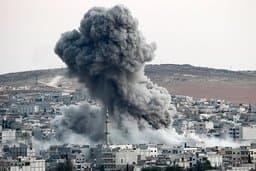
Prediction markets are signaling significant uncertainty about US military activity in Somalia for February 2026. The most liquid contract on Polymarket asks if there will be "between 14 and 17 US strikes." This contract is trading at 55 cents, implying a 55% probability. This slim majority suggests the market leans toward a high-tempo operational month, but views it as a near-coin flip. The other three markets cover lower strike ranges (0-6, 7-13, and 18+), with their collective pricing indicating the consensus expects an active month, but one unlikely to exceed the recent historical peak.
The pricing reflects two primary dynamics. First is the established pattern of US counterterrorism operations. AFRICOM data shows that in early 2025, strike frequency against al-Shabaab targets averaged 10-15 per month during intensified campaigns. A forecast of 14-17 strikes for February 2026 aligns with a continuation of this sustained pressure, not an escalation or de-escalation. Second, market odds incorporate the seasonal and tactical reality that al-Shabaab does not cease operations during this period, and US intelligence, surveillance, and reconnaissance assets remain persistently deployed. The 55% probability essentially bets that existing operational protocols will continue unchanged for another 30-day cycle.
The odds are vulnerable to political and tactical surprises. A major al-Shabaab attack on US or partner forces, or a high-profile hostage situation, could trigger a surge in retaliatory strikes, pushing the total above 17 and making the "18+" contract valuable. Conversely, a strategic policy shift from the White House, perhaps following unexpected diplomatic engagements, could slow the pace of operations. Key monitoring points are AFRICOM press releases and statements from US Central Command, which often preview changes in operational tempo. The resolution deadline of March 4, 2026, for all announced strikes means the market will react to real-time official disclosures throughout February.
AI-generated analysis based on market data. Not financial advice.
This prediction market focuses on the frequency of United States military strikes in Somalia during February 2026. It specifically counts incidents where the U.S. employs aerial weapons, including drones, missiles, or bombs, against targets on Somali soil. The official count is determined by public announcements from United States Africa Command (AFRICOM) by a deadline in early March. This market quantifies a specific aspect of the long-running U.S. counterterrorism mission in the Horn of Africa, primarily targeting the al-Shabaab militant group. Interest in this topic stems from its role as a measurable indicator of U.S. military engagement intensity. Analysts, policymakers, and observers track strike data to gauge strategic priorities, operational tempo, and the evolving conflict dynamics in Somalia. Fluctuations in monthly strike numbers can signal changes in intelligence gathering, target availability, political authorization, or the perceived threat level from al-Shabaab. The market's timeframe, February 2026, falls within a period of continued U.S. security assistance to the Federal Government of Somalia and the African Union Transition Mission in Somalia (ATMIS).
The U.S. military involvement in Somalia, primarily through airstrikes, began in earnest in 2007 with the establishment of AFRICOM and the rise of al-Shabaab. The first publicly acknowledged U.S. drone strike in Somalia occurred in June 2011, targeting al-Shabaab leaders. For years, operations were limited and often targeted high-value individuals. The tempo increased significantly during the Trump administration. In March 2017, the administration designated parts of Somalia as an 'area of active hostilities,' granting the military greater latitude to conduct strikes. This led to a sharp rise in numbers, with over 30 strikes recorded in 2017 and more than 40 in 2018. The Biden administration reviewed these authorities upon taking office. In 2021, it imposed stricter targeting rules intended to reduce civilian casualties, but maintained the legal authority for strikes in support of partner forces. The historical pattern shows strike frequency is not constant; it spikes during specific Somali government offensives or in response to major al-Shabaab attacks, and dips during political transitions or policy reviews.
The number of U.S. strikes in Somalia is a concrete metric for American military commitment in a complex, long-running conflict. Each strike carries immediate consequences, including the potential for civilian casualties which can fuel local resentment and aid militant recruitment. Domestically in the U.S., strike data informs congressional oversight of war powers and defense spending. For the Somali government, consistent U.S. air support is a force multiplier for its ground troops, but over-reliance can hinder the development of independent Somali military capacity. The strikes also have regional implications. Neighboring countries like Kenya, which suffers from al-Shabaab cross-border attacks, generally support robust U.S. action. Conversely, the operations are conducted from bases in Djibouti, affecting bilateral relations there. The financial cost is also significant, with each Hellfire missile costing approximately $150,000 and advanced drone missions costing much more, representing a sustained allocation of defense resources.
As of late 2024 and early 2025, U.S. airstrikes in Somalia continue at a steady but reduced pace compared to the 2017-2020 period. The Somali government's military offensive against al-Shabaab, which began in mid-2022, remains ongoing but has encountered stiff resistance. U.S. strikes are closely integrated with these ground operations, often called in to support Somali commandos from the Danab Brigade. In January 2025, AFRICOM reported several strikes targeting al-Shabaab militants engaged in attacks on partner forces. The legal authority for these operations rests on the 2001 Authorization for Use of Military Force (AUMF) against perpetrators of the 9/11 attacks, an authority that has been applied to al-Shabaab due to its allegiance to al-Qaeda.
For this market, a strike is any incident where the U.S. military uses an aerial weapon like a drone-fired missile, a bomb from a manned aircraft, or a launched missile against a target in Somalia. It must be publicly acknowledged in an official statement from U.S. Africa Command (AFRICOM).
The primary stated objective is counterterrorism. The U.S. aims to degrade the al-Shabaab militant group, which is designated as a terrorist organization, to prevent it from plotting attacks against U.S. interests, allies in the region like Kenya, and the internationally recognized Somali government.
AFRICOM reports are the official record but are sometimes contested. Independent monitors like Airwars and the Bureau of Investigative Journalism often report higher civilian casualty figures by incorporating local Somali media and eyewitness accounts, suggesting the official assessments may be incomplete.
Most aircraft operate from Camp Lemonnier in Djibouti, the primary U.S. military base in Africa. Manned aircraft and drones also sometimes deploy from naval vessels in the Indian Ocean or the Gulf of Aden.
Yes, U.S. special operations forces have conducted ground raids, but these are separate from airstrikes. The most notable was a Navy SEAL raid in 2017 that resulted in the death of a U.S. service member. These raids are far less frequent than airstrikes and are not counted in this market.
Educational content is AI-generated and sourced from Wikipedia. It should not be considered financial advice.
4 markets tracked

No data available
| Market | Platform | Price |
|---|---|---|
![]() | Poly | 55% |
![]() | Poly | 26% |
![]() | Poly | 20% |
![]() | Poly | 1% |


No related news found
Add this market to your website
<iframe src="https://predictpedia.com/embed/Gt47hT" width="400" height="160" frameborder="0" style="border-radius: 8px; max-width: 100%;" title="How many times will the US strike Somalia in February?"></iframe>