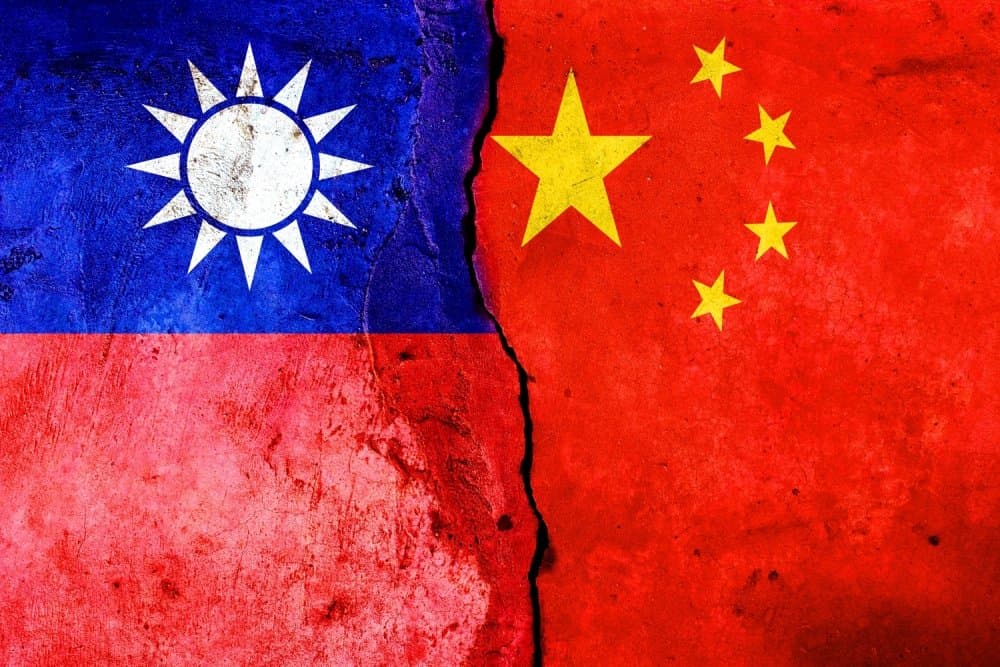
China x Taiwan military clash before 2027?
$3.47M
1
1
China x Taiwan military clash before 2027?
$3.47M
1
1
AI Analysis
Trader mode: Actionable analysis for identifying opportunities and edge
About This Event
This market will resolve to "Yes" if there is a military encounter between the military forces of China (People's Republic of China) and Taiwan (Republic of China) between November 11, 2025, and December 31, 2026, 11:59 PM ET. Otherwise, this market will resolve to "No". A "military encounter" is defined as any incident involving the use of force such as missile strikes, artillery fire, exchange of gunfire, or other forms of direct military engagement between Chinese and Taiwanese military forc
This saved analysis is awaiting a background update.
Current Market Outlook
Polymarket prices a China-Taiwan military clash before 2027 at just 9%. That means the market sees direct armed conflict between PLA and ROC forces as unlikely but not impossible, roughly a 1-in-11 chance over the next 14 months. The $1.7M in volume shows serious money behind this question, and the price has held in the single digits for months despite periodic spikes during military exercises.
The definition matters here. This isn't about skirmishes, intercepted aircraft, or ships shadowing each other in the Taiwan Strait. Missile strikes, artillery exchanges, or direct gunfire between uniformed forces would trigger resolution. That's a high bar, and the market treats it as such.
Key Factors Driving the Odds
Beijing's stated preference for "peaceful reunification" anchors the low probability. China's leadership has repeatedly signaled it wants Taiwan without triggering sanctions or a regional war that could destabilize the CCP. The 2022 Pelosi visit and subsequent missile tests over Taiwanese airspace produced no direct engagement, establishing a pattern of intimidation without contact.
Taiwan's defensive posture also matters. The ROC military has clear rules of engagement that emphasize deterrence over escalation. Neither side wants to fire first, and both understand that a single exchange could spiral beyond control. The mutual restraint observed during every recent crisis, including the 2024 election cycle and ongoing patrols, reinforces the 9% figure.
US involvement complicates the calculus. Washington's security commitment, however ambiguous, raises the cost of any PLA action. Chinese planners must assume American response, which historically pushes Beijing toward coercion rather than combat.
What Could Change These Odds
The market could shift sharply if China launches large-scale blockade exercises around Taiwan, particularly if they extend beyond announced durations. A sustained quarantine of Taiwanese shipping would create conditions where accidental contact becomes more likely. Watch for PLA mobilization patterns and whether Beijing moves assets from the East China Sea to the Taiwan Strait region.
Taiwan's own actions could trigger escalation. If the ROC government formally requests US troop deployment or announces independence-related referendums, Beijing's stated red lines would be crossed. The market currently prices this scenario as unlikely, but political surprises have driven rapid repricing before.
The December 2026 resolution date creates a natural catalyst window. Chinese leadership transitions, US midterm politics, and potential economic shocks could all alter risk calculations. A major financial crisis in China, for instance, might push Beijing toward external adventure as a distraction, though historically such dynamics have not produced direct military clashes.
The 9% price reflects a market that trusts mutual deterrence but respects the volatility of cross-strait relations. It's a bet on restraint, not on peace.
AI-generated analysis based on market data. Not financial advice.
Saved Aug 27, 2026 UTCThis saved content is awaiting a background update.
Overview
This prediction market asks whether there will be a military clash between the People's Republic of China (PRC) and Taiwan (Republic of China, ROC) between November 11, 2025, and December 31, 2026. A 'military encounter' is defined narrowly as any incident involving the use of force, such as missile strikes, artillery fire, or direct exchange of gunfire between the two militaries. The market will resolve to 'Yes' if such an event occurs during this period, and 'No' otherwise. The question reflects growing global concern over cross-strait tensions, which have escalated in recent years amid China's military buildup, Taiwan's increasing self-defense efforts, and shifting U.S. policy. China has consistently claimed Taiwan as part of its territory, and the Chinese government has not renounced the use of force to achieve reunification. In recent years, Chinese military activity around Taiwan has intensified, including frequent incursions into Taiwan's Air Defense Identification Zone (ADIZ). Taiwan, for its part, has increased its defense budget and sought closer ties with the United States and other democracies. The United States, while maintaining its 'One China' policy, has also increased arms sales to Taiwan and conducted joint exercises in the region, further complicating the strategic picture. The period covered by this market is particularly significant because it includes the lead-up to Taiwan's local elections in 2026, which could influence cross-strait dynamics. Additionally, the Chinese Communist Party's 20th National Congress in 2022 set a goal of achieving 'complete reunification' by the centennial of the PRC in 2049, with some analysts suggesting that the mid-2020s could be a critical window for China to assert its claims. However, most experts believe a full-scale military clash is unlikely, given the catastrophic consequences for both sides and the potential for U.S. intervention. Instead, the market likely captures the risk of lower-level incidents, such as accidental clashes or targeted shows of force, that could nevertheless escalate. Interest in this market stems from the profound implications of a cross-strait conflict for global security, the world economy, and international relations. Taiwan is a critical node in the global semiconductor supply chain, producing the majority of advanced chips used worldwide. A military clash could disrupt supply chains, cause massive economic damage, and potentially draw in the United States and other allies. The market provides a probabilistic assessment of this low-probability but high-impact event, offering insights into how experts and traders view the evolving situation.
Historical Context
The cross-strait conflict has deep roots. After the Chinese Civil War, the Nationalist government retreated to Taiwan in 1949, and the two sides have remained divided ever since. The United States recognized the PRC as the sole legal government of China in 1979, but continued unofficial ties with Taiwan through the Taiwan Relations Act. For decades, the 'One China' policy has been a delicate balance, with both sides avoiding direct military confrontation. Military clashes have occurred in the past, most notably during the 1954-1955 and 1958 Taiwan Strait Crises, when China shelled the islands of Kinmen and Matsu. In 1995-1996, China conducted missile tests near Taiwan, prompting the U.S. to deploy two aircraft carrier battle groups to the region. These incidents were resolved without direct military engagement, but they set a precedent for Chinese coercive pressure. In recent years, China has shifted from large-scale exercises to more frequent, smaller incursions, testing Taiwan's response capabilities and international reactions. The 2022 visit of then-U.S. House Speaker Nancy Pelosi to Taiwan triggered a significant escalation, with China conducting large-scale military exercises around the island, including ballistic missile launches that landed in the Pacific Ocean. This marked a turning point in the frequency and intensity of Chinese military activity. Since then, Chinese aircraft and ships have entered Taiwan's ADIZ on a near-daily basis, and the number of incursions has increased dramatically. The current situation is characterized by a pattern of incremental pressure rather than a direct military confrontation, but the risk of an accident or miscalculation remains a concern.
Why It Matters
A military clash between China and Taiwan would have catastrophic consequences. Taiwan is the world's leading producer of advanced semiconductors, with TSMC manufacturing over 90% of the most sophisticated chips used in AI, smartphones, and military systems. A conflict could disrupt global supply chains, causing a severe economic downturn. The Taiwan Strait is also a critical shipping lane, carrying a significant portion of global trade. Any blockade or military action would affect energy supplies and commerce worldwide. Politically, a conflict would likely draw in the United States and its allies, potentially leading to a major power confrontation. The U.S. has stated that it will maintain its 'strategic ambiguity' policy, but has also strengthened its military presence in the region. Japan and South Korea, which host U.S. bases, would be directly affected. The humanitarian cost would be immense, with millions of civilians potentially displaced. The outcome of this market reflects the perceived probability of such an event, which is closely watched by policymakers, investors, and the public. Understanding the likelihood helps in risk assessment for businesses operating in the region and for governments planning contingency measures.
Educational content is AI-generated and sourced from Wikipedia. It should not be considered financial advice.