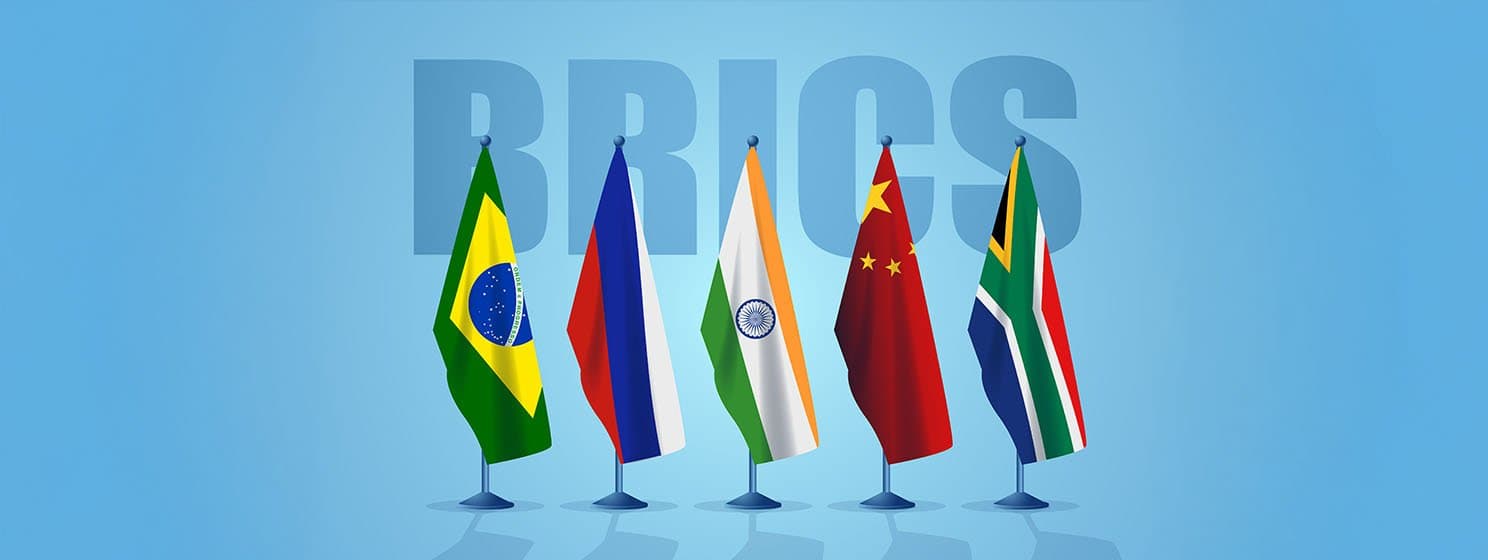
Will a country leave BRICS in 2026?
PM $77.6K
1
1
Will a country leave BRICS in 2026?
PM $77.6K
1
1
Current odds
Snapshot from
As of Oct 27, 2026, 12:00 PM UTC, Yes is priced at 9.4% on Polymarket.
Polymarket
- Yes9.4%
Yes prices. They are not order quotes; check each platform's rules, fees and live prices before trading.
AI Analysis
Trader mode: Market mechanics, assumptions and risks
PM $77.6K
Reported volume · provider units
1
Saved contracts
0
Same-question pairs
Source snapshot: Oct 27, 2026, 12:00 PM UTC
About This Event
This market will resolve to "Yes" if any member state formally withdraws from BRICS or provides an official notice of denunciation to BRICS between market creation and December 31, 2026, 11:59 PM ET. Otherwise, this market will resolve to "No". A notice of denunciation refers to the submission of a notice of withdrawal. The resolution source will be official information from the relevant government and BRICS; however, a consensus of credible reporting may also be used.
This analysis is awaiting a background update, so its prices may be older than the odds above.
Current Market Outlook
Polymarket traders give a 30% chance that at least one country formally leaves BRICS before December 31, 2026. That pricing suggests the market sees a withdrawal as possible but far from likely. With only $6,000 in volume, this is a thin market. The odds can swing sharply on a single headline, so treat the 30% figure as a rough consensus rather than a precise forecast.
The market resolves on official government notices or BRICS statements, though credible reporting can also trigger resolution. That's a fairly loose standard, which matters given how opaque BRICS membership mechanics have become.
Key Factors Driving the Odds
The bloc has expanded aggressively since 2024, adding Egypt, Ethiopia, Iran, and the UAE alongside founding members Brazil, Russia, India, China, and South Africa. Argentina initially accepted an invitation under Javier Milei's predecessor, then rejected it after Milei took office. That near-miss shows withdrawal is a live possibility, not a theoretical one.
Turkey has held ongoing talks about joining, which creates internal tension. A bloc containing both Russia and Turkey, a NATO member, strains credibility. Meanwhile, Saudi Arabia has yet to formally ratify its invitation, leaving its status ambiguous. Any of these countries could plausibly issue a denunciation if domestic politics shift.
The bigger driver is the bloc's declining relevance. BRICS has failed to deliver on its de-dollarization agenda or create a meaningful alternative financial system. For smaller members like Ethiopia or Egypt, the costs of membership are unclear and the benefits are thin. When an organization offers little tangible value, defection becomes easier.
What Could Change These Odds
The next major test comes in mid-2026 when BRICS holds its annual summit, likely in Brazil. A summit produces communiques and photo opportunities, but it also creates a natural moment for a disaffected member to announce its exit. Watch for any country that skips the summit or sends a low-level delegation.
US sanctions policy could also shift the calculus. If Washington offers incentives to countries like Iran or Ethiopia to distance themselves from Russia and China, that could accelerate a departure. Conversely, a Trump administration that escalates pressure on BRICS members might push them closer together, reducing the odds of withdrawal.
The 30% price already embeds some skepticism. A 2025 report from the Carnegie Endowment noted that BRICS has no formal exit procedure, which makes denunciation legally messy. That ambiguity could keep odds below 50% even if tensions rise. For traders, the edge lies in tracking specific countries' domestic politics rather than bloc-wide headlines.
AI-generated analysis based on market data. Not financial advice.
Saved Aug 5, 2026 UTCThis saved content is awaiting a background update. It may contain outdated claims; use the dated market data and provider rules for the latest available information.
Overview
BRICS, an intergovernmental organization originally comprising Brazil, Russia, India, China, and South Africa, has expanded its membership in recent years to include Iran, Egypt, Ethiopia, and the United Arab Emirates as of January 2024. The bloc, which represents a significant share of global GDP and population, has positioned itself as a counterweight to Western-dominated institutions like the IMF and World Bank. The question of whether a member state will formally withdraw in 2026 is not merely speculative; it reflects underlying tensions within the group, including divergent economic interests, geopolitical pressures, and the challenges of coordinating policy among a diverse set of nations. The organization operates without a formal charter or binding treaty, making withdrawal a matter of state decision rather than a legal process. This market, therefore, hinges on the political will of member governments to remain in the bloc, which has been tested by issues such as the Ukraine conflict, sanctions, and the push for de-dollarization. Interest in this topic has grown as BRICS has become a focal point for debates about the future of global governance and the emergence of a multipolar world order. Observers watch for signals from member states, especially those with strained relations with other members or with the West, as any formal exit could reshape alliances and impact global economic arrangements.
Historical Context
BRICS was formed in 2009 as a grouping of Brazil, Russia, India, and China, with South Africa joining in 2010. The bloc was initially focused on economic cooperation and reform of global financial institutions. Over the years, it has held annual summits, with notable ones in 2014 (Fortaleza, Brazil) where the New Development Bank was established, and 2023 (Johannesburg, South Africa) where expansion was a key agenda item. The 2024 summit in Kazan, Russia, marked the first meeting with the expanded membership, solidifying the bloc's shift toward a more political and anti-Western stance. There is no precedent for a member state withdrawing from BRICS, as the organization is relatively young. However, historical parallels can be drawn from other groupings, such as the Non-Aligned Movement, where members have drifted in and out based on changing geopolitical alignments. The closest example is the G77, which has seen members leave and rejoin over time. The lack of a formal withdrawal mechanism makes any exit a politically significant act, as it would require a state to publicly repudiate the bloc's goals and its fellow members.
Why It Matters
A withdrawal from BRICS would have significant economic and political implications. Economically, the bloc represents over 40% of the world's population and about 30% of global GDP (in PPP terms). A member leaving could disrupt trade agreements, investment flows, and the push for de-dollarization, as the remaining members would need to recalibrate their strategies. For the departing country, leaving could mean losing access to the New Development Bank and other financial mechanisms, potentially impacting its infrastructure projects and currency stability. Politically, a withdrawal would be a major blow to the bloc's credibility and its narrative of representing the Global South. It could embolden other members to reconsider their participation, leading to a domino effect. For the West, such an event would be seen as a validation of its policies, while for the remaining BRICS members, it would highlight the challenges of maintaining unity amid diverse interests. The broader impact would be felt in global governance, as BRICS has been proposed as an alternative to Western-led institutions. A departure would weaken that alternative, reinforcing the status quo and potentially affecting negotiations on issues like climate change, trade, and security.
Frequently Asked Questions
What is BRICS and why is it important?
BRICS is an intergovernmental organization of major emerging economies, originally Brazil, Russia, India, China, and South Africa, with new members added in 2024. It aims to foster economic cooperation and reform global governance institutions. Its importance lies in its collective economic and demographic weight, offering an alternative to Western-led frameworks.
Has any country ever left BRICS?
No, no country has ever left BRICS since its founding in 2009. The bloc has only expanded, with new members joining in 2024 and 2025. However, the absence of a formal withdrawal mechanism means that any exit would be a political decision without legal precedent.
Why might a country leave BRICS?
Reasons could include geopolitical pressure from the West, domestic political changes, economic costs of membership (e.g., sanctions risk), or disagreements over the bloc's direction, such as the push for de-dollarization or expansion. For example, India's border issues with China or South Africa's ties with the US could strain relations.
What are the consequences of a country leaving BRICS?
The departing country would lose access to the New Development Bank and other cooperative mechanisms, potentially affecting its infrastructure financing. The bloc's credibility would be damaged, possibly leading to further exits. Economically, trade and investment flows could be disrupted, and the country might face pressure to align more with Western institutions.
AI-written background. References identify the evidence used; Wikipedia links under Learn More are additional reading. Prices and provider rules are dated snapshots. This is not financial advice.
Related prediction markets
Prices are catalog snapshots and may have changed. Check each market's rules and observation time.
Will any country leave NATO by...?
PM $1.43M
How many more people leave the Trump cabinet this year?
PM $11.2K
Will another country leave OPEC in 2026?
PM $200.4K
Will another country leave OPEC in 2026?
K 25.6K contracts
Where will the next US-Iran senior diplomatic meeting take place...?
PM $177.7K
Jerome Powell departure as Fed Governor announced?
K 323.1K contractsMarket Insights
Price gaps of 2 pp+
0
Same-question pairs
0
No outcomes on this page have been reviewed as the same question on both platforms yet.
Price differences do not establish arbitrage. Check each pair's review, current order prices, fees and settlement rules.