$181.45K
1
1

1 market tracked

No data available
| Market | Platform | Price |
|---|---|---|
![]() | Poly | 14% |
$181.45K
1
1
Trader mode: Actionable analysis for identifying opportunities and edge
This market will resolve to "Yes" if any country not already apart of the Abraham Accords formally signs a normalization agreement with Israel under the framework of the Abraham Accords by March 31, 2026 11:59 PM ET. Otherwise, this market will resolve to "No". A formal signing refers to an official agreement between Israel and another country that is publicly acknowledged by both governments and clearly attributed to the Abraham Accords or their continuation. Countries already part of the Abr
Prediction markets currently give about a 1 in 5 chance that a new country will join the Abraham Accords by March 31. This means traders collectively see a new normalization deal with Israel as unlikely, but not impossible, within the next month.
The low probability reflects the complex diplomatic situation. The Abraham Accords, which began in 2020, saw the United Arab Emirates, Bahrain, Sudan, and Morocco establish formal ties with Israel. Recent expansion has stalled for a few reasons.
First, the war in Gaza has made public normalization with Israel a difficult political move for many potential candidate nations, like Saudi Arabia or Indonesia, due to domestic and regional pressure. Second, major diplomatic deals typically require lengthy, visible negotiations. There are no public signs of an imminent signing ceremony. Historically, these agreements are announced with some fanfare, not secretly.
The March 31 deadline is itself the key date. Watch for official state visits between Israeli officials and leaders from Muslim-majority nations, or joint statements from the U.S. State Department, which has been a key broker. A sudden meeting between, for example, Israeli and Saudi foreign ministers would be a strong signal. The lack of such events in the coming weeks would reinforce the current low odds.
Markets are generally decent at aggregating geopolitical odds when there is clear, time-bound resolution. For similar "deal or no deal" foreign policy events, they often capture the consensus of informed observers. The main limitation here is that diplomacy can change quickly with a single phone call. The current 22% chance essentially captures the possibility of a surprise announcement, weighed against the visible political headwinds.
Prediction markets assign a low 22% probability that a new country will join the Abraham Accords by March 31, 2026. This price indicates traders see expansion as unlikely in the near term. With $181,000 in volume, the market has sufficient liquidity for its sentiment to be taken seriously, reflecting a consensus among informed participants.
The primary factor suppressing the probability is the current geopolitical environment. The war in Gaza, which began in October 2023, has dramatically altered regional diplomacy. Public sentiment in many Arab nations has hardened against normalization with Israel, making it politically costly for governments to pursue new agreements. Saudi Arabia, long considered the next major candidate for normalization, has explicitly linked any deal to an irreversible pathway toward a Palestinian state, a condition currently unmet.
Historical context also informs the low odds. The original Abraham Accords in 2020 were brokered under a different U.S. administration with a specific focus on Arab-Israeli détente. The current U.S. foreign policy approach is more consumed with managing the immediate conflict, reducing the diplomatic bandwidth and leverage available to broker new accords.
A significant shift requires a major geopolitical development. The most plausible catalyst would be a durable ceasefire in Gaza, followed by a credible political process addressing Palestinian statehood. This could allow Saudi Arabia to re-engage seriously on normalization, which would almost certainly trigger a market repricing. Conversely, a regional escalation, such as a full-scale war between Israel and Hezbollah, would drive the probability toward zero. Key dates to watch are not specific but revolve around diplomatic cycles, such as the next UN General Assembly or responses to any new U.S.-led peace initiatives. The market's 30-day window to resolution is too short to expect these complex processes to conclude, which partly explains the current pessimistic pricing.
AI-generated analysis based on market data. Not financial advice.
This prediction market addresses whether any additional country will join the Abraham Accords by March 31, 2026. The Abraham Accords are a series of bilateral agreements normalizing diplomatic relations between Israel and several Arab states, brokered by the United States and announced in 2020. The market resolves to 'Yes' if a country not currently part of the accords formally signs a normalization agreement with Israel under that framework by the deadline, with official public acknowledgment from both governments. The original signatories were the United Arab Emirates, Bahrain, Sudan, and Morocco. Since the Hamas-led attack on Israel on October 7, 2023, and the subsequent war in Gaza, the expansion of the accords has become a central diplomatic goal for Israel and the U.S., while also facing significant regional backlash and complications. Interest in this market stems from its direct measurement of a major geopolitical realignment in the Middle East, where normalization is seen as a pathway to regional stability and economic integration by some, and as a betrayal of the Palestinian cause by others. The outcome will signal the resilience or stagnation of this diplomatic initiative amid ongoing conflict.
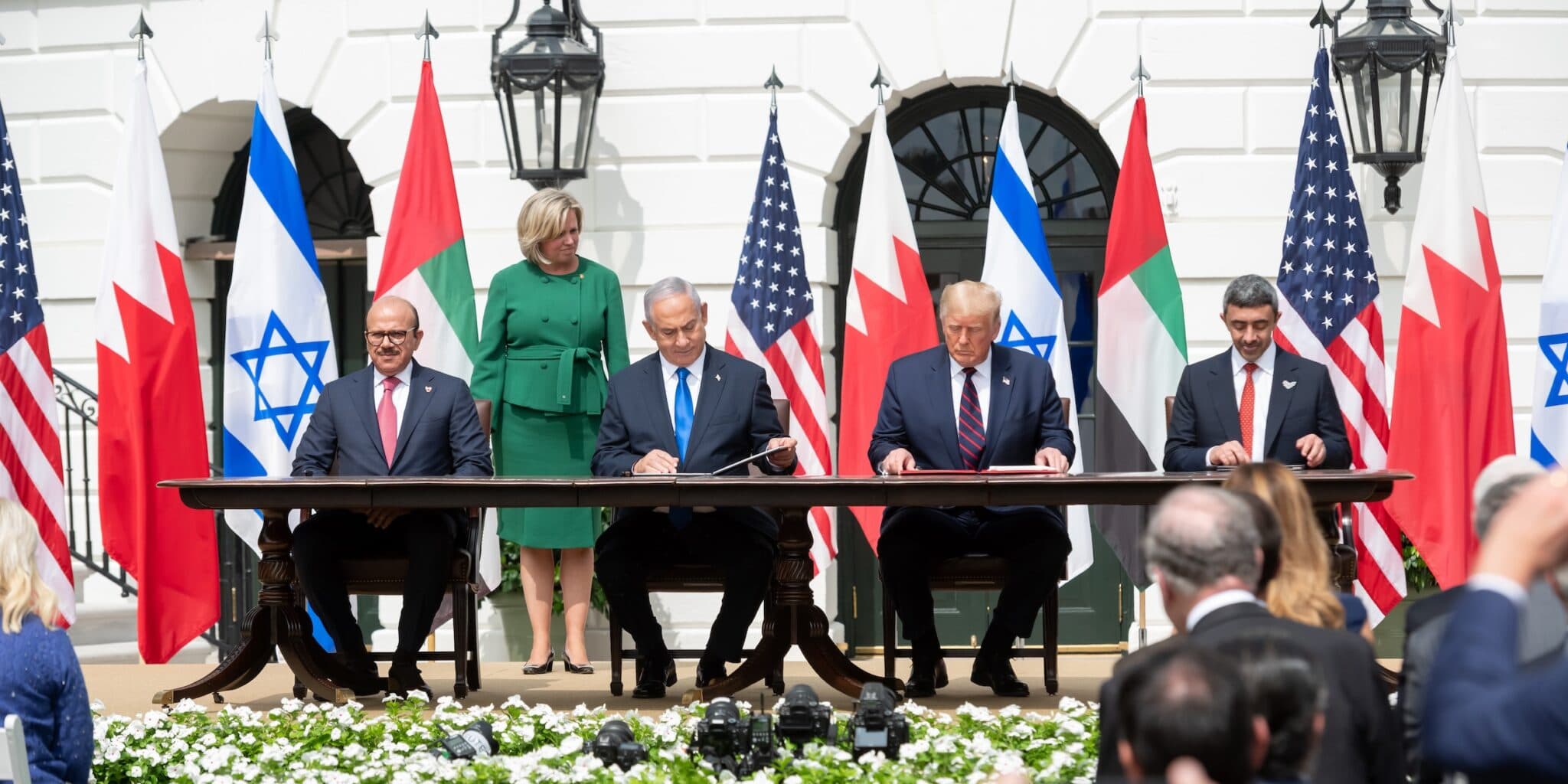
The Abraham Accords were formally unveiled on September 15, 2020, at a White House ceremony. The agreements marked a dramatic shift, as the UAE and Bahrain became the first Arab states to normalize relations with Israel since Jordan in 1994 and Egypt in 1979. Sudan joined the process in October 2020, and Morocco normalized ties in December 2020, receiving U.S. recognition of its sovereignty over Western Sahara in return. These deals were facilitated by shared concerns over Iranian influence and the prospect of significant economic and security cooperation. They also notably departed from the long-standing Arab League consensus, established in 2002, that normalization with Israel should be contingent upon a resolution to the Israeli-Palestinian conflict and the establishment of a Palestinian state. The accords created a new template for Arab-Israeli relations that sidelined the Palestinian issue as a prerequisite. The war in Gaza that began in October 2023 represents the most severe test of this new paradigm, galvanizing public opinion across the Arab world against Israel and placing governments that normalized ties under domestic pressure.
The expansion or stalling of the Abraham Accords has profound implications for the Middle East's geopolitical and economic architecture. A new accession would signal that the momentum of normalization can withstand the shock of a major Israeli-Palestinian war, potentially encouraging further countries to follow. It would bolster Israel's diplomatic standing and its vision of regional integration that bypasses the Palestinian issue. Economically, it would open new trade, investment, and technology transfer corridors, particularly if a major economy like Saudi Arabia joins. Conversely, a failure to expand the accords by the deadline would indicate the process has effectively frozen. This would be interpreted as a victory for Iran and its 'axis of resistance,' which opposes normalization, and for Palestinian factions that argue the accords failed to deliver tangible benefits. It would also represent a setback for U.S. diplomacy in the region, which has invested significant capital in brokering these deals. The outcome affects global energy markets, security alliances, and the long-term viability of a two-state solution to the Israeli-Palestinian conflict.
As of late 2024, diplomatic efforts to expand the Abraham Accords are active but face severe headwinds due to the war in Gaza. The U.S. continues to push for a mega-deal involving Saudi normalization, which would be contingent on Israeli commitments to a Palestinian political horizon and U.S. security guarantees for Riyadh. Israel's government is divided on the Palestinian concessions required. Other rumored candidates, like Oman or Mauritania, have made no public moves toward normalization and have condemned Israeli military actions. The International Court of Justice's proceedings on the legality of Israel's occupation and the intensity of the conflict have made any public steps toward Israel politically toxic for most Arab governments in the immediate term.
Saudi Arabia is considered the most significant potential candidate, as advanced talks were underway before October 2023. However, a deal now requires complex trilateral agreements with the U.S. and major Israeli concessions on Palestine. Smaller Gulf states like Oman are also mentioned, but all movement is currently on hold due to the war.
No, the agreements with the UAE, Bahrain, and Morocco remain formally intact, though diplomatic relations have been strained and scaled back. The war has, however, halted the expansion of the accords and made immediate new signings highly unlikely, as Arab public opinion has turned sharply against normalization.
Historically, incentives have included advanced U.S. weapons sales (UAE, Morocco), removal from the U.S. State Sponsors of Terrorism list (Sudan), and U.S. political support for territorial claims (Morocco). Future incentives likely involve security guarantees, nuclear energy cooperation, and expanded access to U.S. technology and investment.
While both are Muslim-majority nations without diplomatic ties to Israel, they are considered long-shot candidates. Their governments have repeatedly and recently reaffirmed support for Palestine and rejected normalization absent a just solution to the conflict, making accession before March 2026 extremely improbable.
Iran is vehemently opposed to the accords, labeling them a 'betrayal' of the Palestinian cause and a scheme to create an anti-Iran alliance. Iran supports proxy groups like Hamas and Hezbollah that explicitly aim to disrupt the normalization process, viewing it as a threat to its regional influence.
Educational content is AI-generated and sourced from Wikipedia. It should not be considered financial advice.

No related news found
Add this market to your website
<iframe src="https://predictpedia.com/embed/JTvuBl" width="400" height="160" frameborder="0" style="border-radius: 8px; max-width: 100%;" title="Will a new country join the Abraham Accords by March 31?"></iframe>