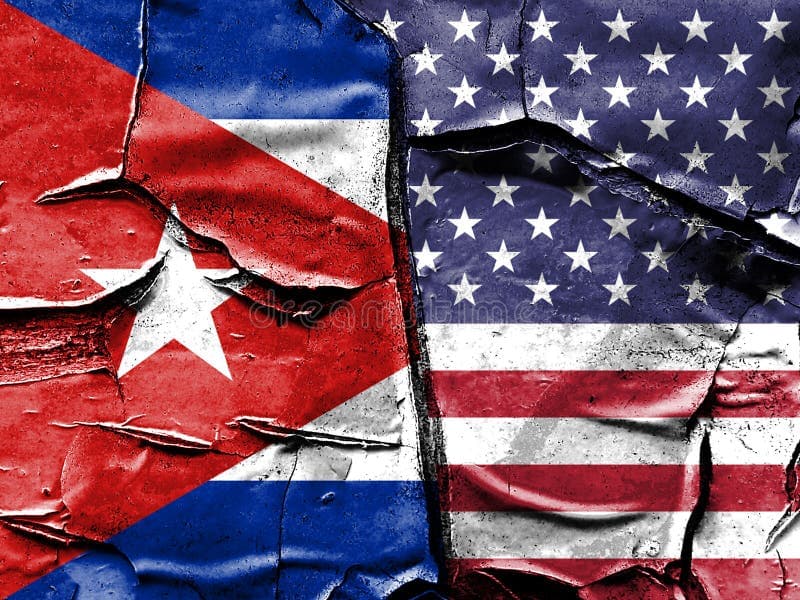
Will the U.S. invade Cuba in 2026?
$3.50M
1
1
Will the U.S. invade Cuba in 2026?
$3.50M
1
1
AI Analysis
Trader mode: Actionable analysis for identifying opportunities and edge
About This Event
This market will resolve to "Yes" if the United States commences a military offensive intended to establish control over any portion of Cuban land territory by December 31, 2026, 11:59 PM ET. Otherwise, this market will resolve to "No". For the purposes of this market, land de facto controlled by Cuba or the United States as market creation, will be considered the sovereign territory of that country. The resolution source for this market will be a consensus of credible sources.
Snapshot observed 2026-10-13T18:00:05.634Z. This analysis describes that snapshot and is not a live news update.
What the contract measures
The contract asks whether the United States will invade Cuba in 2026. Under the stated rules, it resolves "Yes" if the United States "commences a military offensive intended to establish control over any portion of Cuban land territory by December 31, 2026, 11:59 PM ET" [1]. Otherwise it resolves "No" [1]. The rules also state that "land de facto controlled by Cuba or the United States as market creation, will be considered the sovereign territory of that country" [1]. The resolution source is "a consensus of credible sources" [1].
The listed end time is 2027-01-01T04:59:00.000Z [1]. This matches the 11:59 PM ET deadline in the rules, but the rules text is the governing wording. The listed time is a platform field, not a separate event date.
Reading the snapshot
The saved market is a single Polymarket contract with a "Yes" price of 0.045 and a "No" price of 0.955 [1]. The provider observation time is 2026-10-13T18:00:05.634Z, and the source was retrieved at 2026-10-13T18:28:32.295Z [1]. These are the times for this saved record. They do not establish the price at any later moment, and the provider status shown is "active" as of that retrieval [1].
These figures are snapshot prices. They are not executable quotes, and they are not verified probabilities of an invasion. The sample includes all saved markets for this event, which is one market, so no other outcomes from this provider are omitted here. The evidence does not show trading volume, depth, or the number of participants, so the price cannot be read as a measure of liquidity or agreement.
What remains uncertain
The evidence does not explain why the price is at its observed level, and this summary does not infer any cause. It does not include news, official statements, or any other event information that would bear on the question.
The rules rely on a "consensus of credible sources" without naming them [1]. Readers comparing this with contracts on other platforms should check wording carefully, since different definitions of an invasion, territorial control, or deadline can change what a similar price means. Prices from different platforms should not be averaged or treated as an arbitrage signal without matching the rules and closing times.
References
- Polymarket: Will the U.S. invade Cuba in 2026?. Provider data observed 2026-10-13T18:00:05.634Z.
AI-generated analysis based on market data. Not financial advice.
Saved Oct 13, 2026 UTCOverview
This contract is a Polymarket event asking whether the United States will invade Cuba in 2026. Under its rules, it resolves "Yes" if the United States begins a military offensive intended to establish control over any portion of Cuban land territory by December 31, 2026, at 11:59 PM ET, and "No" otherwise [1]. The rules also state that land de facto controlled by Cuba or the United States at market creation will be treated as the sovereign territory of that country [1]. The resolution source is described as a consensus of credible sources [1]. The contract's listed end time is January 1, 2027, at 04:59 UTC, which is later than the stated resolution deadline because of the time zone conversion [1]. That listed time is the contract's closing schedule, not an announced event date. The rules set the December 31, 2026 deadline, and the contract's status is recorded as active in the saved provider data [1]. In the saved snapshot, the Yes outcome was priced at 0.045 and the No outcome at 0.955 [1]. These figures are observed prices from a single saved moment, not executable quotes or verified probabilities. The market sample for this event contains one contract, so it does not show any other outcomes for this question.
Historical Context
Background sources describe a long history of tension between the two countries. Modern diplomatic relations between Cuba and the United States were severed in 1961 during the Cold War and restored on July 20, 2015 [2]. The United States has maintained a comprehensive trade embargo against Cuba since 1960, which restricts commercial, economic, and financial activity [2]. The Cuban Missile Crisis, a 13-day confrontation between the United States and the Soviet Union from 16 to 28 October 1962, arose when Soviet nuclear missiles were deployed in Cuba and is widely considered the closest the Cold War came to full-scale nuclear war [3]. These sources are historical background only. They do not describe military planning or events in 2026.
Why It Matters
The contract measures whether a specific type of action occurs within a defined window: the start of a United States military offensive aimed at controlling any part of Cuban land territory by the end of 2026 [1]. The wording focuses on commencing an offensive with intent to establish control, not on diplomatic statements, sanctions, or other forms of pressure [1]. Because the rules define the resolution condition narrowly, the price reflects how the market currently values that specific outcome rather than the broader state of US-Cuba relations. Background on the longstanding embargo and the history of hostility between the two countries [2][3] provides context for why the question is asked, but it does not establish whether any such action will occur.
Snapshot context
The latest published provider snapshot for this topic was observed on 2026-10-13 at 18:00 UTC. It contains listings from Polymarket. Market descriptions and listed closing times define the contracts; they do not establish that the real-world outcome has occurred. This article does not include a separately verified news update. [1]
Frequently Asked Questions
What must happen for this market to resolve Yes?
The market resolves Yes if the United States commences a military offensive intended to establish control over any portion of Cuban land territory by December 31, 2026, at 11:59 PM ET [1]. Otherwise it resolves No [1].
Does the price show the probability that the invasion will happen?
The saved prices were 0.045 for Yes and 0.955 for No at the observation time [1]. These are snapshots of market prices, not verified probabilities or executable quotes, so they should not be read as a forecast of the outcome.
Do the background sources describe current events?
No. The Wikipedia background pages cover historical events, including the 1961 severing of relations, the 2015 restoration, the embargo, and the 1962 missile crisis [2][3]. They do not describe developments relevant to the contract's 2026 window.
AI-written background. References identify the evidence used; Wikipedia links under Learn More are additional reading. Prices and provider rules are dated snapshots. This is not financial advice.
Market Insights
Price gaps of 2 pp+
0
Saved price pairs
0
No exact saved pairs with both binary Yes prices are available.
Price differences do not establish arbitrage. Check each pair's review, current order prices, fees and settlement rules.