This event has ended. Showing historical data.

$23.79K
1
1

1 market tracked

No data available
| Market | Platform | Price |
|---|---|---|
![]() | Poly | 0% |
Trader mode: Actionable analysis for identifying opportunities and edge
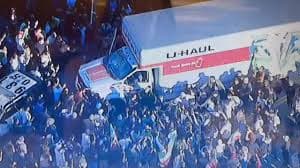
On January 11, 2026, a U-Haul truck drove into a crowd in Los Angeles, during a demonstration in support of Iranian protestors. ABC7 Los Angeles reported that a man was later pulled out of the truck and taken into police custody. This market will resolve to “Yes” if any Federal or State jurisdiction of the United States formally charges or otherwise announces a criminal indictment of the alleged driver of this U-Haul for terrorism, by February 28, 2026, 11:59 PM ET. Otherwise, this market will
Prediction markets currently give this event a 75% chance of happening. This means traders collectively believe there is a roughly 3 in 4 chance that the alleged driver of the U-Haul truck will be formally charged with a terrorism-related crime by the end of February 2026. The market shows high confidence that prosecutors will pursue terrorism charges, not just more common offenses like assault with a deadly vehicle.
Two main factors are driving the high probability. First, the specific context of the attack matters. The truck drove into a crowd at a demonstration supporting Iranian protestors. This suggests a potential political or ideological motive, which is a key element federal prosecutors look for when considering terrorism charges. An attack on a political gathering is often treated differently than a random act of violence.
Second, there is legal precedent. In recent years, prosecutors have increasingly used terrorism statutes in cases where vehicles are used as weapons against crowds, especially when a hateful or political intent can be demonstrated. The market is likely betting that law enforcement will interpret this event through that legal lens, given the targeted nature of the demonstration.
The resolution deadline is February 28, 2026. The most important event to watch for is an official announcement from a prosecuting authority, which could be the U.S. Department of Justice (federal terrorism charges) or the Los Angeles County District Attorney (state terrorism charges). Such an announcement could come at any time before the deadline. If late February arrives with no charges filed, the market probability will drop sharply as the clock runs out.
For binary, short-term legal outcomes like this, prediction markets have a mixed but interesting track record. They often efficiently aggregate insider knowledge and public reporting about prosecutorial priorities. However, they can be wrong if non-public legal deliberations take an unexpected turn. The relatively small amount of money wagered here suggests this is a niche market, so it may be more influenced by a few informed traders than a broad consensus. While generally useful as a snapshot of informed opinion, the prediction is not a guarantee.
The Polymarket contract "L.A. U-Haul attack perp charged with terrorism?" is trading at approximately 95 cents, or a 95% probability, for a "Yes" resolution. This price indicates the market views a terrorism charge as nearly certain. With only $24,000 in total volume, liquidity is thin, making the price more susceptible to large bets but reflecting a strong consensus. The market is set to resolve by February 28, 2026, based on whether a federal or state jurisdiction formally announces such a charge.
The high probability stems directly from the nature of the January 11, 2026, incident. Driving a vehicle into a crowd at a political demonstration is a hallmark method of terrorist attacks prosecuted under statutes like 18 U.S.C. § 2332b, which defines acts of terrorism transcending national boundaries. The Los Angeles Police Department's initial characterization of the event and the specific targeting of a demonstration supporting Iranian protestors creates a clear nexus to political motive, a core element for terrorism charges. Historical precedent is decisive. Similar attacks, like the 2017 Times Square vehicle attack where driver Richard Rojas was charged with federal terrorism, establish a direct legal pathway prosecutors are likely to follow.
The primary risk to the near-certain market price is prosecutorial discretion. Authorities could opt for faster, more straightforward charges like attempted murder or assault with a deadly weapon to secure a conviction, especially if federal investigators struggle to immediately document direct foreign ties or a specific terrorist group affiliation. A formal announcement of lesser charges before the February 28 deadline would cause the market to crash to near zero. Conversely, any official statement from the FBI or U.S. Attorney’s Office labeling the investigation as domestic or international terrorism would solidify the "Yes" outcome. All significant news will occur well before the resolution date, making the next few weeks critical for price movement.
AI-generated analysis based on market data. Not financial advice.
$23.79K
1
1
On January 11, 2026, a U-Haul truck drove into a crowd of demonstrators in Los Angeles. The demonstration was in support of Iranian protestors. According to ABC7 Los Angeles, police pulled a man from the truck and took him into custody. The incident occurred in the Westwood area of Los Angeles, near the Federal Building on Wilshire Boulevard. The crowd had gathered to express solidarity with ongoing anti-government protests in Iran. This event immediately raised questions about whether it was a deliberate attack and what charges the suspect might face. The central question for this prediction market is whether federal or state prosecutors will formally charge the alleged driver with terrorism by February 28, 2026. The definition of a terrorism charge under U.S. law is critical. Federal statutes like 18 U.S.C. § 2331 define international terrorism as violent acts intended to intimidate or coerce a civilian population, or to influence government policy. California state law has its own terrorism statutes, such as California Penal Code § 11415, which covers acts intended to cause great bodily injury or death to further a political agenda. The decision to pursue terrorism charges depends on evidence of motive, intent, and whether the act was designed to terrorize a population. People are interested in this market because it tests the legal and political threshold for labeling an act of violence as terrorism, especially when it occurs at a politically charged demonstration with international dimensions.
The question of when a violent act becomes a legally defined terrorism charge in the United States has a complex history. The modern federal framework was largely established by the Antiterrorism and Effective Death Penalty Act of 1996 and expanded after the September 11, 2001 attacks. These laws created specific crimes for acts of terrorism transcending national boundaries. Domestically, high-profile vehicle-ramming attacks have set precedents. On October 31, 2017, Sayfullo Saipov used a rented truck to kill eight people on a New York City bike path. Federal prosecutors charged him with providing material support to a terrorist organization and committing acts of terrorism, resulting in a conviction and life sentence. This case demonstrated the federal government's willingness to apply terrorism statutes to a lone actor inspired by a foreign ideology. In contrast, the 2017 Charlottesville car attack, where a man drove into counter-protesters, killing one, was prosecuted as a federal hate crime, not under terrorism statutes. The key distinction often lies in proving the perpetrator's intent to influence government policy or intimidate a civilian population on behalf of a political or ideological cause, rather than a purely personal or bigoted motive. The Los Angeles incident echoes these events, forcing authorities to examine the driver's intent toward a demonstration with explicit political goals concerning a foreign nation.
The charging decision carries significant political and social weight. A terrorism indictment would formally categorize the attack as a political act of terror, likely inflaming tensions between the U.S. and Iran and potentially impacting diplomatic relations. It would also signal a federal assessment that the perpetrator acted to intimidate the Iranian diaspora or influence U.S. foreign policy. For the Iranian-American community in Los Angeles, home to one of the largest such populations outside Iran, a terrorism designation could validate their fears of being targeted for their political activism, but might also increase scrutiny and stigmatization. Conversely, if prosecutors pursue only state charges like attempted murder or assault, it could be perceived as downplaying the political dimension of the attack. This could lead to accusations that authorities are reluctant to label violence against certain communities as terrorism. The outcome will set a legal precedent for how similar acts at politically motivated demonstrations are classified, influencing future investigations and potentially affecting the security posture at public protests across the country.
As of mid-January 2026, the suspect remains in police custody. The LAPD is conducting a criminal investigation with assistance from the FBI. No formal charges have been filed by either the Los Angeles County District Attorney or the U.S. Attorney's Office. Authorities are likely examining the suspect's electronic devices, social media, and any possible affiliations while interviewing witnesses from the demonstration. The police have not publicly released the suspect's name or a possible motive. The next procedural step will be the filing of a criminal complaint, which will reveal the initial charges.
The primary federal definition, under 18 U.S.C. § 2331, defines international terrorism as violent acts dangerous to human life that violate U.S. or state law, appear intended to intimidate or coerce a civilian population, influence government policy by intimidation or coercion, or affect government conduct by mass destruction or assassination. The act must occur primarily outside U.S. jurisdiction or transcend national boundaries.
As of January 2026, law enforcement has not publicly released the name of the man taken from the U-Haul truck. Suspect identities are often withheld until formal charges are filed, especially in ongoing investigations where authorities are pursuing leads and evidence.
Federal terrorism charges are brought by U.S. Attorneys under federal law and are typically used when crimes have an interstate or international component, or involve federal interests. State terrorism charges, like those in California, are prosecuted by county district attorneys under state law and apply to acts intended to cause great bodily injury or death to advance a political agenda within the state.
Probable initial charges could include attempted murder, assault with a deadly weapon (the vehicle), felony hit-and-run, and reckless driving causing injury. These are standard charges for a vehicular attack and could be filed while terrorism allegations are still under investigation.
The timeline varies. Initial criminal charges for the immediate act (like assault) can be filed within days. Formal terrorism indictments, which require extensive evidence of motive and intent, often take weeks or months. The 7-week window for this market is a condensed but plausible period for an initial terrorism indictment announcement.
Educational content is AI-generated and sourced from Wikipedia. It should not be considered financial advice.

No related news found
Add this market to your website
<iframe src="https://predictpedia.com/embed/LiXqEo" width="400" height="160" frameborder="0" style="border-radius: 8px; max-width: 100%;" title="L.A. U-Haul attack perp charged with terrorism?"></iframe>