$369.51K
1
3

$369.51K
1
3
Trader mode: Actionable analysis for identifying opportunities and edge
This market will resolve to "Yes" if police officers, security forces, or military personnel belonging to neither Israel nor a Palestinian entity begin an officially acknowledged police, military, peacekeeping, and/or security operation on the ground within Gaza by March 31, 2026, 11:59 PM ET. Otherwise, this market will resolve to "No". The foreign personnel must physically enter the terrestrial territory of the Gaza Strip to qualify. Entering the maritime territory, as occurred during the US’
Prediction markets currently give foreign military or police intervention in Gaza by June 30 about a 44% chance. This is essentially a coin flip. Traders collectively see it as almost equally likely that foreign troops will or will not begin an officially acknowledged ground operation in Gaza within the next month.
The even odds reflect deep uncertainty and conflicting signals. On one hand, there is intense international debate about post-conflict security and governance for Gaza. The United States has proposed a multinational force, and some Arab states have discussed possible peacekeeping roles. This keeps the idea alive.
On the other hand, major obstacles exist. No country has publicly volunteered to lead a risky ground operation. Israel has historically been wary of international forces on its borders. The ongoing conflict and unclear political endgame make any intervention logistically and politically difficult. The market is balancing these real proposals against the significant reluctance to actually deploy.
The deadline for this specific market is June 30. The most important signals will come from official statements by potential contributing nations, like the U.S., Egypt, or Arab Gulf states. Progress or collapse in ceasefire and hostage negotiations could also change the calculus rapidly, making intervention more or less urgent. Watch for any United Nations Security Council resolutions authorizing a force, as that would be a major step.
Markets are generally good at aggregating geopolitical intelligence, but their accuracy depends on available information. For events like this, which hinge on secret diplomatic talks and sudden government decisions, predictions can be volatile. The current coin-flip odds honestly represent a situation where experts are also deeply divided. The market is not forecasting a specific outcome, but rather the high uncertainty of the moment.
The Polymarket contract "Foreign intervention in Gaza by March 31, 2026" is trading at 44¢, indicating a 44% probability. This price signals the market is nearly evenly split, viewing foreign ground intervention as a significant possibility but slightly leaning against it happening within the next two years. With $369,000 in total volume across related markets, liquidity is sufficient for the odds to reflect meaningful trader consensus rather than speculative noise.
The 44% price directly responds to stalled diplomatic efforts and escalating regional tensions. In late 2024 and early 2025, public proposals from the United States, European Union, and Arab states for a multinational security force gained traction in policy discussions but faced firm rejection from the Israeli government. This created a baseline probability that diplomatic pressure could eventually overcome political obstacles. The market also accounts for historical precedent, where similar deadlocks in conflicts like the 2006 Lebanon War eventually saw international troop deployments.
A second factor is the operational reality on the ground. For any third-party force to deploy, even for humanitarian or peacekeeping purposes, it requires a permissive environment from the warring parties. Current hostilities and Israel's stated security objectives make such permission unlikely in the short term, capping the probability below 50%. Traders are effectively pricing the high political and military barriers to entry.
The primary catalyst for a major price shift would be a formal agreement on a post-conflict governance plan for Gaza that includes an explicit mandate for foreign security forces. Any public commitment from a major power like the United States or a coalition like the Arab League to contribute troops would cause the "Yes" share to rise sharply. The next key window for such an announcement is around diplomatic milestones, such as UN Security Council meetings or renewed ceasefire talks.
Conversely, the odds will fall if Israel consolidates unilateral security control or if potential contributing nations publicly rule out deployment. A decisive military conclusion to the conflict without an international security component baked into the settlement would make this market resolve to "No." The two-year timeline means the market will remain sensitive to headline diplomacy, but a sustained move above 60% likely requires a signed framework agreement.
AI-generated analysis based on market data. Not financial advice.
This prediction market asks whether foreign military, police, or security forces from a third party, meaning neither Israel nor a Palestinian entity, will begin an officially acknowledged ground operation within the Gaza Strip by March 31, 2026. The operation must involve personnel physically entering the terrestrial territory of Gaza. This question arises from the intense international debate over potential solutions to the ongoing conflict and humanitarian crisis in Gaza following the October 7, 2023 attacks by Hamas and the subsequent Israeli military campaign. The possibility of an international force has been discussed by various governments and international bodies as a mechanism to facilitate humanitarian aid delivery, oversee a potential ceasefire, or provide security during a post-conflict transition. Interest in this market reflects speculation on whether diplomatic pressure, the scale of the humanitarian emergency, or security vacuums will compel external nations to deploy boots on the ground in a historically complex and volatile theater.
The concept of foreign intervention in Gaza and the broader Israeli-Palestinian conflict has multiple precedents. Following the 1956 Suez Crisis, the United Nations Emergency Force (UNEF I) was deployed to supervise the ceasefire and Israeli withdrawal from the Sinai Peninsula and Gaza Strip, marking the first UN peacekeeping force. It operated in Gaza until 1967. After the 1973 Yom Kippur War, the UN Disengagement Observer Force (UNDOF) was established on the Golan Heights, and it remains deployed today. More recently, the 1982 Multinational Force and Observers (MFO) was created following the Egypt-Israel Peace Treaty to monitor security arrangements in the Sinai, though not in Gaza itself. These missions demonstrate a history of international military presence in the region, but always with a clear mandate and host-nation consent, conditions that are absent in the current Gaza conflict. The 2005 Israeli disengagement from Gaza left the territory under the control of Hamas, which seized full control in 2007, leading to a blockade by Israel and Egypt. No foreign peacekeeping force has operated inside Gaza since 1967.
The deployment of a foreign force would represent a major shift in the international community's approach to the Israeli-Palestinian conflict, moving from diplomacy and aid to direct security responsibility. It could have significant ramifications for regional stability, either by containing the conflict or by drawing intervening nations into direct confrontation with armed Palestinian factions. For the people of Gaza, an international force could theoretically improve humanitarian conditions and civilian protection, but it could also be perceived as an occupation, potentially fueling resistance. Politically, it would require a UN Security Council resolution or a complex regional agreement, testing the limits of international cooperation. The decision would also set a precedent for how the world responds to severe humanitarian crises within active conflict zones involving a nuclear-armed state and non-state actors.
As of late 2024, no country has committed to deploying a ground force to Gaza. The United States has explicitly ruled out sending American troops. Discussions at the UN and among regional actors have focused on ceasefire negotiations, humanitarian access, and post-conflict governance plans for Gaza, with some proposals mentioning a possible role for Arab or international forces. These talks remain speculative and contingent on a lasting ceasefire and a political agreement that currently does not exist. The temporary US maritime aid corridor, operational in mid-2024, involved military personnel on a floating pier but did not constitute a ground operation within Gaza's terrestrial territory.
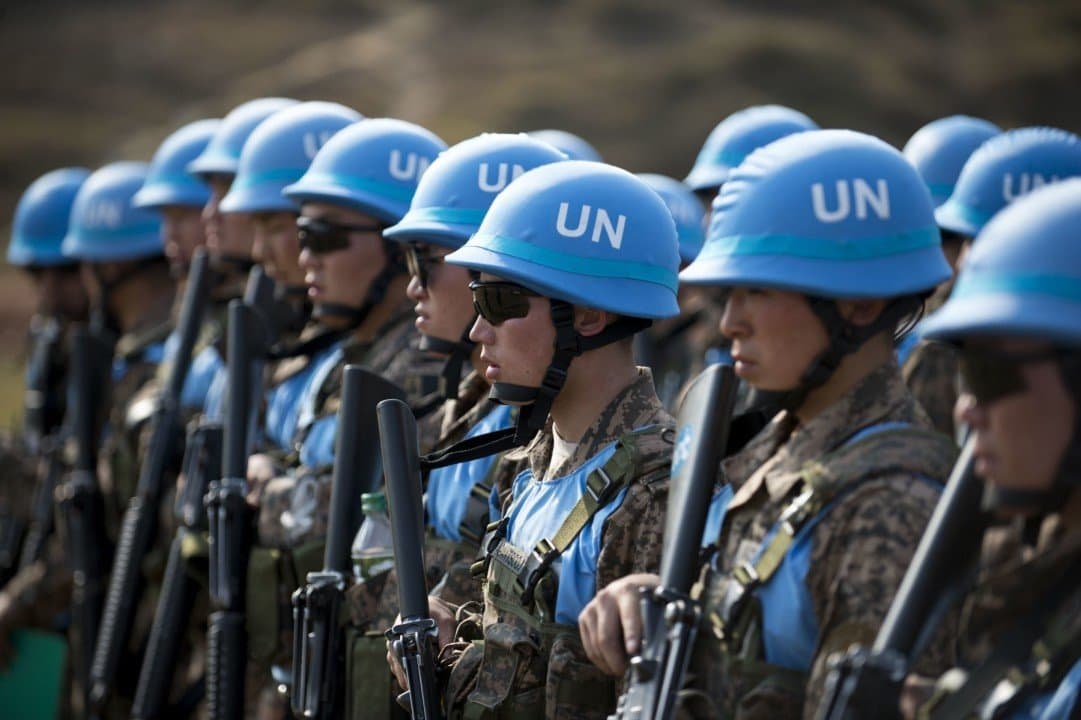
Peacekeeping typically refers to UN-mandated forces deployed with the consent of conflict parties to monitor ceasefires. A security operation is a broader term that can include combat and counter-terrorism missions to enforce stability, which may not have the consent of all local armed groups. The prediction market's wording includes both.
No, the United States has never deployed its military forces for operations inside the Gaza Strip. US involvement has been limited to diplomacy, intelligence cooperation, financial and military aid to Israel, and recent offshore humanitarian efforts like the temporary pier.
The UN Security Council can authorize a peacekeeping mission, but this requires a resolution that is not vetoed by the five permanent members. Such a mission would also traditionally require the consent of the host state, which is a complex issue as Gaza lacks a universally recognized sovereign government.
Potential contributors could include nations with strong UN peacekeeping records like Fiji, India, or Nepal, or regional actors like Turkey or Arab states from a coalition. However, any deployment would require a clear mandate, funding, and acceptance by key stakeholders, which are not currently in place.
No. The prediction market specifies that personnel must enter the 'terrestrial territory of the Gaza Strip.' The US pier was a floating structure in the Mediterranean Sea. Operations were confined to the pier and its associated support ships, not on land within Gaza.
Educational content is AI-generated and sourced from Wikipedia. It should not be considered financial advice.
3 markets tracked

No data available
| Market | Platform | Price |
|---|---|---|
![]() | Poly | 52% |
![]() | Poly | 30% |
![]() | Poly | 5% |


No related news found
Add this market to your website
<iframe src="https://predictpedia.com/embed/NeVfxF" width="400" height="160" frameborder="0" style="border-radius: 8px; max-width: 100%;" title="Foreign intervention in Gaza by..?"></iframe>