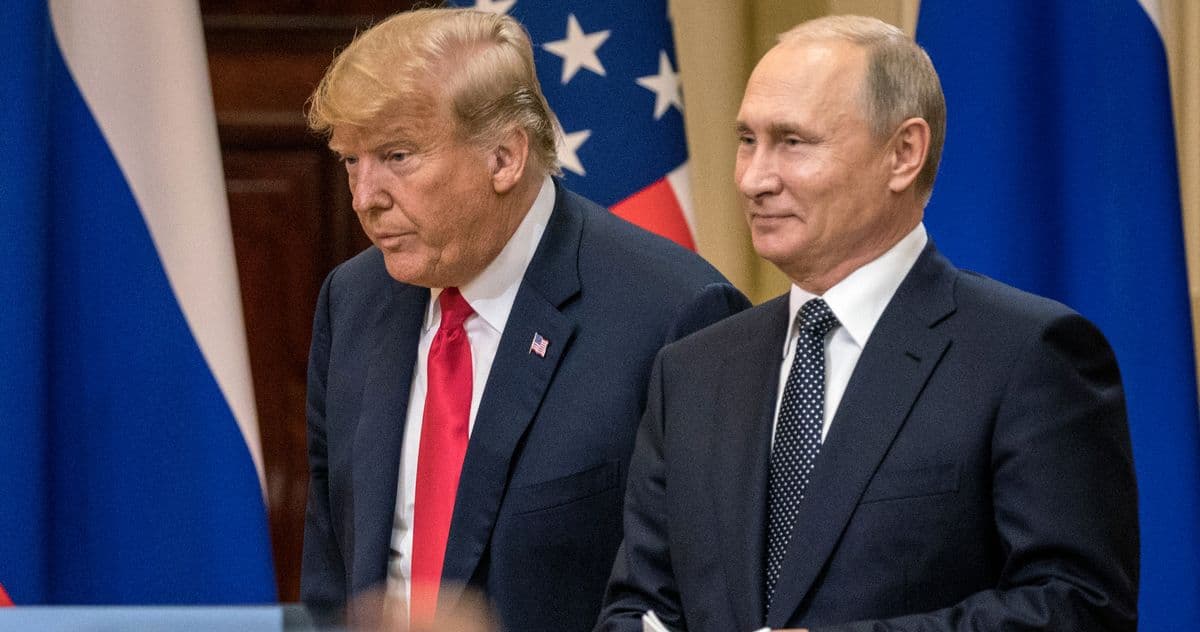
US recognizes Russian sovereignty over Ukraine before 2027?
$191.80K
1
1
US recognizes Russian sovereignty over Ukraine before 2027?
$191.80K
1
1
AI Analysis
Trader mode: Actionable analysis for identifying opportunities and edge
About This Event
This market will resolve to "Yes" if the United States government officially recognizes Russian sovereignty over any portion of Ukrainian territory by December 31, 2026, 11:59 PM ET. Otherwise, this market will resolve to "No". Donald Trump's March 25, 2019, recognition of Israel's sovereignty over the Golan Heights is an example of a qualifying action. Statement of intents, or announcements of planned recognition will not qualify. Ukrainian territory is defined as any portion of Ukraine as
This saved analysis is awaiting a background update. Its prices and claims may be outdated; compare them with the dated market data above.
Current Market Outlook
Polymarket traders give this a 16% probability, meaning the market sees a US recognition of Russian sovereignty over Ukrainian territory as unlikely but not impossible. With only $41K in volume across a single market, liquidity is thin enough that a single large bet could shift the price. The market resolves in 154 days, so the window is tight.
Key Factors Driving the Odds
The 16% price reflects three realities. First, Donald Trump has repeatedly claimed he could end the war in 24 hours, but his actual policy positions remain vague. His 2019 Golan Heights recognition shows he is willing to break with decades of US foreign policy precedent for geopolitical bargains. But that was Israel, a close ally, not Russia.
Second, any formal recognition would require an official State Department declaration or presidential statement, not just a tweet or offhand remark. The Golan Heights precedent required a formal proclamation. The administrative and legal machinery needed to recognize Russian sovereignty over, say, Crimea or Donetsk would trigger immediate congressional backlash and likely lawsuits.
Third, Russia has not achieved full military control over any of the four annexed regions. Even Crimea, taken in 2014, remains contested in international law. Recognizing partial sovereignty would be diplomatically bizarre and strategically pointless for Washington.
What Could Change These Odds
A ceasefire deal that freezes front lines could create pressure for some form of recognition. If Trump and Putin negotiate a settlement where the US accepts Russian control of occupied territory in exchange for security guarantees for the rest of Ukraine, the odds jump to 40-50%.
The 2026 midterm elections also matter. A Republican loss of the House or Senate would sharply reduce Trump's ability to push through controversial foreign policy shifts. The market resolves right after those elections, so weak Republican performance in November 2026 would push odds toward zero.
The key date to watch is Trump's first 100 days in 2025. If no recognition happens by April 2025, the odds likely drift below 10%. If he signals openness, they could spike to 30% quickly.
AI-generated analysis based on market data. Not financial advice.
Saved Jul 30, 2026 UTCThis saved content is awaiting a background update. It may contain outdated claims; use the dated market data and provider rules for the latest available information.
Overview
This prediction market asks whether the United States government will officially recognize Russian sovereignty over any portion of Ukrainian territory by December 31, 2026. The resolution criteria are specific: a formal recognition, similar to the U.S. recognition of Israeli sovereignty over the Golan Heights in 2019, would trigger a 'Yes' outcome. Statements of intent or announcements of planned recognition do not qualify. The territory in question is any part of Ukraine as defined by its internationally recognized borders, including Crimea and the regions of Donetsk, Luhansk, Zaporizhzhia, and Kherson, which Russia claimed to annex in September 2022. The question sits at the intersection of U.S. foreign policy, international law, and the ongoing Russo-Ukrainian War. Since Russia's full-scale invasion in February 2022, the U.S. has consistently affirmed Ukraine's territorial integrity within its 1991 borders. The Biden administration provided over $175 billion in military, economic, and humanitarian aid to Ukraine through late 2024, and the U.S. led international sanctions against Russia. A U.S. recognition of Russian sovereignty would represent a radical reversal of this policy, with major implications for global security, the NATO alliance, and the post-World War II international order. Interest in this market spiked after Donald Trump's return to the presidency in January 2025. Trump has a history of breaking with established U.S. foreign policy norms, as demonstrated by his 2019 Golan Heights recognition and his withdrawal from the Iran nuclear deal. During his 2024 campaign, Trump stated he could end the war in Ukraine 'in 24 hours' and suggested Ukraine might need to cede territory to Russia. His administration has signaled a more transactional approach to foreign policy, raising the possibility of a recognition deal as part of a broader peace negotiation. The market also reflects uncertainty about the trajectory of the war itself. As of early 2025, Russia controls roughly 18% of Ukrainian territory, including Crimea and much of the Donbas. Ukraine's 2023 counteroffensive failed to achieve major breakthroughs, and Western aid has become a subject of political debate in the U.S. Congress. The combination of a new administration, war fatigue, and shifting political dynamics makes the question of U.S. recognition a plausible, if still unlikely, scenario.
Historical Context
The question of U.S. recognition of territorial claims has a specific precedent in the 2019 Golan Heights decision. On March 25, 2019, President Donald Trump signed a proclamation recognizing Israeli sovereignty over the Golan Heights, territory that Israel captured from Syria in the 1967 Six-Day War and effectively annexed in 1981. This broke with decades of U.S. policy and international consensus, as the United Nations Security Council had passed Resolution 497 in 1981 declaring the annexation 'null and void.' The Trump administration argued that the recognition was justified by changed circumstances, including the Syrian civil war and Iran's presence in Syria. Ukraine's borders have been contested since Russia's annexation of Crimea in March 2014. Following the 2014 Revolution of Dignity, Russia annexed Crimea after a disputed referendum and backed separatist forces in eastern Ukraine. The Minsk agreements of 2014 and 2015 attempted to establish a ceasefire and political settlement, but they were never fully implemented. The United States and European Union imposed sanctions on Russia and consistently refused to recognize the annexation. The 2014 Budapest Memorandum, in which Ukraine gave up its nuclear weapons in exchange for security assurances from Russia, the U.S., and the UK, further committed signatories to respect Ukraine's borders. The full-scale invasion of February 24, 2022, dramatically escalated the conflict. Russia initially attempted to seize Kyiv and topple the government but was repelled by Ukrainian forces. By early 2025, the front line had stabilized along a roughly 1,000-kilometer arc from Kherson to Kharkiv. Russia claimed annexation of Donetsk, Luhansk, Zaporizhzhia, and Kherson regions in September 2022, though it did not fully control any of them. The U.S. and its allies rejected these annexations and continued to supply Ukraine with advanced weapons systems, including HIMARS, Abrams tanks, and F-16 fighter jets. The 2024 U.S. presidential election was a turning point. Trump's victory, combined with Republican control of both houses of Congress, shifted the political calculus. In December 2024, the outgoing Biden administration rushed to deliver remaining aid packages, but the incoming Trump administration signaled a desire to wind down U.S. involvement. By February 2025, the U.S. had paused new aid packages and initiated peace talks with Russian and Ukrainian representatives in Saudi Arabia.
Why It Matters
A U.S. recognition of Russian sovereignty over Ukrainian territory would fundamentally alter the post-World War II international order. The principle that borders cannot be changed by force is a cornerstone of the United Nations Charter and the Helsinki Final Act of 1975. If the U.S., the world's largest military power and a permanent UN Security Council member, endorses territorial conquest, it would set a precedent that other nations could exploit. China might feel emboldened to press its claims over Taiwan, India could accelerate its actions in Kashmir, and North Korea could seek recognition of its nuclear program. The credibility of U.S. security guarantees would be damaged, potentially triggering a cascade of nuclear proliferation as allies seek their own deterrents. Economically, the recognition would have immediate consequences. The U.S. has imposed over $100 billion in sanctions on Russia since 2022, many of which are tied to the territorial dispute. Recognition would likely lead to the lifting of some sanctions, benefiting Russian energy exports but undermining the dollar's role as a reserve currency. European allies, who have provided over $100 billion in aid to Ukraine, would face a strategic crisis. The NATO alliance, already strained by Trump's criticisms, could fracture if the U.S. unilaterally recognizes Russian gains. Ukraine itself would face a humanitarian catastrophe, with millions of refugees potentially forced to accept Russian rule or flee. The Ukrainian economy, which contracted by 29% in 2022, would face permanent loss of its industrial heartland in the Donbas.
AI-written background. References identify the evidence used; Wikipedia links under Learn More are additional reading. Prices and provider rules are dated snapshots. This is not financial advice.
Market Insights
Price gaps of 2 pp+
0
Saved price pairs
0
No exact saved pairs with both binary Yes prices are available.
Price differences do not establish arbitrage. Check each pair's review, current order prices, fees and settlement rules.