Which country will join Abraham Accords before 2027?
$1.75M
1
12
Which country will join Abraham Accords before 2027?
$1.75M
1
12
AI Analysis
Trader mode: Actionable analysis for identifying opportunities and edge
About This Event
This market will resolve to "Yes" if the listed country formally signs a normalization agreement with Israel under the framework of the Abraham Accords by December 31, 2026, 11:59 PM ET. Otherwise, this market will resolve to "No". A formal signing refers to an official agreement between Israel and another country that is publicly acknowledged by both governments and clearly attributed to the Abraham Accords or their continuation. The resolution source will be official government statements, h
This saved analysis is awaiting a background update. Its prices and claims may be outdated; compare them with the dated market data above.
Current Market Outlook
The Abraham Accords expansion market is pricing a 37% chance that Somaliland formalizes a normalization agreement with Israel before December 31, 2026. That's roughly a 1 in 3 shot, which the market treats as plausible but far from certain. Trading volume sits at $562K across seven country-specific markets, with Somaliland drawing the most attention. The other six markets, covering countries like Indonesia, Saudi Arabia, and Morocco, trade at significantly lower probabilities, suggesting traders see Somaliland as the most likely next entrant.
The resolution window is tight: 125 days remain. Any agreement must be publicly acknowledged by both governments and explicitly tied to the Abraham Accords framework.
Key Factors Driving the Odds
Somaliland's strategic position explains the elevated probability. The self-declared republic in the Horn of Africa has pursued international recognition for decades, and normalization with Israel offers a path to legitimacy through the back door. In February 2024, Somaliland signed a memorandum of understanding with Ethiopia granting naval access to the Red Sea, which angered Somalia and drew regional attention. Israel has historically maintained quiet ties with Somaliland, and reports of Israeli interest in the Berbera port as a counterweight to Iranian influence in the region have circulated for years.
The Trump administration's return to office in January 2025 revived momentum for expanding the Accords. Trump's team pushed the original Abraham Accords in 2020, and his Middle East envoy has signaled interest in adding new signatories. Somaliland's unrecognized status makes it an easier diplomatic lift than Saudi Arabia, which demands progress on Palestinian statehood before any normalization.
What Could Change These Odds
The biggest catalyst is the upcoming Somaliland presidential election, scheduled for November 2025. Incumbent President Muse Bihi Abdi has been the driving force behind the Israel talks. If he loses, the new administration could deprioritize normalization. Conversely, a Bihi victory would likely accelerate negotiations.
Somalia's fierce opposition remains a wildcard. Mogadishu has lobbied Arab League members to block any Somaliland-Israel deal, framing it as a threat to Somali territorial integrity. Saudi Arabia and the UAE, both wary of regional instability, could pressure Israel to hold off.
The market's 37% price has held steady for weeks, suggesting traders see the election and diplomatic push as a genuine coin flip. A formal signing before year-end would require both governments to move quickly, and the window is narrowing. Watch for any official Israeli delegation visit to Hargeisa or a public statement from the Israeli Foreign Ministry in the coming months, as those would likely push the price toward 60% or higher.
AI-generated analysis based on market data. Not financial advice.
Saved Aug 28, 2026 UTCThis saved content is awaiting a background update. It may contain outdated claims; use the dated market data and provider rules for the latest available information.
Overview
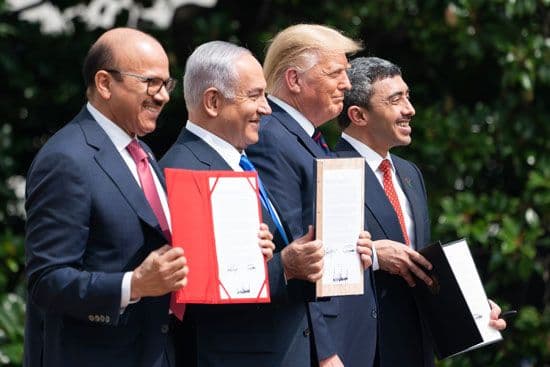
The Abraham Accords, signed in September 2020, marked a historic shift in Middle East diplomacy by normalizing relations between Israel and several Arab nations. The accords, brokered by the United States, established formal diplomatic, economic, and cultural ties, breaking with decades of Arab League policy that conditioned peace with Israel on Palestinian statehood. The initial signatories were the United Arab Emirates, Bahrain, and Morocco, with Sudan later joining. Since then, the framework has expanded to include other agreements and has been a focal point for U.S. foreign policy, particularly under the Trump and Biden administrations. The question of which country might join the accords before 2027 is a live issue, with several nations, including Saudi Arabia, Oman, Qatar, and others, being discussed as potential candidates. The expansion of the accords is seen as a key component of regional stability, economic integration, and a counterbalance to Iran's influence. The market's resolution criteria are specific: a formal signing of a normalization agreement with Israel under the Abraham Accords framework, publicly acknowledged by both governments, by the end of 2026. This has led to intense speculation and analysis of diplomatic signals, regional dynamics, and the strategic interests of potential signatories. The interest in this topic is driven by the potential for a major geopolitical shift, the implications for the Israeli-Palestinian conflict, and the economic opportunities that normalization could unlock. The market's outcome will have significant repercussions for the Middle East's political landscape and global energy markets, given the region's oil wealth and strategic chokepoints.
Historical Context
The Abraham Accords were signed on September 15, 2020, at a White House ceremony, with the UAE and Bahrain as initial signatories. Morocco and Sudan followed, with Sudan's agreement being formalized later. The accords were named after the biblical patriarch Abraham, symbolizing common heritage. They broke with the Arab Peace Initiative of 2002, which conditioned normalization on a two-state solution. The accords were a triumph for the Trump administration, which had brokered the deals, and were seen as a way to isolate Iran and create a new regional order. Since then, the Biden administration has sought to build on this foundation, but progress has been slow. The Israeli-Palestinian conflict remains a major sticking point, with the Palestinian Authority criticizing the accords for bypassing their demands. The accords have already yielded tangible benefits, including direct flights, trade agreements, and security cooperation. The potential addition of Saudi Arabia, the most influential Arab nation, would be a game-changer, but it faces significant obstacles, including the kingdom's insistence on progress toward Palestinian statehood and its desire for U.S. security guarantees. The historical arc of the accords is still being written, with the next few years critical for their future expansion.
Why It Matters
The expansion of the Abraham Accords has profound implications for the Middle East and beyond. Economically, normalization opens up markets and investment opportunities, particularly in technology, defense, and energy. For instance, the UAE and Israel have already seen bilateral trade exceed $2 billion in 2022, and a Saudi deal could unlock even larger flows. Politically, the accords reshape alliances, isolating Iran and creating a pro-U.S. bloc that could counterbalance Russian and Chinese influence in the region. They also affect the Israeli-Palestinian conflict, as some argue that normalization without Palestinian statehood undermines their cause, while others believe it could lead to a more pragmatic approach. Socially, the accords promote people-to-people exchanges and cultural ties, but they also face opposition from populations who sympathize with the Palestinians. The outcome of the market will signal the trajectory of these dynamics. A new signatory before 2027 would likely be seen as a major diplomatic victory for the U.S. and Israel, while a failure to expand could indicate growing resistance and a shift in regional priorities. For investors, the accords affect risk assessments and opportunities in the region, particularly in sectors like fintech, tourism, and energy infrastructure.
Frequently Asked Questions
What are the Abraham Accords?
The Abraham Accords are a series of agreements signed in 2020 that normalized diplomatic relations between Israel and several Arab countries, including the UAE, Bahrain, Morocco, and Sudan. They were brokered by the United States and marked a shift from the traditional Arab stance of conditioning peace on Palestinian statehood.
Which country is most likely to join the Abraham Accords next?
Saudi Arabia is widely considered the most likely and most consequential candidate, but its accession faces significant hurdles, including demands for progress on Palestinian statehood and U.S. security guarantees. Other potential candidates include Oman and Qatar, but they have shown less willingness to move quickly.
Why is Saudi Arabia's potential joining so important?
Saudi Arabia is the custodian of Islam's holiest sites and a major oil producer, giving it immense political and economic influence in the region. Its entry into the accords would likely trigger a cascade of other nations joining and would be a major geopolitical shift, potentially reshaping Middle East alliances.
How do the Abraham Accords affect the Israeli-Palestinian conflict?
The accords are controversial because they allow Arab nations to normalize relations with Israel without requiring a full resolution of the Palestinian issue. Supporters argue that economic and security cooperation could lead to a more pragmatic approach to the conflict, while critics say it undermines Palestinian leverage and the two-state solution.
AI-written background. References identify the evidence used; Wikipedia links under Learn More are additional reading. Prices and provider rules are dated snapshots. This is not financial advice.
Market Insights
Price gaps of 2 pp+
0
Saved price pairs
0
No exact saved pairs with both binary Yes prices are available.
Price differences do not establish arbitrage. Check each pair's review, current order prices, fees and settlement rules.