$160.17
1
1

1 market tracked

No data available
| Market | Platform | Price |
|---|---|---|
![]() | Poly | 20% |
Trader mode: Actionable analysis for identifying opportunities and edge
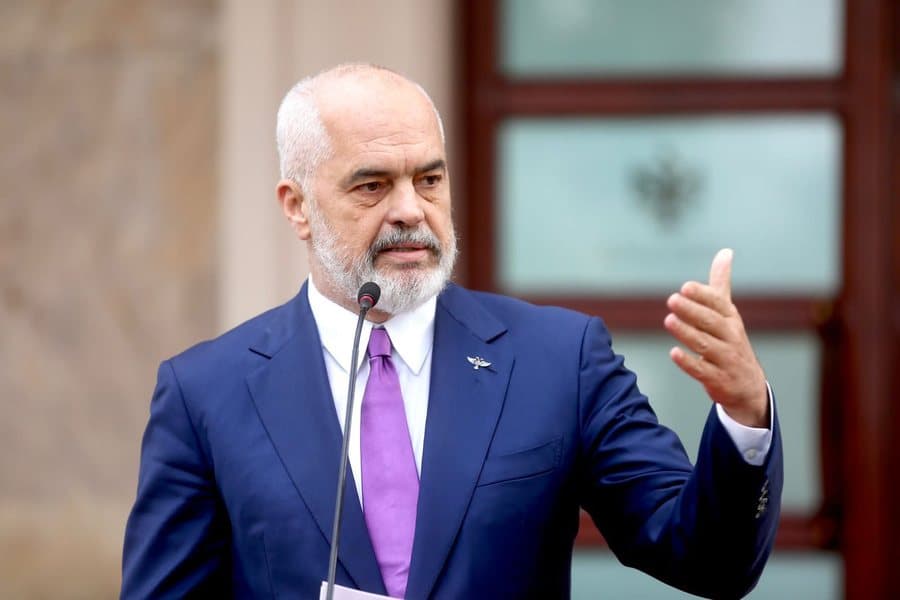
This market will resolve to “Yes” if Edi Rama ceases to be the Prime Minister of Albania for any period of time between market creation and December 31, 2026, 11:59 PM ET. Otherwise, this market will resolve to “No”. An announcement of Rama's resignation/removal before this market's end date will immediately resolve this market to "Yes", regardless of when the announced resignation/removal goes into effect. The resolution source for this market will be official information from Edi Rama and th
Traders on Polymarket currently give about an 18% chance that Edi Rama will stop being Albania's Prime Minister before the end of 2026. In simpler terms, this means the collective bet is that it's unlikely he will leave office in that timeframe, with roughly a 1 in 5 chance it happens. The market shows strong confidence that Rama will remain in his position through at least the next two years.
The low probability reflects Rama's firm political standing. First, he is the leader of Albania's Socialist Party and won a third consecutive term in the 2021 parliamentary elections. This gives his government a stable majority, making a sudden exit from internal parliamentary politics very unlikely before the next scheduled election.
Second, there is no clear, unified opposition force strong enough to force him out early. While protests have occurred over issues like corruption and the cost of living, they have not seriously threatened his government's stability. Third, from a historical perspective, Albanian politics has seen relatively stable leadership tenures in recent cycles. Rama himself has been PM since 2013, and the market is betting on that pattern of continuity holding.
The next major electoral test is the local elections scheduled for 2025. A very poor showing for the Socialist Party could signal weakening support and increase speculation about his future. However, the more critical date is the next parliamentary election, expected in 2025. A loss for his party there would almost certainly lead to his removal as PM, but that outcome would fall after this 2026 market's cutoff.
Before then, watch for any major corruption scandals directly implicating Rama or a severe economic crisis that triggers sustained, large-scale unrest. An announcement from Rama himself about not running in the next election would also shift predictions, though that might be planned as a normal transition rather than a premature exit.
Prediction markets are generally decent at forecasting political stability in systems with clear electoral calendars, like Albania's. They aggregate many viewpoints and react quickly to news. However, for a niche market with a relatively low trading volume like this one, the odds can be less precise and more sensitive to small bets. They are a useful snapshot of informed opinion, but unexpected events like a health issue or a sudden political rupture could easily make the current 18% chance look wrong in hindsight.
The Polymarket contract "Edi Rama out as Albania PM in 2026?" is trading at 18¢, implying an 18% probability that Rama will leave office before the end of 2026. This price indicates the market views his departure as unlikely within this timeframe. With minimal trading volume, this is a speculative, low-liquidity market where the current price is more indicative of initial sentiment than a deeply held consensus.
The low probability is anchored in Albania's political reality. Edi Rama's Socialist Party secured a third consecutive term in the 2025 parliamentary elections, solidifying his control. His party holds a strong majority, and no immediate, credible challenge from the fragmented opposition exists. Historically, Albanian PMs have served full parliamentary terms barring extraordinary crises. The market pricing reflects a belief that the institutional and political conditions for an unplanned exit are not present. Rama himself has shown no indication of stepping down voluntarily before the next scheduled election cycle.
The primary catalyst for a dramatic shift in odds would be a significant, destabilizing event. Widespread protests escalating beyond current levels or a major corruption scandal directly implicating Rama could fracture his parliamentary coalition. An unexpected health issue could also force a resignation. The market will be sensitive to any signals from within the Socialist Party of internal dissent or a leadership challenge. Monitoring local Albanian news for reports of political instability or judicial actions against high-ranking officials is essential, as these would be leading indicators the market has not yet priced in.
AI-generated analysis based on market data. Not financial advice.
$160.17
1
1
This prediction market addresses whether Edi Rama will leave his position as Prime Minister of Albania before the end of 2026. Rama has led Albania since 2013 as head of the Socialist Party, winning three consecutive parliamentary elections. The question of his political future is significant because he is the longest-serving prime minister in post-communist Albania and has centralized considerable power within his government. His potential departure could result from electoral defeat, internal party challenges, resignation, or other unforeseen political events. The market will resolve to 'Yes' if he ceases to be Prime Minister for any period before December 31, 2026, based on official announcements. Interest in this topic stems from Albania's geopolitical position in the Western Balkans, its ongoing negotiations for European Union membership, and domestic debates about democratic governance and corruption under Rama's administration. Observers are watching whether Rama will attempt to secure a fourth term in the next general election, expected in 2025, or if political fatigue and opposition pressure will end his tenure.
Albania's modern political landscape was shaped by its transition from communist rule in 1991. The Democratic Party and Socialist Party emerged as the two dominant forces, with power alternating between them. Edi Rama's rise began when he became Mayor of Tirana in 2000, revitalizing the city's appearance. He transformed the Socialist Party after becoming its chairman in 2005. Rama first became Prime Minister in 2013, ending eight years of Democratic Party rule led by Sali Berisha. His 2013 victory was notable for being the first time an Albanian government changed hands through an election without significant controversy. Rama secured re-election in 2017, and again in April 2021, when the Socialist Party won 74 of 140 parliamentary seats. The 2021 election was conducted under a new proportional representation system that Rama introduced, which critics argued was designed to fragment the opposition. Historically, no Albanian prime minister has served four consecutive terms since the fall of communism, making Rama's potential 2025 re-election bid a test of this precedent.
The stability of Albania's government directly affects its European Union accession process. Formal negotiations began in July 2022, and continued progress requires consistent political leadership. A change in prime minister could delay reforms related to judiciary independence and anti-corruption measures that the EU demands. Domestically, Rama's potential exit would trigger a significant realignment within the Socialist Party, which has no clear successor. This could lead to internal factionalism or a power struggle. For Albanian citizens, a change in leadership could alter economic policies, including infrastructure spending and tourism development, which have been hallmarks of Rama's administration. The outcome also matters for regional stability in the Western Balkans, where Albania is viewed as a relatively pro-Western actor compared to neighbors like Serbia. International partners, including the United States, have invested in Rama's government as a counterbalance to Russian and Chinese influence in the region.
As of early 2024, Edi Rama remains in office with his parliamentary majority intact. The next general election is constitutionally due by April 2025. Rama has not formally declared whether he will lead the Socialist Party ticket for a fourth term, though he is widely expected to do so. The opposition Democratic Party, led by Lulzim Basha, continues to organize protests alleging government corruption and electoral manipulation. In December 2023, the EU agreed to fund Albania with 80 million euros in pre-accession aid, maintaining pressure on Rama to deliver reforms. Domestically, the government is focusing on major infrastructure projects, including airport expansions and a controversial tourism development on the coast, which have sparked environmental protests.
The next parliamentary election must be held by April 2025. The exact date will be set by presidential decree, typically several months in advance.
Yes, Albanian law does not limit prime ministerial terms. Rama can run for a fourth consecutive term if his party selects him as its candidate.
Potential reasons include losing the 2025 election, a health issue, a major corruption scandal, or losing the support of his own Socialist Party through an internal revolt.
If the Socialist Party wins the 2025 election, a party figure like Foreign Minister Olta Xhaçka could succeed him. If the opposition wins, Democratic Party leader Lulzim Basha would likely become prime minister.
Rama has tied his legacy to EU integration. Significant setbacks in negotiations could weaken his political standing and provide ammunition for the opposition.
Educational content is AI-generated and sourced from Wikipedia. It should not be considered financial advice.

No related news found
Add this market to your website
<iframe src="https://predictpedia.com/embed/SXPkAh" width="400" height="160" frameborder="0" style="border-radius: 8px; max-width: 100%;" title="Edi Rama out as Albania PM in 2026?"></iframe>