$11.22K
1
1

1 market tracked

No data available
| Market | Platform | Price |
|---|---|---|
![]() | Poly | 6% |
Trader mode: Actionable analysis for identifying opportunities and edge
This market will resolve to "Yes" if a solar radiation storm with a severity level of 3 or greater occurs between market creation and April 30, 2026, 11:59PM ET. Otherwise, this market will resolve to "No". An S3 event is a solar radiation storm with a "Strong" classification. More information on the space weather classification criteria can be found here: https://www.swpc.noaa.gov/noaa-scales-explanation This market will resolve immediately upon the occurrence of a qualifying event. Any late
AI-generated analysis based on market data. Not financial advice.
$11.22K
1
1
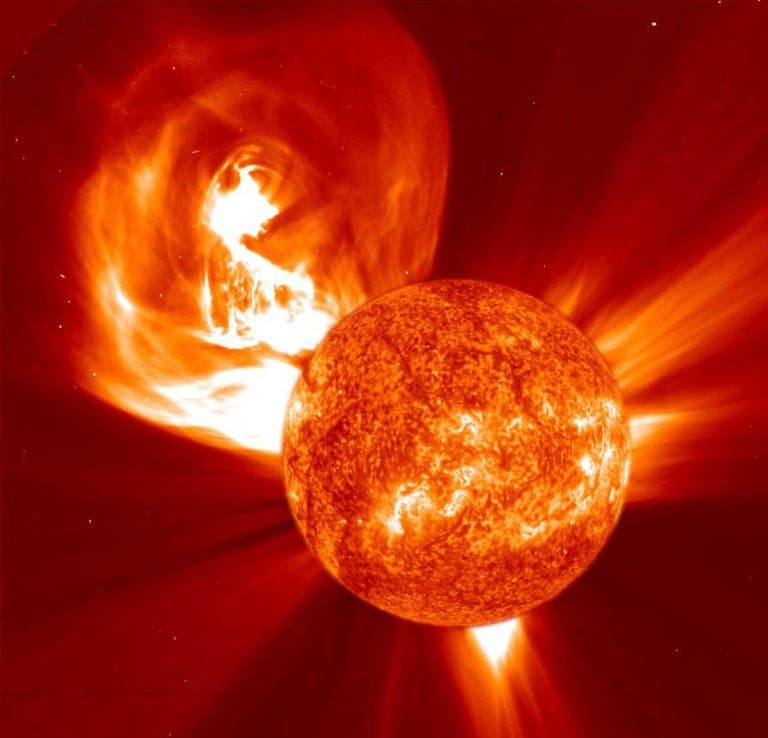
This prediction market asks whether Earth will experience a major solar radiation storm, classified as S3 or stronger, by April 30, 2026. Solar radiation storms are events where the Sun emits intense bursts of energetic particles, primarily protons, that travel through space and can reach Earth. These storms are measured on the NOAA Space Weather Scales, where an S3 event is labeled 'Strong' and represents a significant increase in radiation levels. The market resolves immediately if such an event is officially confirmed by monitoring agencies before the deadline. The interest in this specific timeframe stems from the approaching peak of Solar Cycle 25, which scientists predict will occur between late 2024 and early 2026, a period when solar activity and the likelihood of such storms are highest. People are interested because these events pose real risks to satellite operations, astronaut safety, and high-frequency radio communications, making their prediction relevant to industries from aviation to space exploration. The market provides a quantified way to track expert and public sentiment on the probability of a disruptive space weather event in the near future.
The modern understanding of solar radiation storms began with the Carrington Event of September 1859, a geomagnetic storm caused by a coronal mass ejection. While that event is famous for its geomagnetic effects, it was almost certainly accompanied by an extreme solar radiation storm. In the space age, direct measurement of these particle events became possible. A major radiation storm occurred in August 1972, between the Apollo 16 and 17 missions. NASA analysis later suggested that if astronauts had been on a lunar excursion during that storm, they could have received a life-threatening radiation dose. This event highlighted the direct danger to human spaceflight. More recently, the Halloween Storms of October 2003 produced an S4 (Severe) solar radiation storm. This event forced astronauts on the International Space Station to take shelter in a more shielded part of the station and caused satellite anomalies, including the temporary failure of Japan's Midori 2 satellite. These historical events demonstrate that while S3 storms are less severe than these examples, they are a recurring feature of active solar cycles and carry measurable risks.
A major solar radiation storm has concrete economic and operational consequences. The elevated radiation levels can damage satellite electronics, degrade solar panel performance, and increase drag on low-Earth orbit spacecraft through atmospheric heating. This poses a direct financial risk to the global satellite industry, valued at over $280 billion. For aviation, radiation storms can elevate radiation exposure for crew and passengers on polar flight routes, potentially forcing costly flight diversions. The most immediate impact is on high-frequency (HF) radio communications, which are used by aviation, maritime, and amateur radio operators. An S3 storm typically causes radio blackouts on the sunlit side of Earth for several hours. Beyond immediate disruptions, these events test the resilience of modern technological infrastructure. A storm during this predicted solar maximum period serves as a real-world stress test for space weather forecasting models and mitigation protocols developed by agencies and industries over the past decade.
As of early 2024, Solar Cycle 25 continues to progress toward its predicted maximum. Solar activity has been increasing, with monthly sunspot numbers consistently exceeding those of the same period in the previous cycle. Several strong solar flares and coronal mass ejections have occurred in recent months, though none have yet produced the sustained proton flux required for an S3 classification. Forecasting centers like NOAA SWPC continue to monitor active regions on the Sun daily. The progression suggests the highest probability for significant radiation storms will fall within the window of this prediction market, which extends through April 2026.
A solar radiation storm involves a surge of energetic particles, mainly protons, that reach Earth quickly. A geomagnetic storm is caused by disturbances in Earth's magnetic field from coronal mass ejections and arrives days later. They are different phenomena, though they can originate from the same solar event.
Storms are measured by satellites like the NOAA GOES series, which have instruments that count the flux of protons in space. The official S-scale is based on the flux of protons with energies greater than 10 million electron volts (MeV) measured in particle flux units (pfu).
No, Earth's atmosphere and magnetic field provide sufficient shielding to protect people on the ground from the radiation levels of an S3 storm. The primary risks are to astronauts, airline crews and passengers on high-altitude polar flights, and satellite systems.
The February 1956 solar particle event is considered one of the most intense ever directly measured. Modern analysis suggests it would have been classified as an S5, or Extreme, event on today's scales, with a proton flux thousands of times higher than the S3 threshold.
Educational content is AI-generated and sourced from Wikipedia. It should not be considered financial advice.

No related news found
Add this market to your website
<iframe src="https://predictpedia.com/embed/U91_nn" width="400" height="160" frameborder="0" style="border-radius: 8px; max-width: 100%;" title="Major solar storm by April 30?"></iframe>