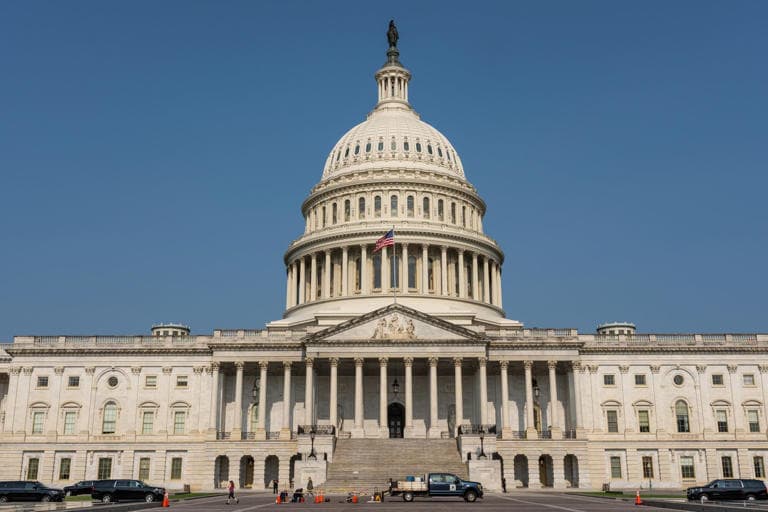
Clarity Act (H.R.3633) signed into law in 2026?
PM $24.01M
1
1
Clarity Act (H.R.3633) signed into law in 2026?
PM $24.01M
1
1
AI Analysis
Trader mode: Market mechanics, assumptions and risks
PM $24.01M
Reported volume · provider units
1
Saved contracts
0
Reviewed equivalent pairs
Source snapshot: Oct 13, 2026, 12:27 PM UTC
About This Event
This market will resolve to "Yes" if the Digital Asset Market Clarity Act of 2025 (H.R.3633) is passed by both chambers of the U.S. Congress and signed into law by December 31, 2026, 11:59 PM ET. Otherwise, this market will resolve to "No". The primary resolution source is Congress.gov’s legislation tracker (https://www.congress.gov/bill/119th-congress/house-bill/3633) and other official information from the government of the United States, however other credible reporting may be used.
This saved analysis is awaiting a background update. Its prices and claims may be outdated; compare them with the dated market data above.
Snapshot observed 2026-10-14T15:00:05.948Z. This analysis describes that snapshot and is not a live news update.
What the contract measures
The Kalshi event asks whether "crypto market structure legislation" becomes law. Its rules define that as any bill that establishes "a comprehensive regulatory framework for digital assets, cryptocurrencies, or virtual currencies, but not solely for stablecoins" and also delineates "regulatory authority between federal agencies, such as the SEC, CFTC, or others" [1]. The Polymarket market is narrower. It resolves "Yes" only if the Digital Asset Market Clarity Act of 2025 (H.R.3633) is "passed by both chambers" of Congress and "signed into law by December 31, 2026, 11:59 PM ET" [2].
Kalshi's event contains seven separate markets, each with a different close date, from November 1, 2026 to January 1, 2028 [1]. The Polymarket event has one market, with a listed end time of January 1, 2027 at 05:00 UTC [2]. A Kalshi contract and a Polymarket contract can therefore differ in both the bill they cover and the deadline, so their prices should not be read as the same question.
Reading the snapshot
The provider observed these prices at 15:00 UTC on October 14, 2026, and the source was retrieved at 16:32 UTC the same day. These are saved snapshots, not live or executable quotes.
Within the Kalshi event, the Yes prices rise with the close date. The listed Yes prices are 0.005 for November 1, 2026, 0.03 for December 1, 2026, about 0.0585 for January 1, 2027, 0.075 for April 1, 2027, 0.12 for July 1, 2027, 0.16 for October 1, 2027, and 0.28 for January 1, 2028 [1]. The Polymarket Yes price is 0.0635 for the H.R.3633 market [2].
Because the Polymarket contract covers a specific bill and a December 31, 2026 deadline, its price is not directly comparable with the Kalshi market closing January 1, 2027, which covers any qualifying bill. Any gap between them does not by itself indicate an opportunity.
What remains uncertain
The evidence contains no explanation for why these prices are where they are, and no information about the number of traders or the depth of the markets. Volume and listed prices are not measures of liquidity.
Both samples are complete for the saved events: all seven Kalshi markets and the one Polymarket market are included [1][2]. The source still does not establish that the providers list every possible real-world outcome, so a missing deadline should not be read as having a particular price.
The evidence also includes no current news about the bill's legislative status, so these figures show only what the providers recorded at the observation time.
References
- Kalshi: Will the Clarity Act become law?. Provider data observed 2026-10-14T15:00:05.948Z.
- Polymarket: Clarity Act (H.R.3633) signed into law in 2026?. Provider data observed 2026-10-14T15:00:05.948Z.
AI-generated analysis based on market data. Not financial advice.
Saved Oct 14, 2026 UTCOverview
The Clarity Act is the common name used in these prediction markets for the Digital Asset Market Clarity Act of 2025, which is identified as H.R.3633 [2]. The contracts ask whether a crypto market structure law will be enacted before a set deadline. The two providers word the question differently, so the exact conditions matter. On Kalshi, the event asks whether the Clarity Act will become law, and the contract resolves to Yes if a crypto market structure bill has become law before the deadline [1]. The contract defines crypto market structure legislation as a bill that does two things. It must establish a comprehensive regulatory framework for digital assets, cryptocurrencies, or virtual currencies, and it must not be solely about stablecoins. It must also delineate regulatory authority between federal agencies, such as the SEC, CFTC, or others, for oversight of digital assets [1]. Because the definition refers to a bill type rather than one named bill, a different bill meeting these criteria could satisfy a Kalshi contract. Polymarket's market is narrower. It resolves to Yes only if the Digital Asset Market Clarity Act of 2025 (H.R.3633) is passed by both chambers of the U.S. Congress and signed into law by December 31, 2026, 11:59 PM ET [2]. Its primary resolution source is the Congress.gov legislation tracker, with other official United States government information and other credible reporting allowed as secondary support [2]. The Kalshi event contains several contracts with different deadlines, from November 1, 2026 through January 1, 2028 [1]. These are contract rules, not announced dates for any legislative action. Each contract is priced separately, and the prices in this snapshot are not executable quotes or verified probabilities.
Historical Context
The 119th United States Congress convened on January 3, 2025, for the last 17 days of Joe Biden's presidency and continued during the first two years of Donald Trump's second presidency [3]. The H.R.3633 bill named in the Polymarket contract is part of that Congress's legislative record [2]. The supplied sources do not describe the bill's introduction, committee action, or votes, so no further legislative history can be given here.
Why It Matters
These contracts measure whether a specific legal outcome, enactment of crypto market structure legislation, occurs before a stated date. Under the Kalshi definition, the relevant test is the content of the bill: a comprehensive framework for digital assets and a division of authority among federal regulators [1]. Under the Polymarket definition, the test is a specific bill's passage by both chambers and signature by a deadline [2]. Traders reading the prices should note that a price reflects the market's view of these exact rules, and the deadline and bill definition determine what a Yes outcome requires.
Snapshot context
The latest published provider snapshot for this topic was observed on 2026-10-14 at 15:00 UTC. It contains listings from Kalshi and Polymarket. Market descriptions and listed closing times define the contracts; they do not establish that the real-world outcome has occurred. This article does not include a separately verified news update. [1]
Frequently Asked Questions
What must happen for the Polymarket Clarity Act market to resolve Yes?
The Digital Asset Market Clarity Act of 2025 (H.R.3633) must be passed by both chambers of the U.S. Congress and signed into law by December 31, 2026, 11:59 PM ET [2].
Does a Kalshi contract require the Clarity Act specifically?
No. The Kalshi contract resolves Yes if a crypto market structure bill becomes law before the deadline, using a definition based on the bill's content rather than its name [1].
Does a contract deadline mean lawmakers have scheduled a vote or signing?
No. A date in the contract rules is not an announced event date. The Kalshi contracts list several deadlines, and the Polymarket contract sets December 31, 2026 as its deadline [1][2].
AI-written background. References identify the evidence used; Wikipedia links under Learn More are additional reading. Prices and provider rules are dated snapshots. This is not financial advice.
Market Insights
Price gaps of 2 pp+
0
Reviewed equivalent pairs
0
No currently reviewed equivalent pairs with both binary Yes prices are available.
Price differences do not establish arbitrage. Check each pair's review, current order prices, fees and settlement rules.