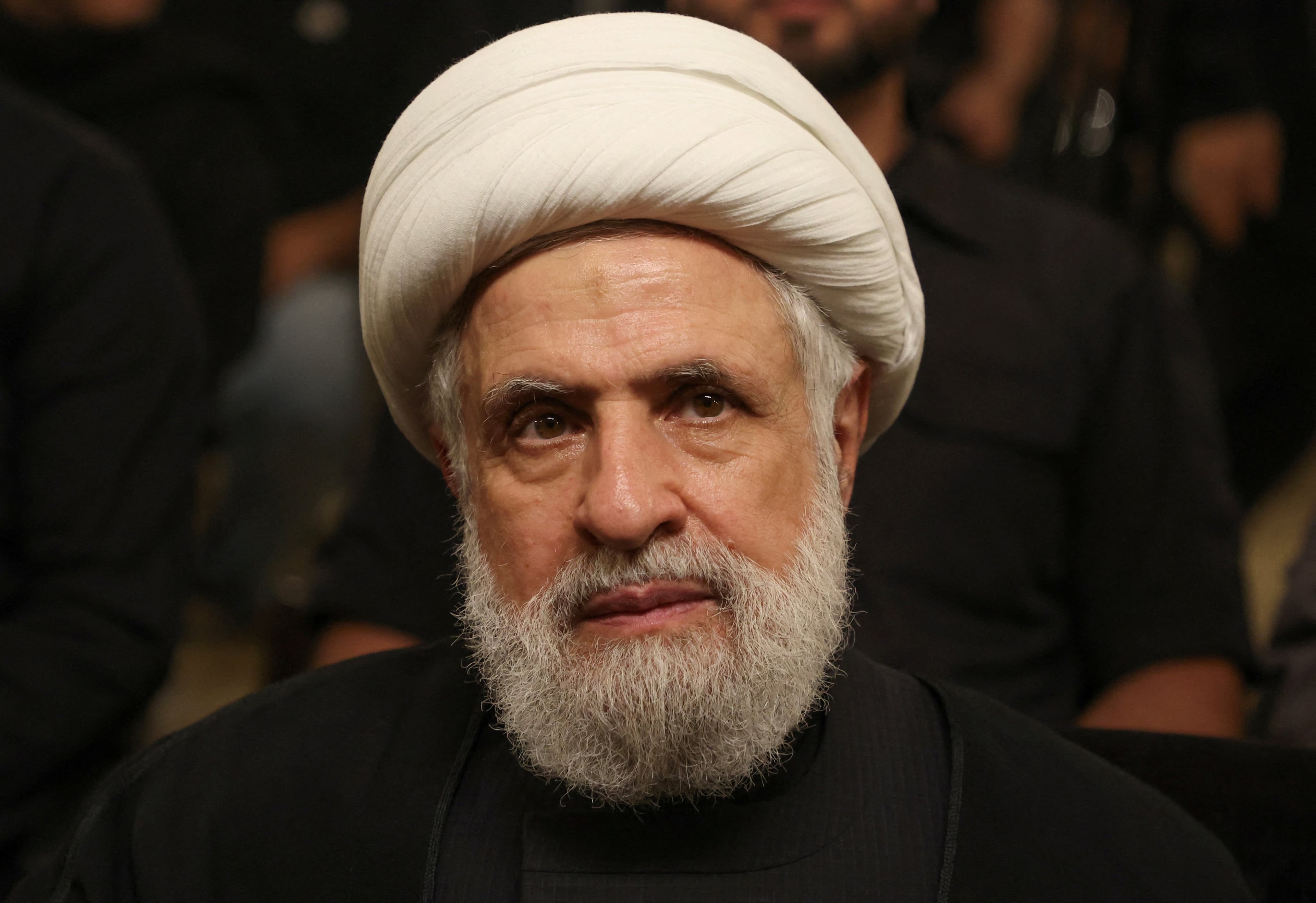
Naim Qassem out as Hezbollah’s secretary-general by...?
PM $945.8K
1
1
Naim Qassem out as Hezbollah’s secretary-general by...?
PM $945.8K
1
1
Current odds
Snapshot from
As of Oct 26, 2026, 12:00 PM UTC, the highest-priced outcome on Polymarket is December 31, 2026 at 8.3%.
Polymarket
- December 31, 20268.3%
Yes prices. They are not order quotes; check each platform's rules, fees and live prices before trading.
AI Analysis
Trader mode: Market mechanics, assumptions and risks
PM $945.8K
Reported volume · provider units
1
Saved contracts
0
Same-question pairs
Source snapshot: Oct 26, 2026, 12:00 PM UTC
About This Event
This market will resolve to "Yes" if Naim Qassem ceases to be Hezbollah’s secretary-general for any length of time by the specified date, 11:59 PM ET. Otherwise, this market will resolve to "No". Naim Qassem will be considered to be removed from power if he resigns, is detained, or otherwise loses his position or is prevented from fulfilling his duties as Hezbollah’s secretary-general within this market's timeframe. The primary resolution source for this market will be official statements from Hezbollah; however, a consensus of credible reporting will also be used.
This analysis is awaiting a background update, so its prices may be older than the odds above.
Snapshot observed 2026-10-20T00:00:06.267Z. This analysis describes that snapshot and is not a live news update.
What the contract measures
This is a single Polymarket contract on whether Naim Qassem will cease to be Hezbollah's secretary-general by a set deadline. The title reads "Naim Qassem out as Hezbollah's secretary-general by December 31, 2026?" [1]. The source says the market "will resolve to "Yes" if Naim Qassem ceases to be Hezbollah's secretary-general for any length of time by the specified date, 11:59 PM ET" [1].
The wording is broad. The source states that he "will be considered to be removed from power if he resigns, is detained, or otherwise loses his position or is prevented from fulfilling his duties" [1]. A reader should check that these conditions match their own interpretation before comparing this contract with any other.
The source names its resolution method: "The primary resolution source for this market will be official statements from Hezbollah; however, a consensus of credible reporting will also be used" [1]. The listed end time is 2027-01-01T04:59:00.000Z [1]. That timestamp is when the contract is listed to close, not an announced event. The evidence does not establish any resolution outcome.
Reading the snapshot
The provider observed the market at 2026-10-20T00:00:06.267Z, and the record was retrieved at 2026-10-20T00:06:42.427Z [1]. These times describe this saved record only. They do not show live prices now.
The saved prices were Yes at 0.0895 and No at 0.9105 [1]. Each figure is a snapshot price, not an executable quote or a verified probability. The Yes price is roughly nine cents on a one-dollar payout scale. The evidence does not explain why the price is at that level.
The sample covers one market from one provider event. The coverage record lists one total market, one included market, and no partial sample [1]. Because only this contract was saved, there is no other outcome in the sample to compare against. The source also notes that the saved markets "do not establish that the providers list every possible real-world outcome" [1].
What remains uncertain
The evidence does not include any news, statements, or events about Naim Qassem or Hezbollah after the snapshot. It also does not include trading volume, liquidity, or the number of traders. Those figures cannot be inferred from the price.
No comparison with other platforms appears in the evidence, so no cross-platform conclusion is supported. Any future comparison would also need matching wording, deadlines, and resolution sources before prices could be read together.
References
- Polymarket: Naim Qassem out as Hezbollah’s secretary-general by...?. Provider data observed 2026-10-20T00:00:06.267Z.
AI-generated analysis based on market data. Not financial advice.
Saved Oct 20, 2026 UTCThis saved content is awaiting a background update. It may contain outdated claims; use the dated market data and provider rules for the latest available information.
Overview
This PredictPedia entry covers a prediction market asking whether Naim Qassem will cease to be secretary-general of Hezbollah by a specified deadline. The contract is listed on Polymarket under the event title "Naim Qassem out as Hezbollah's secretary-general by...?" [1]. The market's rules state that it resolves to "Yes" if Qassem stops being secretary-general for any length of time before the deadline, which is 11:59 PM ET on the date in the market title, and to "No" otherwise [1]. The rules define removal broadly. Qassem counts as removed from power if he resigns, is detained, or otherwise loses his position, or if he is prevented from carrying out his duties as secretary-general within the market's timeframe [1]. Because the test is whether he ceases to hold the role at any point, a brief interruption would be enough for a "Yes" outcome under the wording as written [1]. The primary resolution source is official statements from Hezbollah. The rules also say that a consensus of credible reporting will be used [1]. This means the outcome depends on how the organization or credible news coverage describes his status, not on a separate government or court process. The listed end time for the contract is 2027-01-01T04:59:00.000Z [1]. That is the contract's closing time in UTC, which corresponds to the 11:59 PM ET deadline in the rules. It is not an announced event date, and it does not mean anything is scheduled to happen on that day. The market is one binary contract with Yes and No outcomes. Its saved entry is the only market in the sampled event, so the figures for this entry describe only this single contract [1].
Historical Context
Wikipedia reports that Hassan Nasrallah, then secretary-general of Hezbollah, was killed on 27 September 2024 in an Israeli airstrike in Beirut. The strike occurred while Hezbollah leaders were meeting at an underground headquarters in the Haret Hreik area of the Dahieh suburb, and the Israeli Air Force conducted it using F-15I fighters dropping more than 80 bombs [3]. Wikipedia's account of Qassem's career says he has served as secretary-general since 29 October 2024, after previously serving as first deputy secretary-general from 1991 to 2024 [2]. These are historical records from encyclopedia pages, and they do not establish the situation at the time of this contract's closing.
Why It Matters
The contract measures whether Naim Qassem will stop being secretary-general of Hezbollah at any point before the deadline [1]. Its rules treat resignation, detention, loss of the position, or inability to perform the role as triggers for a Yes outcome [1]. Because the rules count any length of removal, the question is narrower than whether he remains in office on the deadline date. The source of resolution is Hezbollah's official statements, supplemented by consensus credible reporting [1]. The background on Qassem's appointment and the 2024 leadership change is relevant context for understanding why his tenure is a subject of interest [2][3].
Snapshot context
The latest published provider snapshot for this topic was observed on 2026-10-20 at 00:00 UTC. It contains listings from Polymarket. Market descriptions and listed closing times define the contracts; they do not establish that the real-world outcome has occurred. This article does not include a separately verified news update. [1]
Frequently Asked Questions
What would cause this market to resolve to Yes?
The market resolves to Yes if Naim Qassem ceases to be Hezbollah's secretary-general for any length of time by the deadline. Removal includes resigning, being detained, otherwise losing the position, or being prevented from fulfilling the duties of the role [1].
What is the deadline for this contract?
The market title refers to December 31, 2026, and the rules set the cutoff at 11:59 PM ET [1]. The listed end time in UTC is 2027-01-01T04:59:00.000Z [1].
What sources will be used to decide the outcome?
The primary resolution source is official statements from Hezbollah. A consensus of credible reporting will also be used if needed [1].
Does a short absence from the role count?
Under the stated rules, Qassem only needs to cease being secretary-general for any length of time within the market's timeframe for the market to resolve to Yes [1].
AI-written background. References identify the evidence used; Wikipedia links under Learn More are additional reading. Prices and provider rules are dated snapshots. This is not financial advice.
Related prediction markets
Prices are catalog snapshots and may have changed. Check each market's rules and observation time.

Will a cabinet member be impeached?
K 111.3K contracts
Pete Hegseth out as Secretary of Defense?
K 359.0K contracts
Next Secretary-General of the United Nations
PM $241.8K
RFK Jr. out as HHS Secretary?
K 4.1K contracts
Howard Lutnick out as Commerce Secretary?
K 1 contracts
Who will leave their role in the Trump administration in 2026?
PM $1.46M · K 4.63M contractsWill Susie Wiles leave the Trump administration before 2027?
Kalshi: Will Susie WIles leaves Chief of Staff in before 2027?
Related contracts
Will Pete Hegseth leave the Trump administration before 2027?
Kalshi: Will Pete Hegseth leaves Secretary of Defense in before 2027?
Related contracts
Will Tom Homan leave the Trump administration before 2027?
Kalshi: Will Tom Homan leaves White House Border Czar in before 2027?
Related contracts
Related or unreviewed contracts may settle differently. Their gap is not an equivalent-contract comparison.
Saved prices; check contract rules.
Market Insights
Price gaps of 2 pp+
0
Same-question pairs
0
No outcomes on this page have been reviewed as the same question on both platforms yet.
Price differences do not establish arbitrage. Check each pair's review, current order prices, fees and settlement rules.