$459.97K
1
2

$459.97K
1
2
Trader mode: Actionable analysis for identifying opportunities and edge
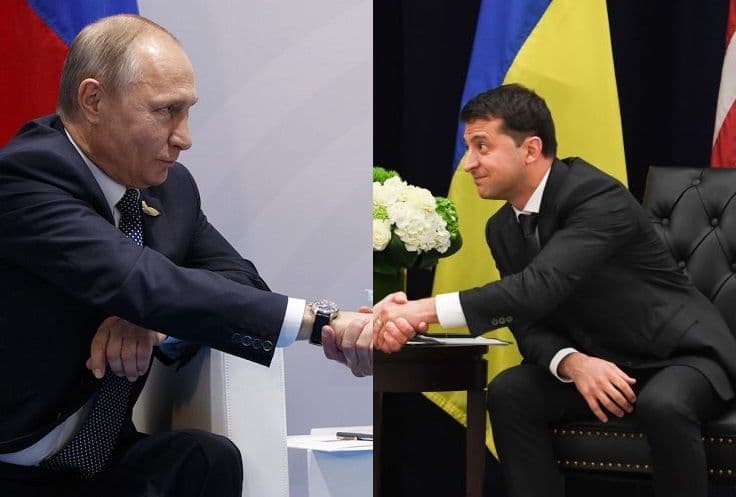
This market will resolve to "Yes" if Volodymyr Zelenskyy and Vladimir Putin talk by November 30, 2025, 11:59 PM ET. Otherwise, it will resolve to "No". A talk is defined as any interaction between Volodymyr Zelenskyy and Vladimir Putin, occurring either in person or through verbal communication by phone or video call. Events that occurred prior to the start of this market will not qualify toward its resolution. The resolution source will be a consensus of credible reporting.
Prediction markets currently give about a 1 in 3 chance that Ukrainian President Volodymyr Zelenskyy and Russian President Vladimir Putin will hold a direct conversation before the end of 2025. With the probability sitting near 34%, traders collectively view such talks as unlikely, but not impossible, within this timeframe. This reflects a significant degree of skepticism that the two leaders will break their long-standing diplomatic silence.
Several factors explain the low odds. First, Zelenskyy has maintained a firm public stance since the full-scale invasion began, stating negotiations are only possible after Russian forces withdraw from Ukrainian territory. His "peace formula" requires Russia to meet specific conditions first, which Putin has rejected.
Second, there has been no direct contact between the two presidents since early 2022. All diplomatic discussions have occurred through intermediaries or lower-level officials. The last known call was in February 2022, just before the invasion.
Finally, the current military and political situation does not suggest an imminent breakthrough. With the front lines largely static and both sides preparing for continued conflict, there is little visible pressure for top-level talks. Historical attempts at mediation, like those by Turkey or African nations, have not created the conditions for a leader-to-leader discussion.
While no specific meeting is scheduled, certain events could shift these predictions. The U.S. presidential election in November 2024 could change the dynamics of Western support for Ukraine, potentially altering the negotiation landscape. Major shifts on the battlefield, like the capture of a key city, might force a reevaluation by either side. Statements from major neutral intermediaries, such as China or Turkey, about organizing a summit would also be a strong signal to watch. The probability may drift as the December 2025 deadline approaches without a change in the war's status.
Prediction markets have a mixed but generally decent record on geopolitical questions, often aggregating expert opinion effectively. However, on high-stakes, unpredictable events like wartime diplomacy, they can be volatile and swayed by headlines. The 34% probability is not a scientific forecast, but it does represent the collective judgment of many people betting real money. It should be seen as a snapshot of informed sentiment, which can change quickly with unexpected news. The biggest limitation is that a single unpredictable decision by either leader could instantly make talks happen, regardless of what the market expects today.
Prediction markets assign a low 34% probability that Ukrainian President Volodymyr Zelenskyy and Russian President Vladimir Putin will hold a direct conversation by December 31, 2026. This price, translating to roughly a 1 in 3 chance, indicates traders view a diplomatic talk as possible but unlikely within the next two and a half years. The market has attracted moderate liquidity, with $460,000 in total volume, suggesting informed participants are actively weighing the odds.
The low probability directly reflects the entrenched positions of the warring parties. Zelenskyy's peace formula, which requires a full Russian withdrawal from Ukrainian territory as a precondition for talks, is fundamentally incompatible with Putin's goal of securing conquered land. Since the full-scale invasion began in 2022, the two leaders have not spoken once, a diplomatic deep freeze that markets see persisting. Historical precedent also weighs heavily. The failure of earlier negotiation attempts in 2022, such as those in Istanbul, demonstrated the vast gap between the sides' objectives. The current 34% price essentially represents the market's assessment of the likelihood that a major, unforeseen shift in the war's momentum could force one leader to abandon their core public stance.
Two primary catalysts could significantly alter this pricing. First, a decisive military outcome on the battlefield before late 2026 could create pressure for negotiations. A successful Ukrainian counter-offensive that reclaims significant territory might force Putin to the table, while a major Russian breakthrough could pressure Kyiv. Second, a change in political leadership in either capital, though not currently anticipated, would reset diplomatic possibilities. The U.S. presidential election in November 2024 is a near-term event that traders are monitoring closely, as a shift in Washington's policy on supporting Ukraine could alter the strategic calculus for both Kyiv and Moscow. The market's long time horizon until December 2026 accounts for the potential for such slow-moving but high-impact developments to unfold.
AI-generated analysis based on market data. Not financial advice.
This prediction market asks whether Ukrainian President Volodymyr Zelenskyy and Russian President Vladimir Putin will engage in any form of direct communication by November 30, 2025. The market defines a talk as any interaction, including in-person meetings, phone calls, or video conferences. The outcome will be determined by a consensus of credible reporting, excluding any communications that occurred before the market's creation. The question reflects a central diplomatic impasse in the Russia-Ukraine war. Direct talks between the two leaders have not occurred since the full-scale invasion began in February 2022, despite numerous international calls for negotiation. Zelenskyy has maintained that dialogue with Putin is impossible under current conditions, which include ongoing Russian occupation of Ukrainian territory. The potential for such a conversation is a major geopolitical indicator. It would signal a possible shift toward serious ceasefire or peace negotiations, or could represent a tactical discussion on specific issues like prisoner exchanges. International mediators, including Turkey and China, have periodically floated the idea of facilitating a summit. The market's interest stems from its function as a proxy for measuring the likelihood of a diplomatic breakthrough or a significant change in Ukraine's stated war aims. Investors are essentially betting on whether the fundamental condition for negotiations—direct leader-to-leader contact—will be met within the specified timeframe.
The last confirmed direct conversation between Zelenskyy and Putin occurred on February 24, 2022, the day of the full-scale invasion. According to Ukrainian officials, Putin called Zelenskyy and proposed surrender terms, which were rejected. This call marked the end of formal bilateral dialogue. Prior to that, the leaders had limited contact. They spoke by phone in July 2019, discussing a prisoner exchange and the conflict in Donbas. They also met briefly in person at the Normandy Format summit in Paris in December 2019, which also included the leaders of France and Germany. That summit aimed to revive the stalled Minsk peace agreements. The breakdown of the Minsk process, which was designed to end the conflict that began with Russia's 2014 annexation of Crimea and invasion of Donbas, set the stage for the larger war. Throughout 2021 and early 2022, diplomatic efforts failed to prevent the escalation, with the U.S. and NATO rejecting Russia's security demands. The historical precedent shows that talks have been rare and unproductive at the presidential level, with lower-level diplomatic channels and international formats being the primary venues for contact until they collapsed entirely in 2022.
The occurrence of a direct talk would be one of the most significant political events of the war. It would immediately reshape global diplomatic efforts, potentially moving discussions from abstract principles to concrete bargaining. Such a meeting could create a pathway to a ceasefire, which would have immediate humanitarian benefits for civilians in conflict zones and could begin to stabilize global food and energy markets that have been disrupted by the war. Conversely, a talk that fails to produce results could demoralize Ukrainian society and its international backers, or could be used by Russia to advocate for a reduction in Western military support for Ukraine under the guise of diplomacy. For global security, the outcome influences the perceived viability of military aggression as a tool for territorial expansion. A talk that leads to a settlement rewarding Russia could embolden other authoritarian states, while a talk that strengthens Ukraine's position could reinforce international norms. The decision of whether to talk is also deeply symbolic within Ukraine, representing a balance between the pursuit of victory and the pragmatism of ending bloodshed.
As of late 2024, there are no publicly known plans or ongoing preparations for a talk between Zelenskyy and Putin. Ukraine continues to promote its 10-point peace formula at international gatherings, the latest being a summit in Switzerland in June 2024. This framework calls for Russian withdrawal and a special tribunal, not bilateral talks. Russia has dismissed the Swiss summit. In September 2024, Putin reiterated his demand that Ukraine cede four regions as a precondition for peace, a non-starter for Kyiv. Mediation efforts by countries like Turkey and China remain active but have not yielded progress on arranging a leaders' meeting. The frontline remains largely static but active, with no military breakthrough that might force either side to the table.
Zelenskyy's official position is that talks can only begin after Russian forces withdraw to Ukraine's internationally recognized 1991 borders. This precondition is outlined in a presidential decree and has been consistently stated by Ukrainian officials.
Putin has stated he has never refused negotiations, but his terms include Ukraine recognizing Russia's annexation of Crimea and the Donetsk, Luhansk, Kherson, and Zaporizhzhia regions. Ukraine rejects these terms as a surrender of its sovereignty.
Turkey and China have been the most active mediators proposing to host a summit. Vatican officials have also made appeals. The United States has supported Ukraine's decision-making but has not publicly pushed for direct Zelenskyy-Putin talks.
According to Ukrainian officials, on February 24, 2022, Putin called Zelenskyy and suggested that Ukraine avoid bloodshed by capitulating. Zelenskyy reportedly responded by saying he would not surrender and would defend his country.
Yes, a limited discussion on a specific issue like a prisoner exchange is theoretically possible. However, such negotiations have historically been handled by intelligence agencies and lower-level officials, not the presidents directly.
Educational content is AI-generated and sourced from Wikipedia. It should not be considered financial advice.
2 markets tracked

No data available
| Market | Platform | Price |
|---|---|---|
![]() | Poly | 34% |
![]() | Poly | 7% |


No related news found
Add this market to your website
<iframe src="https://predictpedia.com/embed/a-O-Dg" width="400" height="160" frameborder="0" style="border-radius: 8px; max-width: 100%;" title="Will Zelenskyy talk to Putin by...?"></iframe>