$3.68K
1
1

1 market tracked

No data available
| Market | Platform | Price |
|---|---|---|
![]() | Poly | 18% |
Trader mode: Actionable analysis for identifying opportunities and edge
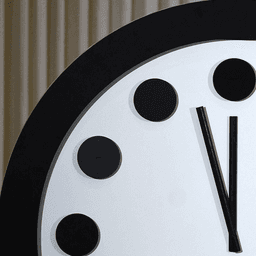
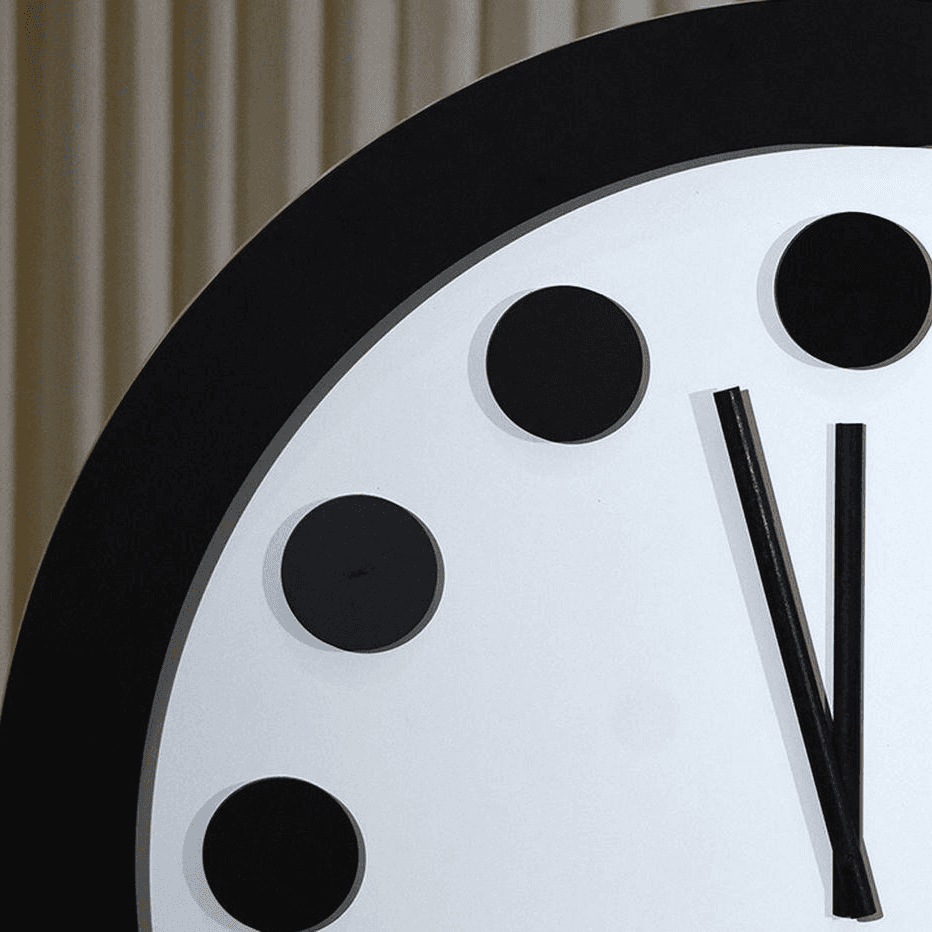
The Doomsday Clock is a symbolic clock face that represents the likelihood of a man-made global catastrophe, maintained since 1947 by the members of the Bulletin of the Atomic Scientists. The closer the clock is set to midnight, the closer the scientists believe the world is to global disaster. This market will resolve to "Yes" if the Doomsday Clock is moved by ten seconds or more in either direction (i.e. closer than 80 seconds to midnight, or farther than 98 seconds to midnight, see https://t
Prediction markets currently assign a 68% probability that the Doomsday Clock will move closer to midnight when the Bulletin of the Atomic Scientists announces its annual update. This price, translating to a 68-cent yes-share on Polymarket, indicates the market views a move toward catastrophe as more likely than not, but with significant uncertainty remaining. The market has seen moderate confidence with $36,000 in total volume, though liquidity remains thin, which can lead to price volatility.
Two primary factors are pushing the market toward a "yes" outcome. First, the clock has moved closer to midnight in three of the last four annual updates, currently resting at a historic 90 seconds to midnight, the closest it has ever been. This persistent trend reflects escalating geopolitical tensions, including ongoing major conflicts and a continued stagnation in nuclear arms control dialogues. Second, the Bulletin's recent statements have explicitly cited inadequate global action on climate change and the disruptive risks of artificial intelligence as accelerating threats. These multidimensional crises create a strong precedent for another symbolic move forward.
The primary catalyst is the official announcement, expected around January 23-24, 2025, based on historical timing. Odds could shift if major diplomatic breakthroughs occur before the announcement, such as a substantive new nuclear treaty or a joint global climate accord, which might justify the scientists holding the clock steady. Conversely, a significant escalation in an existing conflict or a new technological crisis before the decision could solidify the "yes" bet, potentially driving probabilities higher. The thin market liquidity means any new, salient news could cause sharp price movements in either direction in the final days.
AI-generated analysis based on market data. Not financial advice.
$3.68K
1
1
The Doomsday Clock is a symbolic representation of humanity's proximity to global catastrophe, maintained by the Bulletin of the Atomic Scientists since 1947. The clock's hands are adjusted periodically based on assessments of existential threats, primarily from nuclear weapons and climate change, but increasingly incorporating emerging technologies like artificial intelligence and biological threats. A movement of ten seconds or more represents a significant shift in the Bulletin's assessment of global risk, indicating either substantial deterioration or improvement in humanity's security situation. The current setting of 90 seconds to midnight, established in January 2023, represents the closest the clock has ever been to symbolic doom. Recent years have seen unprecedented volatility in the clock's movement, with the 2020 adjustment moving the clock from two minutes to 100 seconds to midnight, followed by further advances to 90 seconds in 2023. This market specifically tracks whether the next adjustment will constitute a major shift of ten seconds or more in either direction. Such movements historically correlate with major geopolitical events, technological breakthroughs, or significant policy changes affecting global security. The interest in this prediction market stems from the Doomsday Clock's status as a respected barometer of existential risk, maintained by Nobel laureates and leading scientists. Market participants are essentially betting on whether experts will perceive the global risk landscape as having fundamentally changed. The clock's movements generate international media coverage and often influence policy discussions, making predictions about its adjustments relevant to understanding expert consensus on global threats. Factors that could trigger a ten-second movement include escalation of nuclear conflicts, breakthrough climate agreements, major advances in AI governance, or catastrophic biological events. The market's resolution depends on the Bulletin's annual announcement, typically made in January, when the Science and Security Board assesses developments across multiple threat domains before deciding on the clock's new position.
The Doomsday Clock was created in 1947 by artist Martyl Langsdorf and Bulletin editor Eugene Rabinowitch, initially set at seven minutes to midnight. Its original purpose was to warn about nuclear annihilation following the atomic bombings of Hiroshima and Nagasaki. The clock remained relatively stable through the 1950s, with its first major movement occurring in 1953 when the United States and Soviet Union tested thermonuclear weapons, advancing the clock to two minutes to midnight, the closest it would come for decades. Throughout the Cold War, the clock reflected nuclear tensions, reaching three minutes to midnight during the Cuban Missile Crisis in 1962, though this wasn't officially reflected until the 1963 adjustment. The farthest the clock has ever been from midnight was 17 minutes in 1991 following the Strategic Arms Reduction Treaty and dissolution of the Soviet Union. This period of optimism was short-lived, as nuclear proliferation concerns brought the clock back to 14 minutes by 1995. The 21st century has seen the clock incorporate climate change as a major factor, with the 2007 adjustment explicitly citing this threat for the first time. The clock reached two minutes to midnight in 2018 and 2019, matching the Cold War peak, before advancing to 100 seconds in 2020, breaking the minute barrier for the first time. The 2023 adjustment to 90 seconds marked another unprecedented advance, reflecting multiple converging crises including the Ukraine war, climate disasters, and biological threats.
The Doomsday Clock serves as a crucial communication tool that translates complex risk assessments into an easily understood metaphor for policymakers and the public. When the clock moves significantly, it often triggers international diplomatic responses and influences funding priorities for risk mitigation. A ten-second movement represents a substantial shift in expert consensus about global security, potentially affecting everything from defense budgets to climate negotiations. Beyond its symbolic value, the clock's movements have real-world consequences for risk perception and preparedness. Insurance companies, investment firms, and government agencies monitor the clock as one indicator of systemic risk. Significant adjustments can affect markets, particularly in sectors vulnerable to geopolitical instability or climate regulation. The clock also shapes educational curricula and public awareness campaigns about existential threats, making its movements relevant to long-term societal resilience planning.
The Doomsday Clock remains at 90 seconds to midnight as announced in January 2023. The Bulletin of the Atomic Scientists cited multiple converging threats including the war in Ukraine, climate change impacts, biological risks, and disruptive technologies. In their 2024 statement, the Science and Security Board warned that 'the world is not only in danger, it is dangerously unstable.' Preparations are underway for the next annual assessment in late 2024, with the announcement expected in January 2025. Recent geopolitical developments, including nuclear posturing and climate agreement implementations, will likely influence the next adjustment.
The Bulletin of the Atomic Scientists' Science and Security Board, composed of experts in nuclear risk, climate change, and disruptive technologies, makes the final decision. They meet twice yearly and announce adjustments each January after assessing global threats.
Significant reductions in nuclear arsenals, major climate agreements with enforceable commitments, improved biological threat monitoring, or international governance frameworks for emerging technologies could move the clock backward. Historical backward movements followed arms control treaties and geopolitical détente.
The clock is not designed as a prediction tool but as a metaphor for current risk levels. It reflects expert assessment of existing threats rather than forecasting specific events. Its value lies in communicating complex risk assessments to the public and policymakers.
No, the clock has never reached midnight. The designers intended midnight to represent catastrophe, so reaching it would mean experts believe global disaster is inevitable. The closest settings have been 90 seconds in 2023 and 100 seconds from 2020-2022.
The clock has spent the most time at 7 minutes (12 years), 6 minutes (11 years), and 3 minutes (10 years) to midnight. These periods correspond to relatively stable but tense periods in Cold War and post-Cold War geopolitics.
While individuals don't directly affect the setting, public pressure on governments regarding nuclear disarmament, climate action, and technology governance can create conditions that might lead to clock adjustments. The Bulletin considers government policies and international agreements in its assessments.
Educational content is AI-generated and sourced from Wikipedia. It should not be considered financial advice.
Share your predictions and analysis with other traders. Coming soon!

No related news found
Add this market to your website
<iframe src="https://predictpedia.com/embed/bsyglY" width="400" height="160" frameborder="0" style="border-radius: 8px; max-width: 100%;" title="Will the Doomsday Clock move by ten seconds or more?"></iframe>