$269.42K
1
2

$269.42K
1
2
Trader mode: Actionable analysis for identifying opportunities and edge
This market will resolve to “Yes” if IMF PortWatch publishes a 7-day moving average of transit calls (“Arrivals of Ships”) for the Bab el-Mandeb Strait less than or equal to 10 for any date between market creation and the listed date. Otherwise, this market will resolve to “No”. This market will resolve as soon as IMF PortWatch publishes a 7-day moving average of transit calls for the Bab el-Mandeb Strait equal to or below 10, or once data has been published for the listed date and no such valu
AI-generated analysis based on market data. Not financial advice.
This prediction market addresses the potential closure of the Bab el-Mandeb Strait, a critical maritime chokepoint connecting the Red Sea to the Gulf of Aden and the Indian Ocean. The market specifically tracks data from the International Monetary Fund's PortWatch platform, which monitors global shipping activity. It resolves to 'Yes' if PortWatch publishes a 7-day moving average of ship arrivals at the strait at or below 10 for any date between the market's creation and its expiration. This low threshold indicates a near-total cessation of commercial maritime traffic, effectively representing a functional closure of the waterway. The strait is approximately 20 miles wide at its narrowest point, with shipping lanes only about 2 miles wide in places, making it highly vulnerable to disruption. Interest in this market stems from the ongoing security crisis in the region, primarily driven by attacks on commercial shipping by Yemen's Houthi movement. Since November 2023, the Houthis have launched dozens of drone and missile attacks against vessels transiting the Red Sea and the Bab el-Mandeb, citing solidarity with Palestinians in Gaza. These attacks have forced major shipping companies, including Maersk and MSC, to reroute vessels around the Cape of Good Hope, adding thousands of nautical miles and significant costs to global trade routes. The U.S. and U.K. have responded with military strikes against Houthi targets in Yemen, but the attacks have persisted. The market provides a quantifiable measure of the conflict's impact on global supply chains. A closure, as defined by the PortWatch metric, would signal a severe escalation with immediate consequences for energy markets, commodity prices, and inflation. Over 10% of global seaborne oil trade and an estimated $1 trillion in annual goods transit through this corridor. The market allows participants to bet on whether the Houthi campaign, combined with potential regional escalation, will succeed in shutting down one of the world's most important trade arteries.
The strategic importance of the Bab el-Mandeb Strait has been recognized for centuries, forming a key link on the trade route between Europe and Asia. In the modern era, its significance grew with the opening of the Suez Canal in 1869, which created a direct shortcut between the Mediterranean and the Red Sea. Control of the strait became a major geopolitical objective. During the Cold War, both the Soviet Union and the United States sought influence in the region surrounding the waterway. Recent history is marked by regional conflicts that have threatened shipping. During the Iran-Iraq War in the 1980s, both sides attacked tankers in the 'Tanker War,' though focused further north in the Persian Gulf. The Bab el-Mandeb has seen previous closures. In 1973, during the Yom Kippur War, Arab oil producers imposed an embargo and briefly blocked the strait. A more direct precedent occurred in 2018, when the Houthis temporarily threatened shipping by claiming to have mined the channel, though a full-scale, sustained campaign did not materialize at that time. The current crisis is the most prolonged and intense assault on freedom of navigation in the strait in over 50 years.
A functional closure of the Bab el-Mandeb Strait would have immediate and severe economic consequences. Rerouting ships around Africa adds roughly 3,500 nautical miles and 10-14 days to a voyage between Asia and Europe. This increases fuel consumption, shipping costs, and delays the delivery of everything from consumer electronics to automotive parts. The World Bank estimated in January 2024 that the crisis could add up to 1.2 percentage points to global core inflation if prolonged. Energy markets are particularly sensitive; any sustained disruption risks spiking oil and liquefied natural gas (LNG) prices. Politically, a closure represents a failure of international deterrence and empowers non-state actors to hold global trade hostage. It tests the credibility of naval powers like the U.S. and challenges the international legal principle of freedom of navigation. For Egypt, it threatens Suez Canal revenue, a critical source of foreign currency. For Yemen, it deepens the humanitarian crisis by potentially disrupting aid shipments and complicating peace efforts. The situation also risks a broader regional war, potentially drawing in Iran, which supports the Houthis, and Saudi Arabia, which shares a long border with Yemen.
As of late March 2024, the Bab el-Mandeb Strait remains open but highly dangerous for commercial shipping. Houthi attacks continue intermittently, with U.S. CENTCOM reporting new intercepts of drones and missiles on a near-weekly basis. Major container shipping lines largely maintain their avoidance policies, routing vessels around Africa. The IMF PortWatch data shows transit numbers significantly depressed compared to pre-crisis levels, though they fluctuate and have not yet sustained the sub-10 average that would trigger this market. The U.S.-led naval coalition continues patrols but has not been able to guarantee safe passage, leading to a de facto reduction in traffic driven by commercial risk assessment.
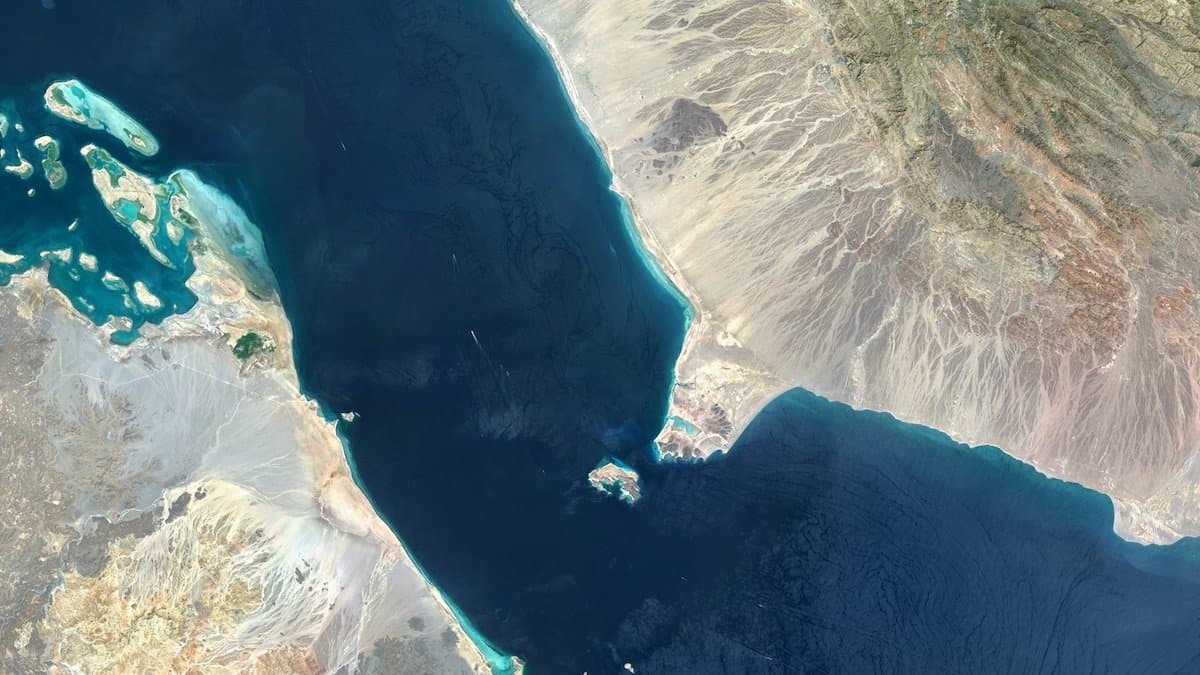
The Bab el-Mandeb Strait is a narrow sea passage between Yemen on the Arabian Peninsula and Djibouti and Eritrea in Africa. It connects the Red Sea to the Gulf of Aden and is a mandatory chokepoint for ships using the Suez Canal to travel between Asia and Europe. Its importance stems from this geographic position, which makes it a critical artery for global oil, gas, and container shipping.
The Houthis, formally known as Ansar Allah, are a Zaydi Shia political and military movement that controls most of northern Yemen, including the capital Sanaa. They began attacking ships in November 2023, stating their actions are in solidarity with Palestinians and will continue until Israel stops its war in Gaza and allows unfettered humanitarian aid. They claim to target only vessels linked to Israel, the U.S., or the U.K., but have attacked ships with vague or no links to these countries.
Educational content is AI-generated and sourced from Wikipedia. It should not be considered financial advice.
2 markets tracked

No data available
| Market | Platform | Price |
|---|---|---|
![]() | Poly | 44% |
![]() | Poly | 3% |


No related news found
Add this market to your website
<iframe src="https://predictpedia.com/embed/dAKA3v" width="400" height="160" frameborder="0" style="border-radius: 8px; max-width: 100%;" title="Bab el-Mandeb Strait effectively closed by...?"></iframe>