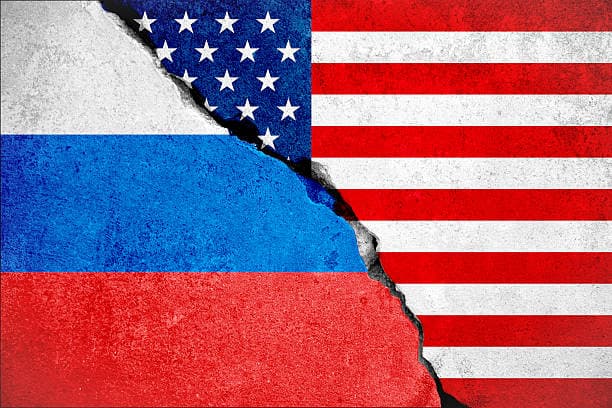
US x Russia military clash by...?
$1.81M
1
1
US x Russia military clash by...?
$1.81M
1
1
AI Analysis
Trader mode: Actionable analysis for identifying opportunities and edge
About This Event
This market will resolve to "Yes" if there is a military encounter between the military forces of the United States and Russia between May 28 and December 31, 2025, 11:59 PM ET. Otherwise, this market will resolve to "No". A "military encounter" is defined as any incident involving the use of force such as missile strikes, artillery fire, exchange of gunfire, or other forms of direct military engagement between U.S. and Russian military forces. Non-violent actions, such as airspace violations,
This saved analysis is awaiting a background update. Its prices and claims may be outdated; compare them with the dated market data above.
Current Market Outlook
Prediction markets price a US-Russia military clash by December 31, 2026 at just 6%. That means traders see this as a low-probability tail risk, not a central scenario. The $1.7 million in volume suggests serious money is behind this assessment, not casual speculation. For context, a 6% probability is roughly the same as the chance of a major earthquake in Tokyo on any given day. Possible. Not likely. But not zero either.
Key Factors Driving the Odds
Three structural realities keep this probability low. First, both nations maintain deconfliction channels. The US and Russia still communicate through the NATO-Russia Council and direct military hotlines, reducing the chance of accidental escalation. Second, neither side wants a direct conventional war. Ukraine proved that Russian conventional forces underperform expectations, while the US has no appetite for another major ground conflict. Third, nuclear deterrence remains the ultimate brake. Even a limited clash risks spiraling, and both militaries train to avoid that.
The 6% price also reflects specific recent history. US and Russian forces have operated in proximity in Syria for years without direct engagement. Near-misses happen. Intentional clashes don't. Traders are betting that pattern holds.
What Could Change These Odds
Watch three specific triggers. A NATO-Russia confrontation in the Baltic or Black Sea could spike odds quickly. If Russia tests Article 5 by attacking a NATO member, direct US engagement becomes likely. Second, a major escalation in Ukraine where Russian forces strike US supply lines or advisors would push odds toward 15-20%. Third, US election year dynamics could matter. A 2026 clash would occur during midterm election season, giving political incentives for either restraint or brinkmanship depending on the White House calculus.
The biggest risk to the 6% price is the "unknown unknown" scenario. A cyber attack misattributed to military action, a radar error triggering retaliation, or a proxy force escalation that neither side can walk back. These are the events that historically have started wars, and markets systematically underprice them.
AI-generated analysis based on market data. Not financial advice.
Saved Jul 10, 2026 UTCThis saved content is awaiting a background update. It may contain outdated claims; use the dated market data and provider rules for the latest available information.
Overview
This prediction market asks whether the United States and Russia will engage in a direct military clash between May 28 and December 31, 2025. A military encounter is defined as any incident involving the use of force, such as missile strikes, artillery fire, exchange of gunfire, or other direct military engagement between U.S. and Russian military forces. Non-violent actions, such as airspace violations or cyberattacks, are excluded. The market resolves to 'Yes' if such an encounter occurs within the specified timeframe, and 'No' otherwise. This topic reflects growing concerns about the risk of direct confrontation between two nuclear-armed superpowers, especially in the context of the ongoing war in Ukraine and other geopolitical flashpoints. The U.S. and Russia have avoided direct military clashes since the end of the Cold War, but the current environment is marked by heightened tensions, proxy conflicts, and increasing military posturing. The outcome of this market depends on a range of factors, including the trajectory of the Ukraine war, NATO's involvement, and potential incidents in regions like the Middle East or the Arctic. Interest in this topic is driven by the catastrophic implications of a direct U.S.-Russia conflict, which could escalate into a broader war with global consequences. Analysts, policymakers, and the public are closely watching for signs of miscalculation or accidental engagement that could trigger such an event.
Historical Context
The U.S. and Russia have a long history of military confrontations, but direct clashes have been rare since the end of the Cold War. During the Cold War, incidents like the 1962 Cuban Missile Crisis brought the two superpowers to the brink of war, but they avoided direct combat. The 1973 Yom Kippur War saw a brief U.S. military alert (DEFCON 3) due to Soviet threats, but no direct engagement. After the Soviet Union collapsed in 1991, tensions eased, but they resurfaced with Russia's 2014 annexation of Crimea and the war in Donbas. The 2018 U.S. airstrike on Syrian forces supporting Russian-backed troops was a close call, but both sides maintained de-confliction channels. The 2022 Russian invasion of Ukraine marked a new era of confrontation, with the U.S. providing intelligence, weapons, and training to Ukraine while avoiding direct military action. Incidents like the 2023 MQ-9 Reaper drone crash over the Black Sea after a Russian Su-27 fighter jet collision highlighted the risks of accidental engagement. The current situation is compared to the Cold War, but with fewer established communication channels and more complex proxy dynamics.
Why It Matters
A direct U.S.-Russia military clash would have catastrophic consequences, potentially escalating into a nuclear war. The two countries possess over 90% of the world's nuclear warheads, and any conflict could result in millions of deaths and global devastation. Economically, such a clash would disrupt global markets, energy supplies, and trade routes, leading to a severe recession. The Ukraine war has already caused energy price spikes and food shortages; a direct clash would amplify these effects. Politically, it would reshape alliances, with NATO likely invoking Article 5, drawing in European allies. The social impact would be immense, with widespread fear, displacement, and loss of life. The outcome of this market matters because it reflects the probability of a scenario that many consider the most significant security risk of the 21st century. Policymakers use such probabilities to assess risk and prepare contingency plans. For the public, it influences perceptions of safety and geopolitical stability.
Frequently Asked Questions
What would trigger a direct U.S.-Russia military clash?
A direct clash could be triggered by an accidental incident, such as a missile strike hitting a U.S. base in Poland or a Russian aircraft downing a U.S. drone. It could also be deliberate, such as a Russian attack on a U.S. ship in the Black Sea or a U.S. airstrike on Russian forces in Syria.
Have the U.S. and Russia ever fought directly?
Yes, during the Russian Civil War (1918-1920), U.S. forces intervened in Siberia and northern Russia. During the Cold War, they fought proxy wars but avoided direct combat. The last direct encounter was in 1968 when a U.S. Navy ship was attacked by Soviet aircraft, but no war followed.
What is the risk of nuclear war from a U.S.-Russia clash?
The risk is significant but not automatic. Both countries have nuclear doctrines that allow for first use in extreme circumstances. A conventional clash could escalate if one side faces defeat or if command-and-control systems are threatened. Analysts estimate a 1-5% chance of nuclear escalation from a conventional conflict.
AI-written background. References identify the evidence used; Wikipedia links under Learn More are additional reading. Prices and provider rules are dated snapshots. This is not financial advice.
Market Insights
Price gaps of 2 pp+
0
Saved price pairs
0
No exact saved pairs with both binary Yes prices are available.
Price differences do not establish arbitrage. Check each pair's review, current order prices, fees and settlement rules.