$158.82K
1
1

1 market tracked

No data available
| Market | Platform | Price |
|---|---|---|
![]() | Poly | 41% |
Trader mode: Actionable analysis for identifying opportunities and edge
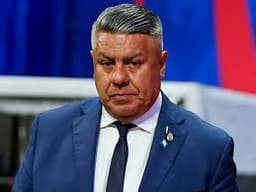
As of market creation, the 2026 FIFA World Cup is scheduled to end on July 19, 2026. This market will resolve to "Yes" if Claudio Fabián Tapia ceases to be President of the Argentine Football Association (AFA) for any length of time between this market's creation and July 19, 2026, 11:59 PM ET. Otherwise, this market will resolve to "No". An announcement of Tapia's resignation/firing before this market's end date will immediately resolve this market to "Yes", regardless of when the announced r
AI-generated analysis based on market data. Not financial advice.
$158.82K
1
1
This prediction market addresses whether Claudio Fabián Tapia will remain President of the Argentine Football Association (AFA) through the conclusion of the 2026 FIFA World Cup on July 19, 2026. The market resolves to 'Yes' if Tapia ceases to hold the presidency for any length of time before that deadline, including through resignation, termination, or any other form of removal. The AFA presidency is a position of immense power and scrutiny in Argentine football, responsible for overseeing the national teams, domestic league structure, and the country's vast footballing infrastructure. Tapia's tenure, which began in 2017, has been marked by significant on-field success for the Argentine national team, including winning the 2021 Copa América and the 2022 FIFA World Cup, but also by persistent internal political challenges, financial controversies, and conflicts with club presidents. Interest in this topic stems from the high-stakes political environment within Argentine football, where federation presidents often face pressure related to team performance, economic management, and alignment with powerful club interests, especially in the volatile period following a World Cup cycle. The 2026 World Cup endpoint serves as a natural political milestone, making Tapia's survival until that date a key question for observers of South American football governance.
The presidency of the AFA has historically been a turbulent position, often subject to political upheaval. Julio Grondona's 35-year reign from 1979 to 2014 created a long period of stability, but his death triggered a crisis. His successor, Luis Segura, served from 2014 to 2016 but was forced to step down after being indicted on fraud charges related to television rights deals, a scandal that deeply tarnished the institution. Armando Pérez led an interim normalizing committee in 2016 before Claudio Tapia was elected in 2017, promising transparency and modernization. Tapia's initial election was itself contentious, requiring multiple rounds of voting. His first term was marked by the financial fallout from the Segura era and the men's national team's failure at the 2018 World Cup. However, his re-election in 2019 and again in 2023 was bolstered by the national team's subsequent triumphs. The precedent set by Segura's removal demonstrates that AFA presidents can be ousted mid-term due to scandal or loss of confidence, not just electoral defeat. The typical AFA presidential term is four years, making Tapia's current mandate theoretically run through 2027, but historical precedent shows terms can be cut short.
The stability of the AFA presidency has direct consequences for the entire ecosystem of Argentine football. A leadership change could trigger a shift in domestic league policies, including formats, promotion/relegation rules, and revenue distribution models, affecting the economic health of dozens of professional clubs. It also influences the environment for the national teams. A period of political instability could disrupt planning and support for the men's team as it defends its World Cup title in 2026 and for the women's team amid its growing profile. Furthermore, the AFA manages substantial commercial contracts related to broadcasting, sponsorship, and licensing. Leadership uncertainty can jeopardize these agreements and the federation's financial stability, which in turn impacts investments in youth development, infrastructure, and player welfare programs. The outcome is closely watched by FIFA and CONMEBOL, as Argentina is a cornerstone of South American football, and governance issues there can have regional repercussions.
As of late 2024, Claudio Tapia remains firmly entrenched as AFA President, having been re-elected to a third term in 2023. His position is currently strengthened by the immense popularity and success of the Argentine national team. However, underlying tensions persist. Critical voices, including from media figures and some club executives, continue to question the federation's financial management and transparency. The focus is now shifting toward preparations for the 2026 World Cup and managing the transition of the national team as its legendary core ages. Any perceived misstep in these areas, or a significant downturn in the national team's results, could quickly reignite open challenges to his leadership.
The AFA president is elected by the General Assembly, which is composed of representatives from all the member professional football clubs. A simple majority is required. Presidents serve four-year terms, and there are no term limits.
Critics primarily focus on the AFA's high level of debt, alleged lack of transparency in contracts and finances, and his centralized management style. Others point to ongoing disputes with some major clubs over revenue sharing and league formats.
Yes. Luis Segura, who succeeded Julio Grondona, was forced to step down in 2016 after being indicted on fraud charges. This established a modern precedent for a mid-term departure outside of an election cycle.
The tournament is a major milestone. Success for Argentina would solidify his legacy and political capital. Early elimination or poor performance, however, could make him vulnerable to blame and erode the support he gains from the team's victories.
There is no official successor. The First Vice President would likely assume interim duties, but a permanent replacement would be chosen by the AFA General Assembly, with figures like Marcelo Tinelli or a major club president considered potential candidates.
Educational content is AI-generated and sourced from Wikipedia. It should not be considered financial advice.
Share your predictions and analysis with other traders. Coming soon!

No related news found
Add this market to your website
<iframe src="https://predictpedia.com/embed/fhqQMZ" width="400" height="160" frameborder="0" style="border-radius: 8px; max-width: 100%;" title="Claudio Tapia out as AFA President by July 19, 2026?"></iframe>