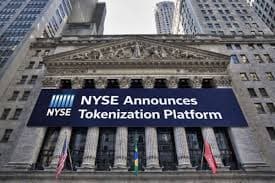
What chain will the NYSE choose for tokenized securities?
PM $4.4K
1
5
What chain will the NYSE choose for tokenized securities?
PM $4.4K
1
5
Current odds
Snapshot from
As of Oct 21, 2026, 3:00 AM UTC, the highest-priced outcome on Polymarket is Base at 43.3%.
Polymarket
- Base43.3%
- Ethereum36.8%
- Own Chain36.5%
- Multichain23%
- Solana19.8%
Yes prices. They are not order quotes; check each platform's rules, fees and live prices before trading.
AI Analysis
Trader mode: Market mechanics, assumptions and risks
PM $4.4K
Reported volume · provider units
5
Saved contracts
0
Same-question pairs
Source snapshot: Oct 21, 2026, 3:00 AM UTC
About This Event
NYSE has announced plans to launch a tokenized securities platform. More details can be found here: https://x.com/NYSE/status/2013263835549819097 This market will resolve to the blockchain that the New York Stock Exchange (NYSE) officially confirms it will use for the settlement of its tokenized securities platform. An official announcement, regulatory filing, or public statement from NYSE or ICE explicitly naming a blockchain will qualify for resolution and will trigger immediate resolution, regardless of whether additional blockchains are announced later. If multiple blockchains are officially confirmed at the time of the first qualifying announcement, this market will resolve to “Multichain.” If NYSE or ICE confirms the use of its own blockchain developed by or for NYSE/ICE—whether public or private, and whether developed independently or in partnership—this market will resolve to “Own Chain.” The primary resolution sources will be official announcements from NYSE or ICE, regulatory filings, or a broad consensus of credible reporting. If no blockchain is officially confirmed by December 31, 2026, 11:59 PM ET, this market will resolve to “Other.”
This analysis is awaiting a background update, so its prices may be older than the odds above.
Snapshot observed 2026-10-15T16:13:13.851Z. This analysis describes that snapshot and is not a live news update.
What the contract measures
The Polymarket event asks which blockchain the New York Stock Exchange will officially confirm for settling its tokenized securities platform [1]. The rules say the market resolves to the chain NYSE or ICE officially confirms, through an announcement, regulatory filing, or public statement [1]. If several chains are confirmed at the time of the first qualifying announcement, it resolves to "Multichain." If the chain is developed by or for NYSE or ICE, it resolves to "Own Chain." If nothing is confirmed by December 31, 2026, 11:59 PM ET, it resolves to "Other" [1]. The listed end time is 2027-01-01T05:00:00.000Z [1]. That is a closing time in the contract data, not an announced event date.
Reading the snapshot
The saved data was observed at 2026-10-15T16:13:13.851Z and retrieved at 2026-10-15T18:11:57.209Z [1]. These prices describe that observation only and may not match current trading. The five saved markets are Base (Yes 0.411), a multichain setup (Yes 0.385), an NYSE-owned chain (Yes 0.375), Ethereum (Yes 0.3505), and Solana (Yes 0.298) [1]. They are ordered by Yes price, so the order shows relative ranking within this snapshot only.
These are separate yes/no contracts, not a single distribution. Their Yes prices do not need to add to one, and the multichain and own-chain contracts can overlap with specific-chain contracts under the rules. Prices here are indicative snapshots, not executable quotes or verified probabilities. The saved volume data is not included here, and volume would not measure liquidity or the number of traders anyway.
What remains uncertain
The saved sample includes all five markets for this event, and the sample is not marked partial [1]. However, the data does not establish that the provider lists every possible outcome. The "Other" outcome described in the rules does not appear among the saved markets, so no price for it is available in this evidence. Nothing here explains why prices sit where they do, and no recent announcements or further developments are included in the supplied material. Readers should check the current contract page and the official sources named in the rules before drawing conclusions.
References
- Polymarket: What chain will the NYSE choose for tokenized securities?. Provider data observed 2026-10-15T16:13:13.851Z.
AI-generated analysis based on market data. Not financial advice.
Saved Oct 15, 2026 UTCAI-written background. References identify the evidence used; Wikipedia links under Learn More are additional reading. Prices and provider rules are dated snapshots. This is not financial advice.
Related prediction markets
Prices are catalog snapshots and may have changed. Check each market's rules and observation time.
First to list tokenized stocks in the US?
PM $83.8K
Tokenized stocks available on Robinhood by ___?
PM $8.8K
Tokenized stocks available on Coinbase by ___?
PM $5.4KWill Robinhood Chain launch a token by ___?
PM $21.9K
What will Vlad Tenev say during NYT DealBook Summit?
K 1.6K contracts
What will Mastercard say during their next earnings call?
K 1.3K contractsMarket Insights
Price gaps of 2 pp+
0
Same-question pairs
0
No outcomes on this page have been reviewed as the same question on both platforms yet.
Price differences do not establish arbitrage. Check each pair's review, current order prices, fees and settlement rules.