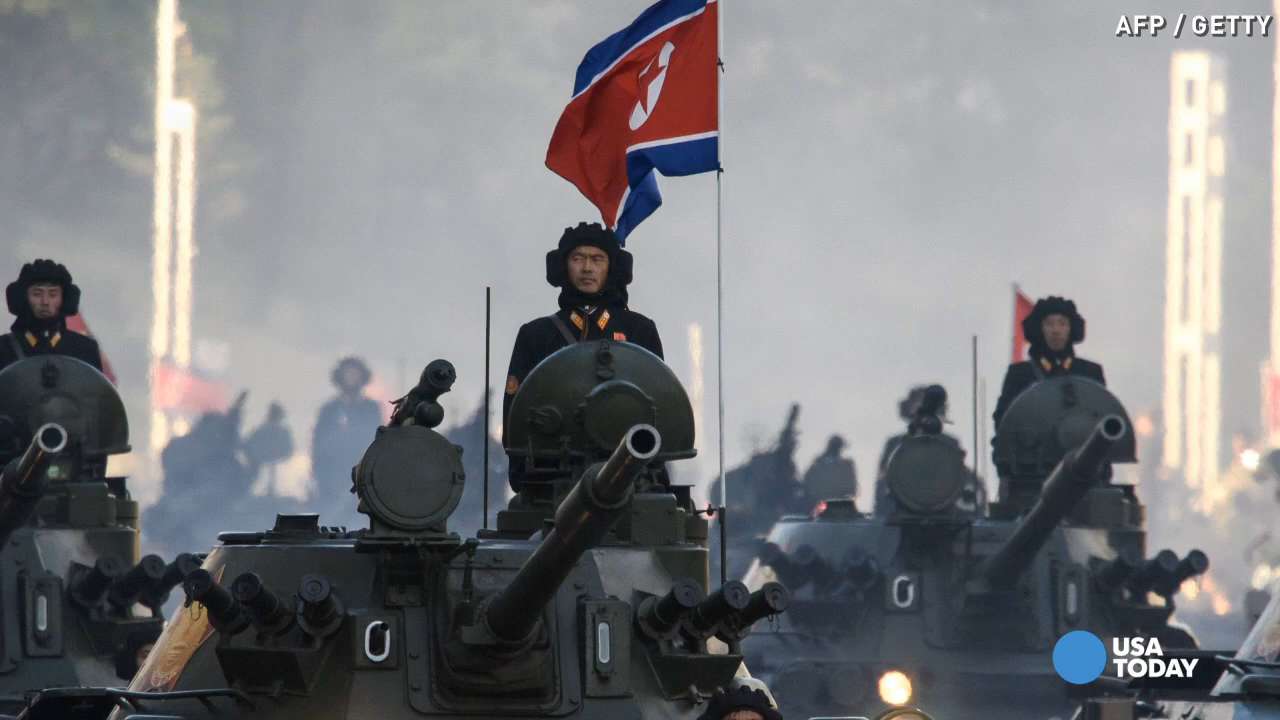
Will North Korea invade South Korea before 2027?
$449.17K
1
1
Will North Korea invade South Korea before 2027?
$449.17K
1
1
AI Analysis
Trader mode: Actionable analysis for identifying opportunities and edge
About This Event
This market will resolve to "Yes" if North Korea commences a military offensive intended to establish control over any portion of the South Korea by December 31, 2026, 11:59 PM ET. Otherwise, this market will resolve to "No". The resolution source for this market will be will be official confirmation by South Korea, North Korea, the United Nations, or any permanent member of the UN Security Council, however a consensus of credible reporting will also be used.
This saved analysis is awaiting a background update. Its prices and claims may be outdated; compare them with the dated market data above.
Current Market Outlook
Polymarket prices a North Korean invasion of South Korea before 2027 at just 7%. That means the market sees a full-scale military offensive as highly unlikely, roughly a 1-in-14 chance. With only $61,000 in volume, this is a thin market, so the 7% figure carries less conviction than a heavily traded contract would. Still, the direction is clear: traders are not seriously pricing in a Korean War restart.
The resolution window closes December 31, 2026, leaving about 142 days of trading. The contract requires an offensive "intended to establish control over any portion" of South Korea, which excludes border skirmishes, artillery exchanges, or cyberattacks. That's a high bar, and the market is treating it as such.
Key Factors Driving the Odds
The 7% price reflects a few structural realities. First, North Korea's military is conventionally inferior to the South Korean and American forces stationed on the peninsula. The U.S. maintains roughly 28,500 troops in South Korea, and the combined forces would likely overwhelm the North in any conventional fight. Kim Jong Un knows this, which is why Pyongyang's doctrine has shifted toward nuclear deterrence and asymmetric threats rather than territorial conquest.
Second, China's position matters. Beijing has no interest in a collapsed North Korean state or a war on its border that could send millions of refugees into Chinese territory. China's backing is the North's lifeline, but it also restrains Kim from launching an offensive that would force Beijing into an unwinnable choice.
Third, the market's timeline covers only 142 days. The probability of any major strategic decision happening in that narrow window is inherently low. Wars don't typically start without months of buildup, troop movements, and diplomatic signaling, none of which are currently visible.
What Could Change These Odds
The obvious catalyst is a miscalculation escalating into conflict. North Korea has a history of provocations, including the 2010 shelling of Yeonpyeong Island and the 2024 border road demolitions. If a skirmish spirals, the market could spike toward 15-20%.
Political instability in the South is another factor. South Korea's martial law crisis in December 2024 created a leadership vacuum that Pyongyang could theoretically exploit, though the military alliance with the U.S. remains intact regardless of who sits in the Blue House.
The nuclear question cuts both ways. If Kim believes his nuclear arsenal neutralizes U.S. intervention, he might calculate a conventional attack is survivable. That logic is flawed, but it's the kind of thinking that starts wars. Watch for any shift in U.S. force posture or a breakdown in the UN Command structure, both of which would signal the market's 7% is too low.
AI-generated analysis based on market data. Not financial advice.
Saved Aug 11, 2026 UTCThis saved content is awaiting a background update. It may contain outdated claims; use the dated market data and provider rules for the latest available information.
Overview
The question of whether North Korea will invade South Korea before 2027 is a perennial concern in international security, rooted in the unresolved Korean War and the continued military standoff along the Demilitarized Zone (DMZ). Since the 1953 armistice, the two Koreas have remained technically at war, with the North periodically engaging in provocations ranging from naval skirmishes and artillery shelling to cyberattacks and nuclear tests. The possibility of a full-scale invasion is considered low by most analysts due to the overwhelming conventional and nuclear superiority of the U.S.-South Korea alliance, yet the North's advancing missile and nuclear capabilities, combined with its unpredictable leadership, keep the scenario on the table for contingency planners. The market's resolution criteria specify any military offensive intended to establish control over South Korean territory, which would encompass not only a ground invasion but also amphibious landings, airborne operations, or a massed artillery barrage followed by ground forces crossing the border. The timeline extends to December 31, 2026, meaning the market covers the remainder of the current South Korean administration under President Yoon Suk Yeol and part of the next U.S. presidential term, adding political variables that could influence risk calculations in Pyongyang. Recent developments, such as North Korea's 2022 and 2023 missile tests, the adoption of a nuclear law that authorizes preemptive strikes, and the closing of border liaison offices, have heightened tensions, but they also reflect a strategy of coercion and diplomacy rather than an immediate war footing. The market's interest lies in the intersection of deterrence, diplomacy, and the possibility of miscalculation, especially given the North's economic isolation and its leader Kim Jong Un's stated goal of achieving 'the world's most powerful' nuclear force. Analysts point to the absence of large-scale troop movements or logistics preparations as evidence that an invasion is not imminent, but the historical record of surprise attacks, such as the 1950 invasion, cautions against complacency. The market also captures the broader geopolitical stakes, including the role of China as North Korea's main ally, the U.S. commitment to defend South Korea under the Mutual Defense Treaty, and the potential for a regional conflict that could draw in multiple powers. As the deadline approaches, the market will reflect changing assessments based on intelligence indicators, diplomatic signals, and the trajectory of North Korea's weapons programs, making it a real-time barometer of one of the most consequential security questions in East Asia.
Historical Context
The Korean War (1950-1953) ended with an armistice, not a peace treaty, leaving the two Koreas technically at war. The invasion of South Korea on June 25, 1950, by North Korean forces was a surprise attack that nearly conquered the entire peninsula before UN forces intervened. Since then, the DMZ has been one of the most heavily fortified borders in the world, with millions of landmines, barbed wire, and military personnel on both sides. The Korean Armistice Agreement established a Military Demarcation Line and a Joint Security Area, but no formal peace has been concluded. Over the decades, North Korea has engaged in numerous provocations, including the 1968 Blue House raid, the 1976 axe murder incident, the 1987 bombing of a South Korean airliner, and the 2010 shelling of Yeonpyeong Island, which killed four South Koreans. These incidents have escalated tensions but have not escalated to full-scale war, partly because of the overwhelming U.S.-South Korea conventional and nuclear superiority and the fear of escalation to a nuclear conflict. North Korea's nuclear program, which began in the 1990s, has progressed through several crises, including the 1994 Agreed Framework, the 2003 withdrawal from the NPT, and the 2006 first nuclear test. Under Kim Jong Un, the regime has conducted multiple nuclear tests and developed a credible intercontinental ballistic missile (ICBM) capability, with tests of the Hwasong-15 and Hwasong-17 missiles in 2017 and 2022, respectively. The 2018-2019 period saw a diplomatic thaw with summits between Kim and South Korean President Moon Jae-in and U.S. President Donald Trump, but the talks collapsed over differences on denuclearization and sanctions relief. Since 2022, North Korea has increased missile testing to record levels, passing a law in September 2022 that allows for preemptive nuclear strikes under certain conditions, and has declared itself a nuclear weapons state, which many see as a step toward de facto acceptance of its arsenal. The historical pattern suggests that North Korea uses provocations as a coercive tool to extract concessions, but the possibility of miscalculation or escalation remains a central concern in assessing the likelihood of an invasion.
Why It Matters
A North Korean invasion of South Korea would have catastrophic consequences, not only for the Korean Peninsula but for the entire world. The Seoul Capital Area, with a population of over 25 million, lies within artillery range of North Korean guns, and a conflict would likely cause massive casualties and destruction. The economic impact would be severe: South Korea is the 10th largest economy in the world, a major exporter of semiconductors, automobiles, and electronics, and a key node in global supply chains. A war would disrupt global trade, technology production, and financial markets, potentially triggering a worldwide recession. The human cost would be staggering, with millions of refugees and the potential for chemical or nuclear weapons use. Moreover, the U.S. would be involuntarily drawn into the conflict under the Mutual Defense Treaty, risking escalation to a larger war involving China and potentially Russia. The geopolitical ramifications would reshape alliances and security arrangements in the Asia-Pacific, possibly leading to a nuclear-armed Japan or South Korea, and a re-evaluation of U.S. commitments in the region. For the prediction market, the question of an invasion before 2027 is not just a hypothetical but a test of deterrence and crisis stability in a region with high stakes. The outcome affects defense planning, military deployments, and the lives of millions, making it a topic of intense interest to policymakers, investors, and the public. The market's timeline, ending in 2026, captures a period of potential political transition in the U.S. and South Korea, which could alter the strategic calculus in Pyongyang. Even if the probability of invasion is low, the tail risk is so severe that it warrants serious attention and preparedness. Understanding the factors that could lead to an invasion, and the indicators that would precede it, is essential for early warning and prevention, and the market provides a mechanism for aggregating expert and public assessments of these risks.
AI-written background. References identify the evidence used; Wikipedia links under Learn More are additional reading. Prices and provider rules are dated snapshots. This is not financial advice.
Market Insights
Price gaps of 2 pp+
0
Saved price pairs
0
No exact saved pairs with both binary Yes prices are available.
Price differences do not establish arbitrage. Check each pair's review, current order prices, fees and settlement rules.