$512.80K
1
2

$512.80K
1
2
Trader mode: Actionable analysis for identifying opportunities and edge
This market will resolve to "Yes" if Israel initiates a major ground offensive in Gaza between May 5, 9:00 PM ET, and May 13, 2025, 11:59 PM ET. Otherwise, this market will resolve to "No". A "major ground offensive" is defined as a large-scale military operation that involves more than 1,000 Israeli ground forces entering Gazan territory that was not under Israeli control at the start of the offensive. This excludes smaller raids, special operations, or limited incursions directly bordering bu
The prediction market currently prices a 45% probability that Israel will launch a major ground offensive in Gaza by December 31. This price, trading on Polymarket, indicates the market views the event as essentially a coin flip, with significant uncertainty about Israel's military strategy. The market has attracted moderate liquidity, with over $500,000 in volume, suggesting traders are actively weighing the available intelligence.
Two primary factors are suppressing the "Yes" probability below 50%. First, international pressure, particularly from the United States, has been a consistent brake on large-scale Israeli operations in Gaza throughout 2024. Public disagreements between U.S. and Israeli officials over the scope of the Rafah operation demonstrate this dynamic. Second, the market may be pricing in a prolonged phase of lower-intensity conflict, characterized by targeted raids and aerial campaigns, which Israeli officials have described as a shift to "mowing the grass" tactics rather than initiating new major invasions. The current 45% price reflects a belief that these restraining factors are strong but not decisive.
The odds are highly sensitive to geopolitical events and intelligence reports. A major escalation by Hezbollah in the north, involving sustained rocket barrages into Israeli cities, could force Israel's hand and trigger a broader ground campaign in Gaza as part of a multi-front strategy. Conversely, a breakthrough in hostage negotiations or a formal, U.S.-backed ceasefire agreement would cause the "No" probability to surge. The market will react sharply to official statements from the Israeli war cabinet or the U.S. State Department in the coming weeks. The resolution date of December 31 creates a defined timeline, with odds likely to become more volatile as the deadline approaches and seasonal or political calendars are considered.
AI-generated analysis based on market data. Not financial advice.
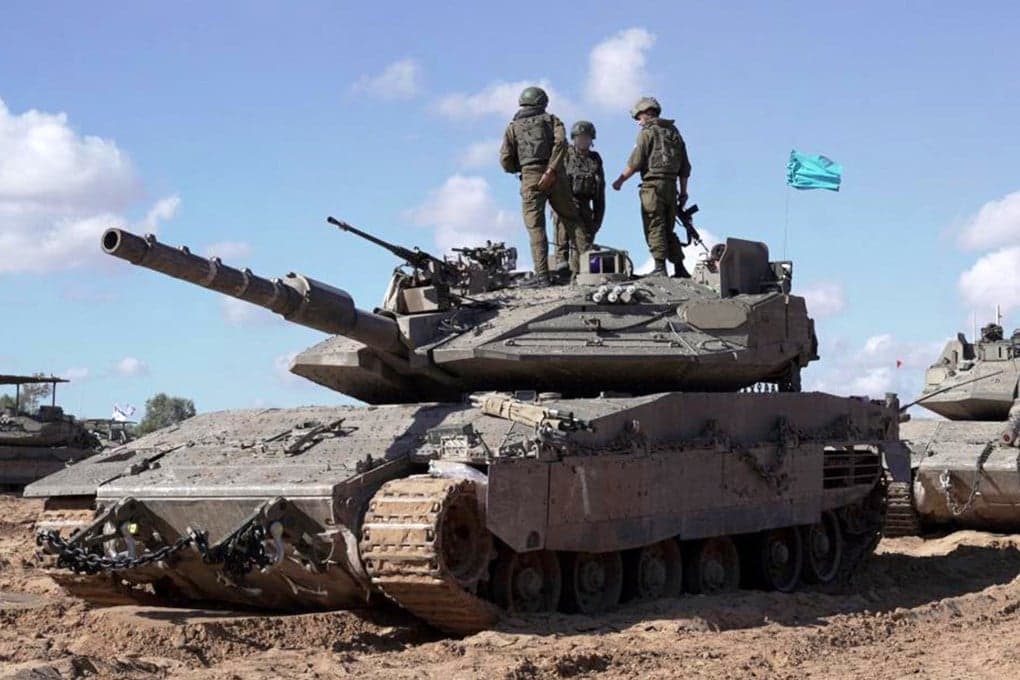
This prediction market asks whether Israel will launch a major ground offensive into the Gaza Strip between May 5 and May 13, 2025. A 'major ground offensive' is specifically defined as a large-scale military operation involving more than 1,000 Israeli ground forces entering Gazan territory not under Israeli control at the start of the period. This excludes smaller raids, special operations, or limited incursions along the border. The question arises from a prolonged period of conflict and tension following the October 7, 2023, Hamas-led attack on Israel, which triggered a major Israeli military campaign in Gaza. The conflict has involved intense aerial bombardment and previous ground operations, but the potential for a new, large-scale ground invasion remains a subject of intense international speculation and concern. Interest in this market stems from its implications for regional stability, humanitarian conditions in Gaza, and the political futures of Israeli and Palestinian leadership. Analysts monitor Israeli government statements, military troop movements, and diplomatic efforts, particularly those involving Egypt, Qatar, and the United States, to gauge the likelihood of such an offensive.
The current conflict is rooted in the long-standing Israeli-Palestinian dispute over territory and sovereignty. Israel captured the Gaza Strip from Egypt in the 1967 Six-Day War. It withdrew all Israeli settlers and military forces from inside Gaza in 2005 but maintained control of its airspace, coastline, and most border crossings. Hamas won Palestinian legislative elections in 2006 and seized full control of Gaza from the Fatah-led Palestinian Authority in 2007, leading to a blockade by Israel and Egypt. Since then, several major rounds of conflict have occurred. Operation Cast Lead was a three-week ground offensive from December 2008 to January 2009. Operation Pillar of Defense in 2012 was primarily an air campaign. Operation Protective Edge in 2014 involved a seven-week conflict with a significant ground component aimed at destroying Hamas tunnel networks. The October 7, 2023, attack was the deadliest single day for Israel since its founding, with approximately 1,200 people killed and over 240 taken hostage. Israel's subsequent military response, Operation Swords of Iron, began with aerial strikes and expanded into a large-scale ground invasion of northern Gaza in late October 2023. Israeli forces have since conducted ground operations across much of the territory, but Hamas's leadership and a significant number of fighters are believed to remain in the southern city of Rafah.
A major new ground offensive would have severe humanitarian consequences. Over 1.4 million displaced Palestinians are currently sheltering in Rafah, according to UNRWA, the UN agency for Palestinian refugees. A large-scale military operation there would likely cause high civilian casualties and further disrupt the already critically limited flow of food, water, and medicine into Gaza. The potential for regional escalation would increase, particularly regarding confrontations with Hezbollah in Lebanon or Iranian-backed groups in Syria and Iraq. Politically, an offensive could fracture Israel's relations with key allies like the United States and Egypt, and destabilize the already fragile Palestinian Authority. It could also determine the political survival of Prime Minister Netanyahu, who is balancing war aims against domestic and international pressure. For global markets, prolonged conflict risks disrupting shipping in the Red Sea due to Houthi attacks, impacting energy prices and supply chains.
As of late April 2025, Israel has conducted airstrikes in Gaza but has not initiated a new ground offensive on the scale defined by this market. Israeli leaders continue to state that an operation in Rafah is necessary to defeat Hamas battalions there, but they have not announced a definitive timeline. Indirect negotiations for a ceasefire and hostage exchange, mediated by Qatar and Egypt with U.S. involvement, are ongoing but have repeatedly stalled. The Israeli military has called up reserve units for training, which analysts interpret as preparation for potential expanded operations. International diplomatic pressure to avoid a Rafah operation remains high, with the U.S. proposing alternatives focused on targeted counter-terrorism raids.
A raid is a limited, temporary incursion by a smaller force, often for a specific mission like rescuing hostages or targeting a particular commander. A major ground offensive, as defined for this market, involves over 1,000 troops entering territory not under Israeli control with the objective of seizing and holding ground, dismantling enemy forces, and altering the strategic picture.
Rafah is the last major population center in Gaza where Israeli ground forces have not yet operated in full strength. Israeli intelligence believes several Hamas battalions, senior leaders, and possibly hostages are located there. It is also the primary entry point for humanitarian aid via Egypt, making any military operation there logistically and politically complex.
The U.S. provides substantial military aid and diplomatic cover for Israel. While it cannot veto Israeli operations, public warnings from President Biden and the potential delay or conditioning of arms shipments can affect the timing, scope, and international legitimacy of an Israeli ground offensive.
Proponents argue it is necessary to destroy Hamas's remaining organized military units, pressure them to release hostages, and achieve the war's stated goals. Opponents cite the high risk of civilian casualties, the potential collapse of humanitarian aid, the threat to hostage safety, and the risk of broader regional war.
No. As of April 2025, Israel maintains a military presence along a corridor that splits Gaza, controls key crossing points, and conducts regular raids into various areas. However, it has reduced its troop levels from the peak of its earlier ground invasion, which involved multiple divisions.
Educational content is AI-generated and sourced from Wikipedia. It should not be considered financial advice.
2 markets tracked

No data available
| Market | Platform | Price |
|---|---|---|
![]() | Poly | 45% |
![]() | Poly | 30% |


No related news found
Add this market to your website
<iframe src="https://predictpedia.com/embed/tsshr6" width="400" height="160" frameborder="0" style="border-radius: 8px; max-width: 100%;" title="Will Israel launch a major ground offensive in Gaza by...?"></iframe>