$9.13K
1
1

1 market tracked

No data available
| Market | Platform | Price |
|---|---|---|
![]() | Poly | 10% |
$9.13K
1
1
Trader mode: Actionable analysis for identifying opportunities and edge
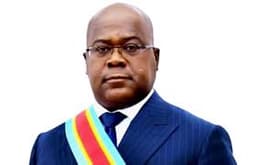
This market will resolve to “Yes” if Félix Tshisekedi ceases to be President of the Democratic Republic of the Congo for any period of time between market creation and the specified date (ET). Otherwise, this market will resolve to “No”. An announcement of Félix Tshisekedi's resignation/removal before this market's end date will immediately resolve this market to "Yes", regardless of when the announced resignation/removal goes into effect. If the specified individual is detained, effectively r
AI-generated analysis based on market data. Not financial advice.
This prediction market asks whether Félix Tshisekedi will cease to be President of the Democratic Republic of the Congo (DRC) before December 31, 2026. The market resolves to 'Yes' if he resigns, is removed from office, dies, or is otherwise replaced as president during this period. Tshisekedi began his first term in January 2019 following a contested election and was sworn in for a second term in January 2024 after winning the December 2023 presidential election with 73.34% of the vote, according to the national electoral commission. His second term is scheduled to last until 2028. The question of his potential departure from office before 2026 centers on the DRC's volatile political environment, ongoing conflict in the eastern regions, and historical patterns of political instability. Interest in this market stems from the DRC's strategic importance as Africa's second-largest country by area, a major global producer of cobalt and copper, and a nation with a history of contested transitions of power. Observers monitor risks including potential constitutional crises, military coups, health issues, or pressure from armed groups that could disrupt his presidency.
The Democratic Republic of the Congo has experienced frequent and often violent changes in leadership since independence from Belgium in 1960. The country's first prime minister, Patrice Lumumba, was overthrown and assassinated in 1961. Mobutu Sese Seko seized power in a 1965 coup and ruled for 32 years until his overthrow in 1997 by Laurent-Désiré Kabila. Laurent Kabila was assassinated in 2001 and succeeded by his son, Joseph Kabila. Joseph Kabila's 18-year presidency, which followed the Second Congo War (1998-2003), ended with the disputed 2018 election that brought Félix Tshisekedi to power. That election was the DRC's first peaceful transfer of power since independence, though it was widely contested by opposition figures and observers from the Catholic Church, who claimed Martin Fayulu was the true winner. The constitutional framework has been tested before. In 2001, the Supreme Court affirmed Joseph Kabila's succession after his father's assassination. A 2006 constitution established a semi-presidential system with a five-year presidential term limit. Public protests in 2015-2016 forced Joseph Kabila to adhere to term limits after he attempted to extend his rule, leading to the 2018 election. This history shows that presidential transitions in the DRC are rarely smooth and often involve extra-constitutional elements.
The stability of the DRC presidency has direct consequences for over 100 million Congolese citizens and the wider Central African region. A premature departure of President Tshisekedi could trigger a constitutional crisis or power vacuum, potentially exacerbating the ongoing conflict in the east where over 120 armed groups operate. This conflict has displaced nearly 7 million people internally. Economically, the DRC is the world's largest producer of cobalt, supplying about 70% of global output, and a major source of copper. Political instability could disrupt these critical supply chains for electric vehicle batteries and electronics, affecting global markets. A change in leadership could also alter the DRC's foreign policy stance, particularly its relationships with neighboring Rwanda and Uganda, which are accused of supporting rebel groups, and with international partners like China, the United States, and the European Union. Domestically, a transition could delay or reverse anti-corruption initiatives and the renegotiation of major mining contracts, which are central to Tshisekedi's economic agenda.
As of mid-2024, Félix Tshisekedi is serving the first year of his second term. The political landscape is tense, with opposition leaders Martin Fayulu and Moïse Katumbi continuing to reject the legitimacy of the 2023 election results. The security situation remains dire in eastern DRC, particularly in North Kivu province, where the Congolese army, supported by UN peacekeepers and troops from the Southern African Development Community (SADC), is fighting the M23 rebel group. In late 2023, Tshisekedi authorized the departure of the long-standing UN peacekeeping mission, MONUSCO, to be replaced by a smaller, more offensive-oriented force. Economically, the government is pursuing a review of mining contracts, notably a $6.2 billion infrastructure-for-minerals deal with China, which could create domestic political friction.
According to Article 75 of the Congolese Constitution, if the presidency becomes vacant due to death, resignation, or permanent incapacity, the President of the National Assembly temporarily assumes the role of Head of State. A new presidential election must then be organized within 90 days.
Yes. The DRC, formerly Zaire, has experienced several coups. The most significant include Joseph-Désiré Mobutu's coup in 1965, which began his 32-year rule, and Laurent-Désiré Kabila's overthrow of Mobutu in 1997. The last successful military coup was in 1997.
The constitution limits the president to two five-year terms. Tshisekedi was first elected in 2018 and re-elected in 2023. His current and final term is scheduled to end in January 2028, barring any early termination.
The eastern DRC, especially North Kivu province, has been in conflict for nearly 30 years involving numerous armed groups. The current major conflict is between the Congolese army and the M23 rebel group, which the DRC government accuses Rwanda of backing, a claim Rwanda denies.
Educational content is AI-generated and sourced from Wikipedia. It should not be considered financial advice.
No related news found
Add this market to your website
<iframe src="https://predictpedia.com/embed/wNkHVP" width="400" height="160" frameborder="0" style="border-radius: 8px; max-width: 100%;" title="Tshisekedi out as President of the DRC by December 31, 2026?"></iframe>