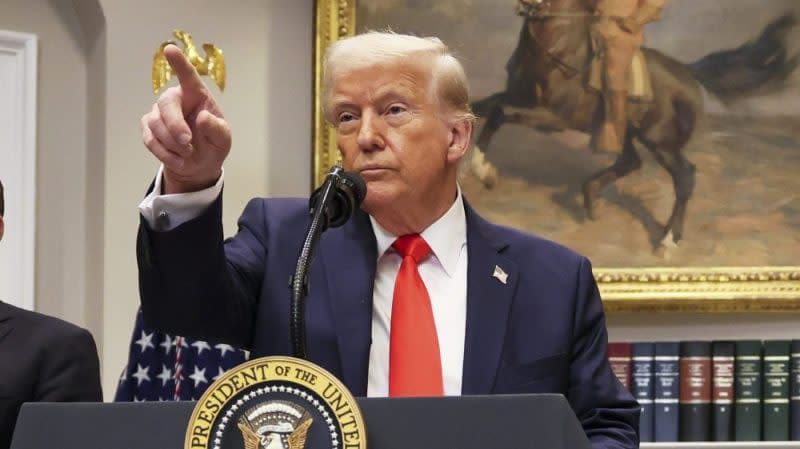
Who will leave their role in the Trump administration in 2026?
$0.00
1
32
Who will leave their role in the Trump administration in 2026?

$0.00
1
32
AI Analysis
Trader mode: Actionable analysis for identifying opportunities and edge
About This Event
before 2027 If X leaves as Y before 2027, then the market resolves to Yes. X Y must have an actual departure date by vacating the role within the time period. If the person leaves the role due to death, i.e., if the person dies while holding the role, all contracts on the person may resolve to the last fair price as determined in the sole discretion of the Exchange. Temporary leaves of absence, suspensions, or recusals do not constitute leaving, resigning from, or retiring from the role unless
Current Market Outlook
Kalshi traders give Todd Blanche a 71% probability of leaving his role as Deputy Attorney General before 2027. That is a strong bet that Blanche will not finish a full four-year term if Donald Trump wins a second term. A 71% price means the market sees his departure as likely, but the 29% chance he stays suggests enough uncertainty to keep the contract from hitting 90 cents or higher.
For context, Deputy Attorneys General in recent administrations have had mixed tenure lengths. Sally Yates served from 2015 to 2017. Rod Rosenstein served from 2017 to 2019. Both left before the end of their appointing president's term.
Key Factors Driving the Odds
Blanche is Trump's former criminal defense attorney, having led the New York hush money case defense. That personal relationship cuts both ways. Trump values loyalty, and Blanche has it. But Trump's administration had the highest turnover of any modern presidency. The first Trump term saw 91% of senior staff leave or be fired by the end.
The Deputy AG role is particularly exposed. The position oversees day-to-day DOJ operations, including politically sensitive investigations. If Trump returns, he may demand aggressive use of the department against political opponents. Blanche would face direct pressure to act in ways that could conflict with DOJ norms or legal boundaries.
The 71% price also reflects base rates. Most Senate-confirmed DOJ officials in the first Trump term left before completing four years. Jeff Sessions was fired. Rod Rosenstein resigned after the Mueller report. William Barr left in the final months.
What Could Change These Odds
A public signal from Blanche that he intends to serve the full term could drop the probability. If Trump explicitly promises Blanche will stay, that might move the price down to 60% or lower. The opposite catalyst would be any reported tension between Blanche and Trump's inner circle over DOJ independence.
The key date is January 20, 2025, when the next term begins. If Blanche is not nominated or confirmed by then, the contract effectively becomes a bet on how quickly he leaves after taking office. Watch for Senate confirmation hearings and any leaked memos about DOJ policy direction under a second Trump term.
Cross-Platform Analysis
This contract trades only on Kalshi. Polymarket does not list a comparable event, likely because Kalshi's CFTC-regulated status allows single-person political contracts that Polymarket's offshore structure avoids. The 71% price on Kalshi reflects the only available market signal, so there is no arbitrage opportunity.
AI-generated analysis based on market data. Not financial advice.
Overview
This prediction market asks which individuals will leave their roles in the Trump administration before 2027. The administration, which began on January 20, 2025, includes cabinet secretaries, agency heads, senior advisors, and other high-level appointees. The question covers departures due to resignation, firing, retirement, or other reasons, but excludes temporary leaves, suspensions, or recusals. Death while in office results in a settlement at the last fair price. The market reflects widespread interest in the stability and turnover of President Donald Trump's second-term team, following a first term marked by record-level staff churn. According to the Brookings Institution, Trump's first term saw 92% turnover among senior White House staff, the highest of any modern presidency. This market allows bettors to speculate on whether patterns of high turnover will continue or if the administration will see more stable tenure. The specific departure date must be before 2027, meaning by December 31, 2026, for the contract to resolve to Yes. The market covers a range of positions, from cabinet secretaries to White House aides, and each person is a separate contract. Interest in this topic is driven by the impact of leadership changes on policy implementation, government operations, and political dynamics. The market also reflects broader uncertainty about the administration's internal cohesion and the president's relationship with his appointees. As of early 2026, several high-profile figures have already left, including Press Secretary Karoline Leavitt and Homeland Security Secretary Tom Homan, while others like Elon Musk and Robert F. Kennedy Jr. remain in their roles. The market continues to attract attention from political analysts, investors, and the general public.
Historical Context
Turnover in presidential administrations is common, but the Trump administration's first term set records for instability. According to a 2020 study by the Brookings Institution, 92% of senior White House staff left or were fired during Trump's first term, compared to an average of 61% for the previous five presidents. Cabinet turnover was also high: 14 of 22 original cabinet members left by the end of the term. Notable departures included Secretary of State Rex Tillerson (fired via tweet in March 2018), Attorney General Jeff Sessions (forced out in November 2018), and Chief of Staff John Kelly (resigned in January 2019). The pattern of high turnover continued through the term, with four chiefs of staff, five press secretaries, and three national security advisors. This history suggests that departure risk is elevated for Trump appointees, though the second term may differ. Trump has stated he learned from his first term and would appoint more loyalists. However, the same management style that caused churn remains. The precedent of high turnover in the first term creates expectations of continued instability, but the second term's appointees are more ideologically aligned with Trump, which could reduce friction. The January 6, 2021 Capitol attack and subsequent impeachment also affected staff retention, with many resignations in the final weeks. The second term's early months have seen some departures, including Press Secretary Karoline Leavitt (resigned in June 2025) and Homeland Security Secretary Tom Homan (fired in September 2025), suggesting the pattern continues.
Why It Matters
The departure of senior officials from the Trump administration has significant implications for governance, policy, and public trust. When a cabinet secretary or senior advisor leaves, it can delay or derail key initiatives. For example, if the Secretary of Defense resigns, military operations and budget decisions may stall. The Department of Government Efficiency, led by Elon Musk, is tasked with reducing the federal workforce by 30%, and his departure could halt that effort. The economic impact of turnover includes market uncertainty, as investors often interpret high turnover as a sign of instability. According to a 2019 study by the University of Chicago, political uncertainty caused by frequent personnel changes can reduce business investment by up to 4%. Politically, departures can signal internal divisions, weakening the administration's ability to advance its agenda. The Democratic opposition uses turnover to argue that the administration is dysfunctional, which can affect public opinion and midterm elections. For the general public, frequent changes in leadership mean inconsistent policy enforcement, such as on immigration, health care, and environmental regulations. Downstream consequences include reduced morale in federal agencies, slower response to crises, and loss of institutional knowledge. The prediction market allows participants to bet on specific individuals, providing a real-time assessment of who is most at risk of leaving.
Current Status
As of early 2026, the Trump administration has experienced several notable departures. Press Secretary Karoline Leavitt resigned in June 2025 to pursue a media career. Homeland Security Secretary Tom Homan was fired in September 2025 after policy disagreements over immigration enforcement. Deputy Chief of Staff Dan Scavino left in October 2025 for personal reasons. The remaining senior officials, including Elon Musk, Robert F. Kennedy Jr., Tulsi Gabbard, and Pete Hegseth, continue in their roles. Rumors have circulated about internal conflicts, particularly between Musk and budget director Russell Vought over spending cuts. Kennedy has faced calls for his resignation from some Republicans over his vaccine policies. Gabbard has been criticized by intelligence committee members for her handling of classified briefings. The prediction market reflects these tensions, with some contracts trading at high probabilities of departure.
Frequently Asked Questions
Who is most likely to leave the Trump administration in 2026?
Based on current betting odds and political analysis, Elon Musk and Robert F. Kennedy Jr. are considered high-risk. Musk's unconventional style and past business departures make him unpredictable. Kennedy's controversial health policies have drawn criticism from both parties.
How does Trump's first-term turnover compare to other presidents?
Trump's first-term turnover was the highest of any modern president. His senior staff turnover rate of 92% far exceeded the average of 61% for the previous five presidents. Cabinet turnover was also higher, with 14 of 22 original members leaving.
What happens if a cabinet secretary leaves before 2027?
If a cabinet secretary leaves by resigning, being fired, or retiring before January 1, 2027, the prediction market contract for that person resolves to Yes. The departure must be a permanent vacating of the role, not a temporary leave or suspension.
Educational content is AI-generated and sourced from Wikipedia. It should not be considered financial advice.