Event GroupPOLYMARKETPolitics
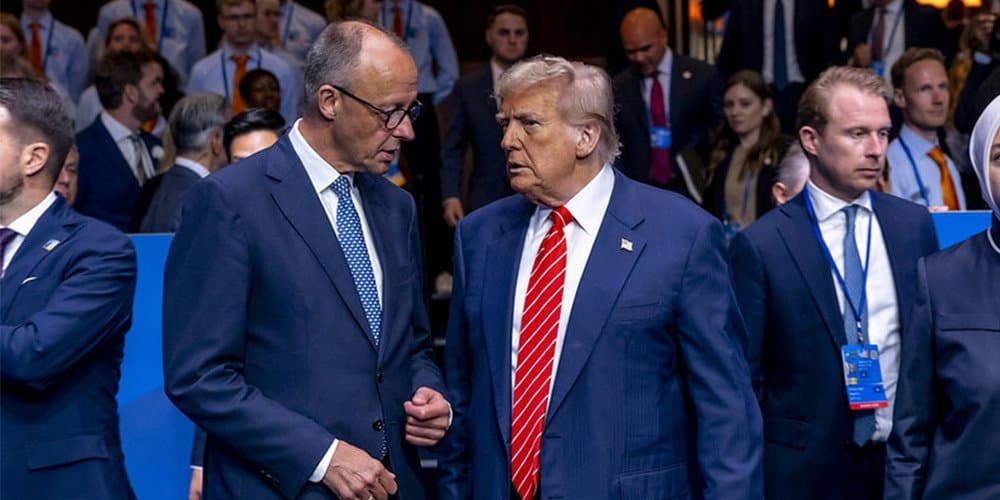
What will Trump say during events with Chancellor Merz on March 3?
Total Volume
$7.95K
Events
1
Markets
23
What will Trump say during events with Chancellor Merz on March 3?
Vol
$7.95K
|
Events
1
|
Markets
23
$7.95K
1
23
$7.95K
1
23
Trader mode: Actionable analysis for identifying opportunities and edge
Donald Trump is scheduled to participate in a meeting with Chancellor Merz of Germany on March 3, 2026 (see https://www.binance.com/en/square/post/296130249729874). This market will resolve to "Yes" if Donald Trump says the listed term during his appearance at events featuring Chancellor Merz on March 3, 2026. Otherwise, the market will resolve to "No". Plural and possessive forms of the listed term will count toward the resolution of this market regardless of context; however, other forms wi
Prediction markets estimate an 87% chance that Donald Trump will say the word “Iran” during his March 3 events with German Chancellor Friedrich Merz. In simple terms, traders believe it is very likely, roughly a 9 in 10 probability, that the topic will come up in his remarks.
Two main factors explain the high confidence. First, Iran is a persistent foreign policy issue where Trump has established a clear record. During his presidency, he withdrew the U.S. from the Iran nuclear deal and applied a “maximum pressure” campaign of sanctions. His rhetoric on Iran has remained consistently critical, making it a staple topic in his discussions on global security.
Second, the meeting’s context with Chancellor Merz makes the topic relevant. Germany was a key party to the original nuclear deal and remains engaged in diplomatic efforts concerning Iran’s nuclear program. Traders likely believe that European security, energy markets, and non-proliferation will be natural discussion points, and Trump’s known positions make it probable he will voice his views using the country’s name.
The main event is the meeting itself on March 3. Any public statements, joint press conferences, or even social media posts from Trump surrounding this date will determine the outcome. A significant, unexpected geopolitical event involving Iran before the meeting could make mention even more certain, while a tightly controlled agenda or a sudden focus on a different crisis could slightly lower the odds.
Markets for specific verbal statements by politicians are niche and can be volatile, as they hinge on a single word. However, for forecasting the topics a well-known figure will emphasize, especially one with consistent talking points, collective markets often have decent insight. The limitation here is that even with a 87% probability, a focused effort to avoid the term or an abrupt change in schedule could lead to a “No” outcome. It reflects strong confidence, not a guarantee.
Prediction markets on Polymarket assign an 87% probability that Donald Trump will say "Iran" during his March 3 events with German Chancellor Friedrich Merz. This price indicates extreme market confidence the event will occur. With $8,000 in total volume across 23 related markets, liquidity is thin, suggesting this is a niche political speculation rather than a heavily traded macro event.
The high probability directly reflects Trump's established rhetorical patterns and the geopolitical context of a U.S.-Germany meeting. Iran's nuclear program, regional proxy conflicts, and European security are persistent topics in transatlantic dialogue. Trump has consistently criticized the 2015 Iran nuclear deal, which Germany helped negotiate, and has maintained a hardline stance on the regime. A meeting with the German chancellor is a logical forum to reiterate this position, potentially to contrast with European policy or to emphasize shared security concerns. The market is effectively betting on a predictable element of Trump's foreign policy script appearing in a relevant diplomatic setting.
Given the 87% price, the market sees little room for surprise. The primary factor that could shift the odds is an abrupt change in the meeting's agenda to focus exclusively on bilateral trade or domestic issues, deliberately avoiding Middle East policy. A highly structured, brief, or scripted appearance with no open press questions could also limit opportunities for the term to be used. However, the market's pricing suggests traders believe the subject is nearly inevitable. The thin volume means a large, last-minute bet against the consensus could move the price, but it would not reflect a fundamental change in the expected outcome.
This market is trading exclusively on Polymarket. No direct comparison with other platforms like Kalshi is available, which is typical for highly specific political utterance markets. The lack of cross-platform trading eliminates arbitrage opportunities and means the 87% probability is the sole consolidated market view. This isolation is common for low-liquidity, long-dated political speculations.
AI-generated analysis based on market data. Not financial advice.
This prediction market focuses on whether former U.S. President Donald Trump will use specific language during his scheduled interactions with German Chancellor Friedrich Merz on March 3, 2026. The event, announced via a Binance Square post in late 2024, represents a significant political engagement between a former American president and a major European leader. The market resolves based on whether Trump utters predetermined terms during public appearances or statements made alongside Merz on that date, with plural and possessive forms counting toward resolution. This type of market reflects growing interest in political rhetoric analysis and the specific diplomatic language used in transatlantic relations. Interest stems from Donald Trump's history of controversial and unpredictable statements about NATO, European security, and Germany during his 2017-2021 presidency and subsequent political activities. His previous comments about Germany being "captive to Russia" due to energy policies, criticism of NATO defense spending, and praise for authoritarian leaders created persistent diplomatic tensions. Observers are watching whether his rhetoric toward a key U.S. ally will change during a potential second presidential campaign or subsequent political activities. The March 3 meeting's timing is notable as it falls during the early stages of the 2026 U.S. midterm election cycle and follows Germany's 2025 federal election, which brought Friedrich Merz to power. Political analysts are monitoring whether Trump's comments might signal future foreign policy directions, influence U.S.-European relations, or reflect evolving political strategies. The specific focus on his exact wording makes this market unique, as it attempts to quantify and predict rhetorical patterns rather than policy positions.
U.S.-German relations experienced significant strain during Donald Trump's presidency from 2017 to 2021. In May 2017, during his first NATO summit, Trump declined to explicitly endorse Article 5 mutual defense commitments and criticized allies for not meeting the 2% GDP defense spending target. He specifically targeted Germany, which was spending approximately 1.2% of GDP on defense at the time. The tension peaked at the 2018 NATO summit in Brussels, where Trump demanded immediate increases to 4% of GDP and suggested Germany was a "captive of Russia" due to the Nord Stream 2 pipeline project. German Chancellor Angela Merkel responded to Trump's criticisms by noting Europe could no longer "completely depend" on the United States, marking a shift in transatlantic relations. The Trump administration withdrew 9,500 U.S. troops from Germany in 2020, a decision reversed by the Biden administration in 2021. These events created a pattern where Trump's rhetoric about Germany focused on financial contributions, energy dependence, and what he perceived as unfair trade practices. The relationship improved under President Joe Biden, with Germany increasing its defense spending to reach NATO's 2% target by 2024 and committing to major military modernization. However, Trump's continued political influence and potential return to power kept concerns alive in European capitals about whether his previous criticisms would resurface. The 2025 German election brought Friedrich Merz to power, creating a new political dynamic for U.S.-German relations.
The specific language Trump uses with Chancellor Merz could signal his future approach to European security and transatlantic alliances if he returns to political power. His previous criticisms of NATO directly affected defense planning and spending decisions across Europe, with multiple countries accelerating military budget increases after 2017. A return to similar rhetoric might influence Germany's ongoing military modernization efforts and its role in European security architecture. Beyond immediate diplomatic implications, Trump's statements could affect financial markets and defense industries. During his presidency, defense stocks often reacted to his NATO comments, and European energy markets responded to his criticisms of Russian energy imports. The language used in high-profile meetings can also shape public opinion in both countries, potentially affecting political support for international cooperation and security commitments. For Germany, which hosts approximately 35,000 U.S. troops, the stability of the bilateral relationship has direct consequences for regional security in Eastern Europe.
As of early 2025, Friedrich Merz has recently assumed the German chancellorship following the 2025 federal election. His government has committed to maintaining defense spending above 2% of GDP and strengthening Germany's military capabilities. Donald Trump remains active in U.S. politics, having secured the Republican presidential nomination for the 2024 election. The announced March 3, 2026 meeting represents one of the first scheduled high-level engagements between Trump and the new German leadership. Recent developments include Germany's continued support for Ukraine, with over 28 billion euros in military aid committed since 2022, and ongoing debates about European strategic autonomy. The U.S. political landscape following the 2024 election will significantly influence the context of the 2026 meeting, particularly regarding future NATO commitments and transatlantic cooperation.
Trump repeatedly criticized Germany's NATO defense spending, calling the country "delinquent" in 2017. In 2018, he stated Germany was "totally controlled by Russia" due to energy imports and suggested the U.S. might reduce troop presence unless spending increased.
Germany reached NATO's 2% of GDP defense spending target in 2024, committing approximately 71.8 billion euros. This followed years below the target, including 1.2% in 2017 when Trump began his criticisms.
The date represents a scheduled meeting between former President Trump and Chancellor Merz during the early 2026 U.S. midterm cycle. It will test whether Trump's rhetoric toward Germany has evolved since his presidency and may signal future policy directions.
Approximately 35,000 U.S. military personnel are based in Germany as of 2024. Trump ordered a reduction of 9,500 troops in 2020, but the Biden administration reversed this decision and maintained the traditional troop levels.
Germany increased defense spending by 47% between 2017 and 2023 and created a 100 billion euro special fund for military modernization. Chancellor Merkel also noted Europe needed to become more independent in security matters.
Educational content is AI-generated and sourced from Wikipedia. It should not be considered financial advice.
23 markets tracked
No data available
| Market | Platform | Price |
|---|---|---|
| Poly | 87% |
| Poly | 77% |
| Poly | 76% |
| Poly | 75% |
| Poly | 64% |
| Poly | 57% |
| Poly | 56% |
| Poly | 56% |
| Poly | 56% |
| Poly | 55% |
| Poly | 55% |
| Poly | 54% |
| Poly | 54% |
| Poly | 53% |
| Poly | 53% |
| Poly | 48% |
| Poly | 47% |
| Poly | 44% |
| Poly | 42% |
| Poly | 40% |
| Poly | 38% |
| Poly | 38% |
| Poly | 36% |
No related news found
Add this market to your website
<iframe src="https://predictpedia.com/embed/yz-eu7" width="400" height="160" frameborder="0" style="border-radius: 8px; max-width: 100%;" title="What will Trump say during events with Chancellor Merz on March 3?"></iframe>