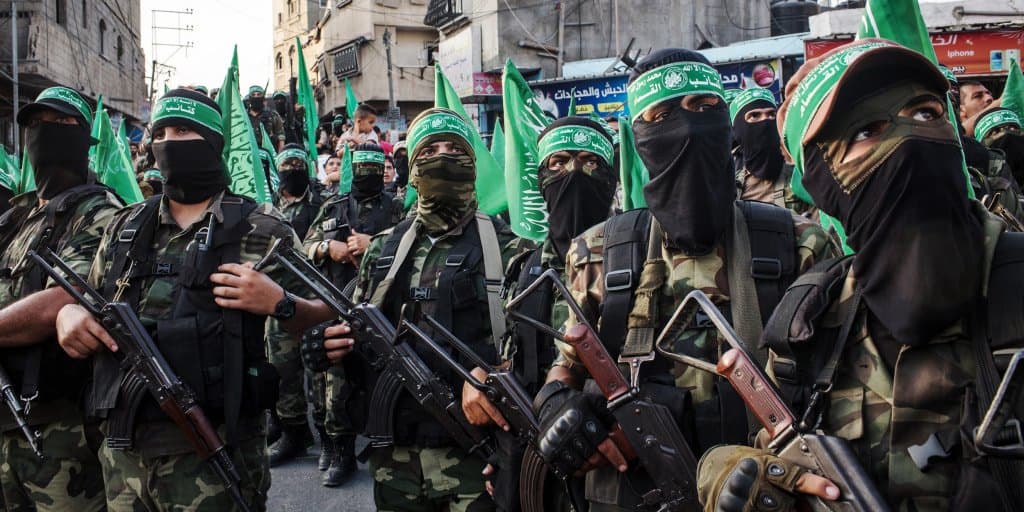
Will Hamas agree to disarm by...?
$3.80M
1
1
Will Hamas agree to disarm by...?
$3.80M
1
1
AI Analysis
Trader mode: Actionable analysis for identifying opportunities and edge
About This Event
This market will resolve to "Yes" if Hamas officially announces it will disarm in the Gaza Strip by December 31, 2025, 11:59 PM ET. Otherwise, this market will resolve to "No". Only credible announcements, for example by the widely acknowledged leadership of Hamas, will qualify. For the purposes of this market, "disarm" refers to a public commitment to relinquish or dismantle its military, whether partially or completely, in the Gaza Strip. Announcements of partial disarmament (e.g., surrende
Snapshot observed 2026-10-13T00:00:05.902Z. This analysis describes that snapshot and is not a live news update.
What the contract measures
This event contains one saved market, "Will Hamas agree to disarm by December 31?" The rules state that the market "will resolve to "Yes" if Hamas officially announces it will disarm in the Gaza Strip by December 31, 2025, 11:59 PM ET" [1]. The source also says that "Only credible announcements, for example by the widely acknowledged leadership of Hamas, will qualify" and that "Announcements of partial disarmament" are addressed separately in the rules [1].
The contract wording and the provider's listed end time do not match on the year. The rule text names December 31, 2025, while the listed end time is 2027-01-01T04:59:00.000Z [1]. That timestamp corresponds to 11:59 PM ET on December 31, 2026. The evidence does not explain this difference, so readers should check the full contract text on the provider before relying on either date.
Reading the snapshot
The saved prices are Yes at 0.11 and No at 0.89 [1]. The provider observed these values at 2026-10-13T00:00:05.902Z, and the market was listed as active at that time [1]. The record was retrieved later, at 2026-10-13T02:22:31.200Z, so the prices describe that earlier observation rather than a live quote.
These figures are snapshot prices, not executable quotes or verified probabilities. The evidence does not include volume, order book depth, or trader counts, so it cannot show how liquid the market is or how many participants hold each view.
The sample covers all saved markets for this event: one market out of one in the provider record, with no partial sample flagged [1]. No other platform or contract appears in the evidence, so there is no basis for comparing this price with any other market.
What remains uncertain
The evidence does not show why the price stands where it does. It also does not show any news or announcements about Hamas after the observation time. The contract's resolution is not in the record. Whether the market resolved, and under which date, cannot be determined from the saved snapshot.
References
- Polymarket: Will Hamas agree to disarm by...?. Provider data observed 2026-10-13T00:00:05.902Z.
AI-generated analysis based on market data. Not financial advice.
Saved Oct 13, 2026 UTCOverview
This PredictPedia contract asks whether Hamas will officially announce that it will disarm in the Gaza Strip. The Polymarket rules say the market resolves "Yes" if Hamas makes that announcement by the date stated in the rules, and "No" otherwise [1]. The rules say that only credible announcements, such as those from the widely acknowledged leadership of Hamas, will qualify [1]. For this contract, "disarm" means a public commitment to relinquish or dismantle the group's military, whether partially or completely, in the Gaza Strip [1]. The rules also address partial disarmament announcements, such as surrender arrangements, but the saved excerpt is cut off before the full wording on that point [1]. The date in the rule text is December 31, 2025, at 11:59 PM ET [1]. The market title reads "Will Hamas agree to disarm by December 31?", and the provider lists an end time of January 1, 2027 at 04:59 UTC [1]. The saved records do not explain why the rule text and the listed end time differ. A date in the contract rules is not an announced event date, and nothing in the evidence shows that an announcement has been made. The provider reports the market as active in its saved record [1]. The background for this contract comes from Wikipedia pages retrieved on the same date. Those pages describe events up to the time they were written and do not confirm current developments. They are used here only for historical context and for the setting in which the rules apply.
Historical Context
The Gaza war began on 7 October 2023, when Hamas led an attack on Israel, according to the Wikipedia article on the war [2]. Since the start of the Israeli offensive that followed, the article reports that over 74,000 Palestinians in Gaza have been killed, and it notes that several studies in The Lancet indicate this figure is likely a significant undercount [2]. During the war, the group lost control over most of the Gaza Strip to the Israel Defense Forces [3]. The Wikipedia article on the Gaza Strip under Hamas says that, as a result of a Gaza peace plan agreed in October 2025, the IDF controls approximately 53 percent of the territory, and that Hamas is set to hand over power to the National Committee for the Administration of Gaza [3]. These figures describe the article as it was retrieved, not a verified present-day situation.
Why It Matters
The contract measures a single, narrow event: whether Hamas officially and publicly commits to disarming in the Gaza Strip within the window set by the rules [1]. Under the rules, partial and complete disarmament both count, so the wording of any announcement would matter for resolution [1]. The contract does not measure whether disarmament actually happens, only whether a qualifying announcement is made [1]. The Wikipedia background explains why the question is tied to the wider conflict and to the planned transfer of administration described in the Gaza peace plan [2][3].
Snapshot context
The latest published provider snapshot for this topic was observed on 2026-10-13 at 00:00 UTC. It contains listings from Polymarket. Market descriptions and listed closing times define the contracts; they do not establish that the real-world outcome has occurred. This article does not include a separately verified news update. [1]
Frequently Asked Questions
What counts as a qualifying announcement?
The rules say the market resolves "Yes" only if Hamas officially announces it will disarm in the Gaza Strip, and that only credible announcements, for example by the widely acknowledged leadership of Hamas, will qualify [1].
Does a partial disarmament announcement count?
The rules define disarm to include a public commitment to relinquish or dismantle the military, whether partially or completely, and they refer to announcements of partial disarmament. The saved excerpt is truncated before the full treatment of that point, so the complete rule text should be checked before drawing conclusions [1].
Why do the dates in this contract differ?
The rule text refers to December 31, 2025, 11:59 PM ET, while the provider lists an end time of January 1, 2027 at 04:59 UTC [1]. The saved records do not explain the difference. The rule date does not indicate that any announcement has been scheduled or made.
Who controls Gaza according to the background sources?
The Wikipedia article on the Gaza Strip under Hamas says that Hamas governs the territory and that the IDF controls approximately 53 percent of it under the October 2025 peace plan, with Hamas set to hand over power to the National Committee for the Administration of Gaza [3]. This describes the article as retrieved and should not be read as a confirmed current situation.
AI-written background. References identify the evidence used; Wikipedia links under Learn More are additional reading. Prices and provider rules are dated snapshots. This is not financial advice.