$7.21K
1
1

1 market tracked

No data available
| Market | Platform | Price |
|---|---|---|
![]() | Poly | 14% |
Trader mode: Actionable analysis for identifying opportunities and edge
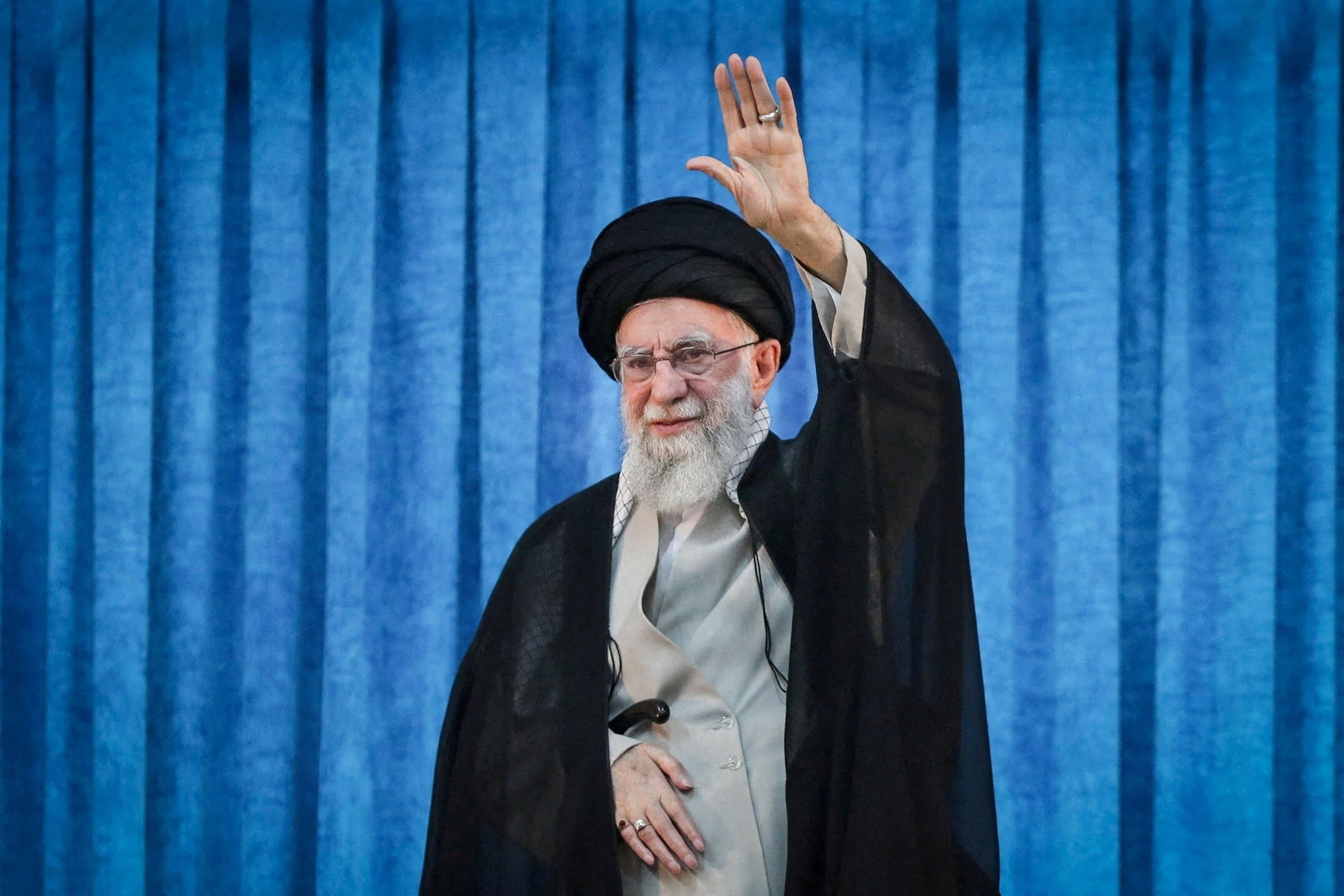
This market will resolve to “Yes” if the United States forcibly removes Iran’s Supreme Leader, Ali Khamenei, from power for any length of time between market creation and March 31, 2026, 11:59 PM ET. Otherwise, this market will resolve to “No”. The United States will be considered to have forcibly removed Khamenei from power if Khamenei is detained, captured, surrenders, or otherwise loses his position or is prevented from fulfilling his duties as Supreme Leader of Iran as a direct result of ac
AI-generated analysis based on market data. Not financial advice.
$7.21K
1
1
This prediction market addresses whether the United States will forcibly remove Iran's Supreme Leader, Ali Khamenei, from power by March 31, 2026. The market resolves to 'Yes' if Khamenei is detained, captured, surrenders, or is otherwise prevented from fulfilling his duties as Supreme Leader as a direct result of U.S. action. This scenario represents an extreme escalation in the long-standing adversarial relationship between the United States and the Islamic Republic of Iran. The topic sits at the intersection of U.S. foreign policy, regime change doctrine, and the stability of Iran's theocratic system. People are interested in this market because it quantifies the perceived probability of a direct, kinetic confrontation between the two nations, an event that would have profound geopolitical consequences. The market's timeframe extends through early 2026, covering a period that includes the potential transition to a new U.S. administration following the 2024 presidential election, adding another layer of political uncertainty. Recent years have seen heightened tensions, including the U.S. withdrawal from the JCPOA nuclear deal in 2018, the assassination of Iranian General Qasem Soleimani by the U.S. in 2020, and ongoing Iranian proxy attacks on U.S. forces in the region, making the question of direct regime targeting a subject of serious strategic discussion.
The prospect of the U.S. forcibly removing an Iranian leader has precedent. In 1953, the CIA orchestrated Operation Ajax, a coup that overthrew Iran's democratically elected Prime Minister, Mohammad Mossadegh, and reinstated the Shah. This event fundamentally shaped modern U.S.-Iran relations, creating deep-seated Iranian distrust of American intentions. The 1979 Iranian Revolution, which ousted the U.S.-backed Shah, led to the seizure of the U.S. Embassy in Tehran and a 444-day hostage crisis, severing diplomatic ties. Since then, the U.S. has employed various strategies short of direct regime removal, including support for Iraq during the Iran-Iraq War (1980-1988), comprehensive sanctions, and cyber warfare like the Stuxnet virus discovered in 2010. The U.S. has directly targeted Iranian military leaders, most notably with the drone strike that killed IRGC Quds Force Commander Qasem Soleimani in Baghdad on January 3, 2020. This act demonstrated a U.S. willingness to conduct lethal operations against the highest levels of the Iranian regime but stopped short of targeting the Supreme Leader himself, a red line that has never been crossed. The historical pattern shows escalation but within bounds, making the forced removal of Khamenei an unprecedented escalation.
The forced removal of Iran's Supreme Leader would be a cataclysmic event with global ramifications. Politically, it would likely trigger immediate and severe retaliation from Iran and its network of proxies across the Middle East, potentially sparking a regional war. Hezbollah in Lebanon, Shia militias in Iraq, and the Houthis in Yemen could launch coordinated attacks on U.S. interests, Israeli territory, and international shipping. Economically, such an event would cause extreme volatility in global oil markets, as Iran controls crucial shipping lanes like the Strait of Hormuz, through which about 20% of the world's oil passes. A closure or conflict in the strait could cause oil prices to spike dramatically, triggering a global economic crisis. Socially, within Iran, it could lead to either a popular uprising against the remaining regime or a powerful nationalist backlash that consolidates support for hardliners. The act would also redefine international norms regarding sovereignty and regime change, potentially encouraging other nations to take similar actions against their adversaries, destabilizing the global order.
As of late 2024, there are no public indications or credible reports that the United States is planning or preparing to forcibly remove Supreme Leader Ali Khamenei from power. The Biden administration's stated policy remains focused on diplomatic containment, enforcing oil sanctions, and deterring Iranian aggression through regional force posture. Tensions remain high due to Iran's advancing nuclear program, its support for proxy groups attacking U.S. allies, and ongoing incidents in the Persian Gulf. However, these are being managed through established channels of deterrence and diplomatic messaging. The U.S. military posture in the region is defensive and retaliatory in nature, not configured for a large-scale invasion or decapitation operation against the Iranian state. The primary focus of U.S.-Iran dynamics is the indirect negotiation over nuclear constraints and regional de-escalation, not regime change.
There is no publicly verified evidence of a U.S. attempt to assassinate a sitting Supreme Leader of Iran. The closest precedent is the 2020 U.S. drone strike that killed Qasem Soleimani, a senior military commander. Historical CIA operations, like the 1953 coup against Prime Minister Mossadegh, targeted the government but not the head of state.
Iran's political system has a defined, though opaque, succession process. The Assembly of Experts would be constitutionally required to select a new Supreme Leader. However, a forced removal by an external power would likely cause massive internal chaos, a violent power struggle, and potentially the fragmentation of the state, as competing factions within the IRGC and government vie for control.
Under international law, such an act would violate the UN Charter's prohibition against the use of force and the principle of sovereignty. Domestically, a U.S. President could argue it as an act of self-defense under the 2001 or 2002 Authorizations for Use of Military Force, but this would be legally contentious and would likely require congressional notification, if not approval.
Educational content is AI-generated and sourced from Wikipedia. It should not be considered financial advice.
Share your predictions and analysis with other traders. Coming soon!

No related news found
Add this market to your website
<iframe src="https://predictpedia.com/embed/C7xKAD" width="400" height="160" frameborder="0" style="border-radius: 8px; max-width: 100%;" title="US forcibly removes Khamenei from power by March 31?"></iframe>