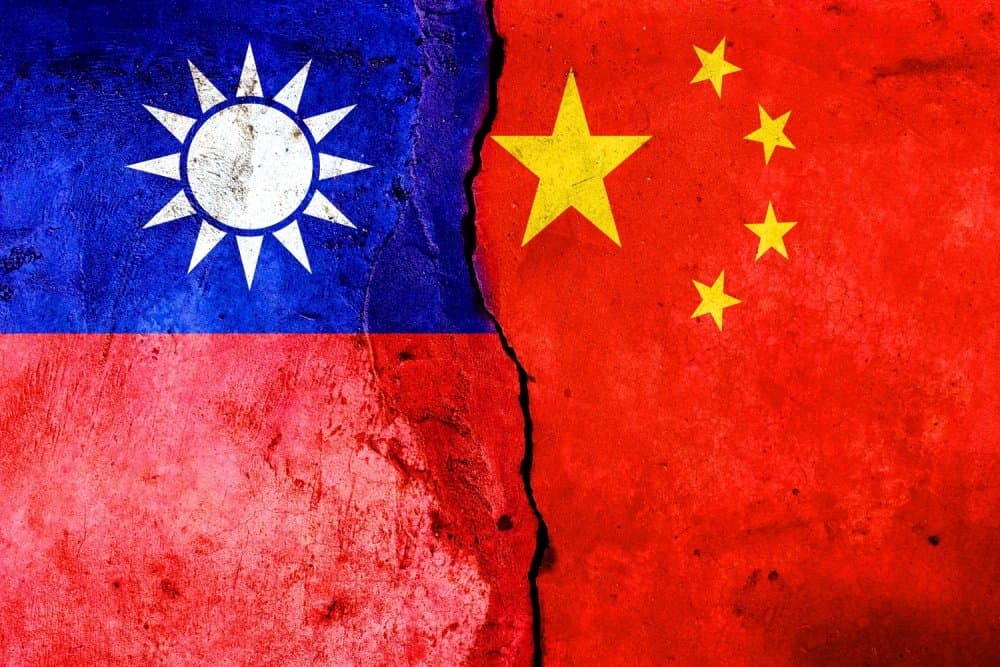
Will China invade Taiwan by end of 2026?
$44.06M
1
1
Will China invade Taiwan by end of 2026?
$44.06M
1
1
AI Analysis
Trader mode: Actionable analysis for identifying opportunities and edge
About This Event
This market will resolve to "Yes" if China commences a military offensive intended to establish control over any portion of the Republic of China (Taiwan) by December 31, 2026, 11:59 PM ET. Otherwise, this market will resolve to "No". Territory under the administration of the Republic of China including any inhabited islands will qualify, however uninhabited islands will not qualify. The resolution source for this market will be will be official confirmation by China, Taiwan, the United Natio
This saved analysis is awaiting a background update. Its prices and claims may be outdated; compare them with the dated market data above.
Snapshot observed 2026-10-13T09:10:12.733Z. This analysis describes that snapshot and is not a live news update.
What the contract measures
The contract asks whether China will invade Taiwan by the end of 2026. Under the rules, it resolves "Yes" if China "commences a military offensive intended to establish control over any portion of the Republic of China (Taiwan)" by December 31, 2026, 11:59 PM ET, and "No" otherwise [1]. The rules say territory under the administration of the Republic of China that includes inhabited islands qualifies, while uninhabited islands do not [1]. The saved excerpt also names the resolution source as official confirmation by China, Taiwan, the United Nations, and others, but that sentence is cut off in the saved text, so the full list is not available here [1].
The provider lists the market end time as 2027-01-01T04:59:00.000Z [1]. That is the same instant as the 11:59 PM ET deadline in the rules, so the listed end time reflects that deadline in UTC. It is a closing time, not a statement that any event is scheduled.
Reading the snapshot
This sample contains one Polymarket market from one event, with no other platform included [1]. The provider observation was recorded at 2026-10-13T09:10:12.733Z, and the source was retrieved at 09:22:50.043Z on the same day [1]. These are snapshot times, so the prices describe that moment and not live conditions.
The saved prices are Yes at 0.0225 and No at 0.9775 [1]. Read as a snapshot, the Yes price corresponds to about 2.25 percent and the No price to about 97.75 percent. These are not executable quotes, and they are not verified probabilities. The two prices sum to 1.0 in this record, but that does not establish a tradable spread or a spot-price estimate.
Because only one market was saved, no comparison with other contracts or platforms is possible here. A different wording, close time, or resolution source on another platform would be a different contract, and its price should not be compared directly with this one.
What remains uncertain
The evidence does not explain why the price is where it is, and it does not show how many participants hold either side. The saved data includes no volume or liquidity figures, so no inference about depth is possible. The sample covers all saved markets for this event, but the source states that this "does not establish that the providers list every possible real-world outcome" [1]. The saved excerpt also cannot confirm how the resolution source will operate in practice, and no current news or official statements are included in this evidence.
References
- Polymarket: Will China invade Taiwan by end of 2026?. Provider data observed 2026-10-13T09:10:12.733Z.
AI-generated analysis based on market data. Not financial advice.
Saved Oct 13, 2026 UTCOverview
This contract asks whether China will commence a military offensive intended to establish control over any portion of the Republic of China (Taiwan) by December 31, 2026, 11:59 PM ET [1]. Under the rules, it resolves "Yes" if such an offensive begins within that window and "No" otherwise [1]. The rules state that territory under the administration of the Republic of China, including any inhabited islands, qualifies, while uninhabited islands do not [1]. The contract's end time is listed as 2027-01-01T04:59:00Z, which corresponds to the December 31, 2026 deadline in Eastern Time [1]. That timestamp is the contract's closing time under its rules. It is not an announced event, and it does not indicate that any military action is scheduled or expected. The question is narrow. It concerns the start of a military offensive with a stated aim of establishing control, not general tensions, diplomatic disputes, or the broader state of relations between the two sides. Resolution depends on official confirmation, and the rules name China, Taiwan, and the United Nations among the bodies whose confirmation is relevant [1]. Because the retrieved rules are cut off at that point, this explanation does not list every confirming source.
Historical Context
Cross-strait relations are the political and economic relations between China and Taiwan across the Taiwan Strait. Because of the controversy over the status of Taiwan and the question of Chinese legitimacy, neither side defines these relations as diplomatic relations [2]. This background explains why the contract's wording refers to the Republic of China (Taiwan) and to control over territory rather than to a conventional diplomatic framework [1][2]. The history of the island reaches back tens of thousands of years, with evidence of early human habitation. Agricultural culture appeared around 3000 BC, which is believed to reflect the arrival of the ancestors of today's Taiwanese indigenous peoples [3]. People from China gradually came into contact with the island by the time of the Yuan dynasty (1271 to 1368), and Han Chinese settlement grew on a larger scale by the early 17th century [3]. Portuguese explorers discovered the island in the 16th century and named it Formosa [3]. Between 1624 and 1662 the Dutch colonized the south of the island from Zeelandia in present-day Anping, Tainan, while the Spanish built an outpost in the north that lasted until 1642, when the Dutch seized the Spanish fortress in Keelung [3]. Later immigration from Fujian and Guangdong followed these European settlements [3].
Why It Matters
The contract measures whether a specific category of event, the commencement of a military offensive intended to establish control over part of Taiwan, occurs before the stated deadline [1]. Its wording makes the threshold concrete: the offensive must be intended to establish control, and the territory must fall under the administration of the Republic of China, including inhabited islands [1]. Uninhabited islands do not count [1]. For readers, the rules show how a headline question becomes a resolvable condition. A broad question about invasion could be read many ways, but these rules set a defined trigger, a defined geography, and a defined deadline [1]. Historical and political background from the sources, including the unresolved status question described in the cross-strait relations overview, helps explain why the wording refers to the Republic of China and to control of territory [1][2].
Snapshot context
The latest published provider snapshot for this topic was observed on 2026-10-13 at 09:10 UTC. It contains listings from Polymarket. Market descriptions and listed closing times define the contracts; they do not establish that the real-world outcome has occurred. This article does not include a separately verified news update. [1]
Frequently Asked Questions
What must happen for this contract to resolve Yes?
The rules say it resolves Yes if China commences a military offensive intended to establish control over any portion of the Republic of China (Taiwan) by December 31, 2026, 11:59 PM ET [1].
Do uninhabited islands count as qualifying territory?
No. The rules state that territory under the administration of the Republic of China, including any inhabited islands, qualifies, while uninhabited islands do not [1].
Does the December 31, 2026 date mean an event is scheduled?
No. The date is the deadline in the contract rules and the listed closing time for the contract [1]. It does not indicate that any military action has been announced or planned.
Who confirms whether the event occurred?
The rules name official confirmation by China, Taiwan, the United Nations, and other bodies as the resolution source, though the retrieved text does not show the complete list [1].
AI-written background. References identify the evidence used; Wikipedia links under Learn More are additional reading. Prices and provider rules are dated snapshots. This is not financial advice.
Market Insights
Price gaps of 2 pp+
0
Saved price pairs
0
No exact saved pairs with both binary Yes prices are available.
Price differences do not establish arbitrage. Check each pair's review, current order prices, fees and settlement rules.