
What will the Fed rate be at the end of 2026?
PM $7.29M · K 1.83M contracts
2
26
- Reported volume
- PM $7.29M · K 1.83M contracts
- Events
- 2
- Markets
- 26
Current odds
Snapshot from
As of Nov 26, 2026, 3:00 PM UTC, the highest-priced outcome on Polymarket is 4.25% at 92.8%, and on Kalshi it is Above 3.00% at 99.5%.
Polymarket
- 4.25%92.8%
- 4.0%3.5%
- ≥ 4.5%2.6%
- 3.75%0.4%
- 1.250.4%
Kalshi
- Above 3.00%99.5%
- Above 3.50%99.5%
- Above 3.25%99.5%
- Above 2.75%99.5%
- Above 3.75%98.5%
Yes prices. They are not order quotes; check each platform's rules, fees and live prices before trading.
AI Analysis
Trader mode: Market mechanics, assumptions and risks
PM $7.29M · K 1.83M contracts
Reported volume · provider units
26
Saved contracts
0
Same-question pairs
Source snapshot: Nov 26, 2026, 3:00 PM UTC
This analysis was written from an earlier market snapshot, so its prices may be older than the odds above.
Snapshot observed Nov 23, 2026, 12:00 PM UTC. This analysis describes that snapshot and is not a live news update.
What the contract measures
This snapshot covers two prediction market events about the Federal Reserve's policy rate at the end of 2026, one listed on Kalshi and one on Polymarket [1][2]. The platforms define the measure differently. Kalshi asks about the first published Effective Federal Funds Rate value for December 31, 2026, and a market resolves Yes if that value is above a stated threshold [1]. Polymarket uses the upper bound of the Federal Reserve's target federal funds range after the December 2026 FOMC meeting, which is currently scheduled for December 8 and 9, 2026. That bound is rounded to the nearest 25 basis points [2]. Because the questions differ, the prices describe different outcomes, even when the rate levels look similar.
Reading the snapshot
The provider observed these prices at Nov 23, 2026, 12:00 PM UTC, and the source was retrieved at 12:07:32Z. These are snapshots, not executable quotes or verified probabilities.
On Kalshi, all five markets are included. Yes prices were 0.99 for above 3.50%, 0.935 for above 4.00%, 0.55 for above 3.75%, 0.055 for above 4.50%, and 0.03 for above 4.25% [1]. The market data lists an end date of Jan 4, 2027, 1:59 PM UTC, while the event excerpt's listed end time reads "not supplied." The excerpt also says the market may close early if economic data is released [1].
On Polymarket, twelve of fifteen markets are included, so this is a partial sample. Yes prices include 0.921 for an upper bound of 4.25%, 0.051 for 4.0%, 0.0165 for 4.5% or higher, and 0.0075 for 3.75%. The listed end time is Jan 1, 2027, 4:59 AM UTC [2]. The three omitted markets are not shown, and their absence does not indicate a lower price.
Reported volume is $7,245,090 on Polymarket and 26,560 contracts on Kalshi. These units differ and should not be added or compared. Volume also does not measure liquidity or the number of traders.
Kalshi's 0.935 for above 4.00% and Polymarket's 0.921 for a 4.25% upper bound are different contracts with different thresholds and rules, so they should not be treated as agreement or disagreement.
What remains uncertain
This snapshot does not explain why prices are at these levels, and it does not report recent news, trader agreement, or past forecasting accuracy. The Polymarket sample is incomplete, and the Kalshi end time is inconsistent between fields in the saved data. The December FOMC date appears only in Polymarket's rule text as "currently scheduled" [2]. Price differences between contracts with different rules do not by themselves show an arbitrage opportunity.
References
- Kalshi: Fed Funds (EFFR) at end of Q4 2026. Provider data observed Nov 23, 2026, 12:00 PM UTC.
- Polymarket: What will the Fed rate be at the end of 2026?. Provider data observed Nov 23, 2026, 12:00 PM UTC.
Snapshot observed Nov 23, 2026, 12:00 AM UTC. This analysis describes that snapshot and is not a live news update.
What the contract measures
The two providers describe related but different measures. Kalshi's event asks whether the first published Effective Federal Funds Rate value for December 31, 2026 will be above a stated threshold, and the market resolves to Yes if it is [1]. Its listed contract close is Jan 4, 2027, 1:59 PM UTC, and the source notes an early close if economic data is released [1]. Polymarket's event resolves on the upper bound of the Federal Reserve's target federal funds range after the December 2026 FOMC meeting, rounded to the nearest 25 basis points, and the rules say that meeting is currently scheduled for December 8-9, 2026 [2]. Its listed end time is Jan 1, 2027, 4:59 AM UTC [2]. Because one measure is an effective rate on a specific date and the other is a target range bound, their prices should not be treated as the same question.
Reading the snapshot
The snapshot was observed at Nov 23, 2026, 12:00 AM UTC and retrieved at Nov 23, 2026, 2:23 AM UTC, so these prices describe that observation window only. They are not executable quotes or verified probabilities.
On Kalshi, the quoted Yes prices for the EFFR thresholds are 0.99 above 3.50%, 0.925 above 4.00%, 0.55 above 3.75%, 0.10 above 4.50%, and 0.035 above 4.25% [1]. These are five contracts, and the source reports all five as included [1].
On Polymarket, the Yes prices for the upper bound are 0.8885 for 4.25%, 0.0665 for 4.0%, 0.0235 for 4.5% or higher, and 0.014 for 3.75% [2]. The sample includes 12 of 15 markets on that event, so it is a partial sample [2]. The selection ranks markets by Yes price, so the three omitted markets are not shown and their prices should not be inferred.
Volume figures are not comparable. Kalshi reports 26,560 contracts and Polymarket reports $7,242,312 for their own events [1][2]. Volume is not liquidity or a count of traders, and the two figures should not be added or compared.
What remains uncertain
The evidence does not explain why any price moved, how many traders hold each view, or what recent news may be relevant. The Kalshi listed end time is not supplied in the source, and its contract close date is a rule setting rather than a confirmed event date [1]. The Polymarket sample is partial, so the displayed ranking does not describe the full field of outcomes [2]. Differences between the two platforms, including their thresholds, resolution sources, and listed close times, mean prices across them should be read separately rather than averaged or treated as an arbitrage signal.
References
- Kalshi: Fed Funds (EFFR) at end of Q4 2026. Provider data observed Nov 23, 2026, 12:00 AM UTC.
- Polymarket: What will the Fed rate be at the end of 2026?. Provider data observed Nov 23, 2026, 12:00 AM UTC.
AI-generated analysis based on market data. Not financial advice.
Saved Nov 23, 2026 UTCOverview
This article explains a set of prediction market contracts tied to the Federal Reserve's policy rate at the end of 2026. The contracts are not a forecast in themselves. Each one asks whether a specific published rate will sit above or below a stated threshold at a specified time, and the prices shown on these markets are the trading levels recorded in a saved snapshot. The snapshot was observed on 2026-11-23 at 18:00 UTC, so the figures describe that moment and should not be read as live prices. The underlying measure is the federal funds rate, which the federal funds rate article describes as the interest rate at which depository institutions lend reserve balances to other depository institutions overnight on an uncollateralized basis [4]. The same source notes that the rate is an important benchmark in financial markets and is central to the conduct of monetary policy in the United States because it influences a wide range of market interest rates [4]. Because the rate is set through policy decisions rather than daily trading alone, the contracts focus on the target range and its published upper bound. Three related contracts appear in the supplied record. The first, from Kalshi, concerns the Federal Reserve's December 9, 2026 meeting. It resolves to Yes if the upper bound of the target federal funds rate, as published on the Federal Reserve's official website, is greater than a stated threshold X following that meeting [1]. The second, from Polymarket, asks about the upper bound of the target federal funds range at the end of 2026 and identifies the Federal Open Market Committee as the body whose meetings make decisions on the target range [2]. The third, from Kalshi, concerns the Effective Federal Funds Rate, or EFFR, for December 31, 2026 [3]. The contracts differ in their resolution mechanics, and those differences matter when reading the prices. The Kalshi meeting contract expires at the first 2:05 PM ET following the release of a Federal Reserve statement for the December 9, 2026 meeting, or one week after the last day of that meeting, whichever the rules set [1]. The Polymarket contract rounds the upper bound to the nearest 25 basis points and says it may resolve immediately after the December statement is issued [2]. If no decision for the December meeting has been issued by December 31, 2026 at 11:59 PM ET, the Polymarket contract resolves according to the upper bound in effect at that time [2]. The Kalshi EFFR contract uses the first published EFFR value for December 31, 2026, and it can close early if the relevant economic data is released [3]. The December 8 to 9, 2026 meeting dates appear in the contract rules as scheduled dates [2]. They are contract references, not confirmed announcements of an event, and the record does not include any other announced schedule. The Polymarket and Kalshi samples are not the same. The Polymarket event shows 12 of 15 markets included, and the record marks that sample as partial, so the omitted markets should not be assumed to have any particular price. The Kalshi meeting event and the Kalshi EFFR event each show all of their included markets. Volume figures are reported in different units by each provider, so they cannot be compared across platforms. Readers should also understand that a snapshot price is not an executable quote or a verified probability. A price difference between two contracts does not by itself indicate an opportunity, because the thresholds, expiry rules, and resolution sources differ.
Historical Context
The Taylor rule article states that the rule was proposed in 1992 by American economist John B. Taylor as a guide for central banks setting short-term interest rates to stabilize economic activity [5]. The article describes the rule as using the federal funds rate, the price level, and changes in real income, and it says the rule prescribes a relatively high interest rate when actual inflation is higher than the inflation target [5]. The supplied sources do not provide a broader history of the federal funds rate or of the 2026 policy path, so this section is limited to the rule's origin and its description.
Why It Matters
These contracts measure a specific published policy outcome rather than a general view of the economy. The Kalshi meeting contract measures whether the upper bound of the target federal funds rate, as published by the Federal Reserve, is above a threshold after the December 9, 2026 meeting [1]. The Polymarket contract measures the upper bound at the end of 2026, rounded to the nearest 25 basis points, with a fallback rule if no December decision is issued by the stated deadline [2]. The Kalshi EFFR contract measures the first published EFFR value for December 31, 2026 against a threshold [3]. Because each contract uses a different rate definition and timing rule, they answer related but distinct questions. Background sources explain why the federal funds rate matters as a benchmark [4], but they do not establish the outcome of any contract.
Snapshot context
The latest published provider snapshot for this topic was observed on 2026-11-23 at 18:00 UTC. It contains listings from Kalshi and Polymarket. Market descriptions and listed closing times define the contracts; they do not establish that the real-world outcome has occurred. This article does not include a separately verified news update. [1]
Frequently Asked Questions
What does the upper bound of the federal funds rate mean in these contracts?
In the Polymarket contract, the rate is defined by the upper bound of the target federal funds range, and the upper bound is rounded to the nearest 25 basis points for resolution [2]. The Kalshi meeting contract also refers to the upper bound published on the Federal Reserve's official website [1].
When do the Kalshi meeting contracts expire?
The Kalshi meeting contract expires at the first 2:05 PM ET following the release of a Federal Reserve statement for the December 9, 2026 meeting, or one week following the last day of that meeting [1]. The listed end time is not supplied in the record.
What happens if the Fed does not decide in December?
The Polymarket contract says that if no FOMC decision on the target range for the December meeting has been issued by December 31, 2026 at 11:59 PM ET, the market resolves according to the upper bound of the target range at that time [2].
What is the difference between the EFFR contract and the target range contracts?
The Kalshi EFFR contract resolves on the first published Effective Federal Funds Rate value for December 31, 2026 [3]. The Polymarket and Kalshi meeting contracts instead refer to the upper bound of the target federal funds range [1][2]. The contracts therefore use different rate definitions and timing rules.
AI-written background. References identify the evidence used; Wikipedia links under Learn More are additional reading. Prices and provider rules are dated snapshots. This is not financial advice.
Related prediction markets
Prices are catalog snapshots and may have changed. Check each market's rules and observation time.
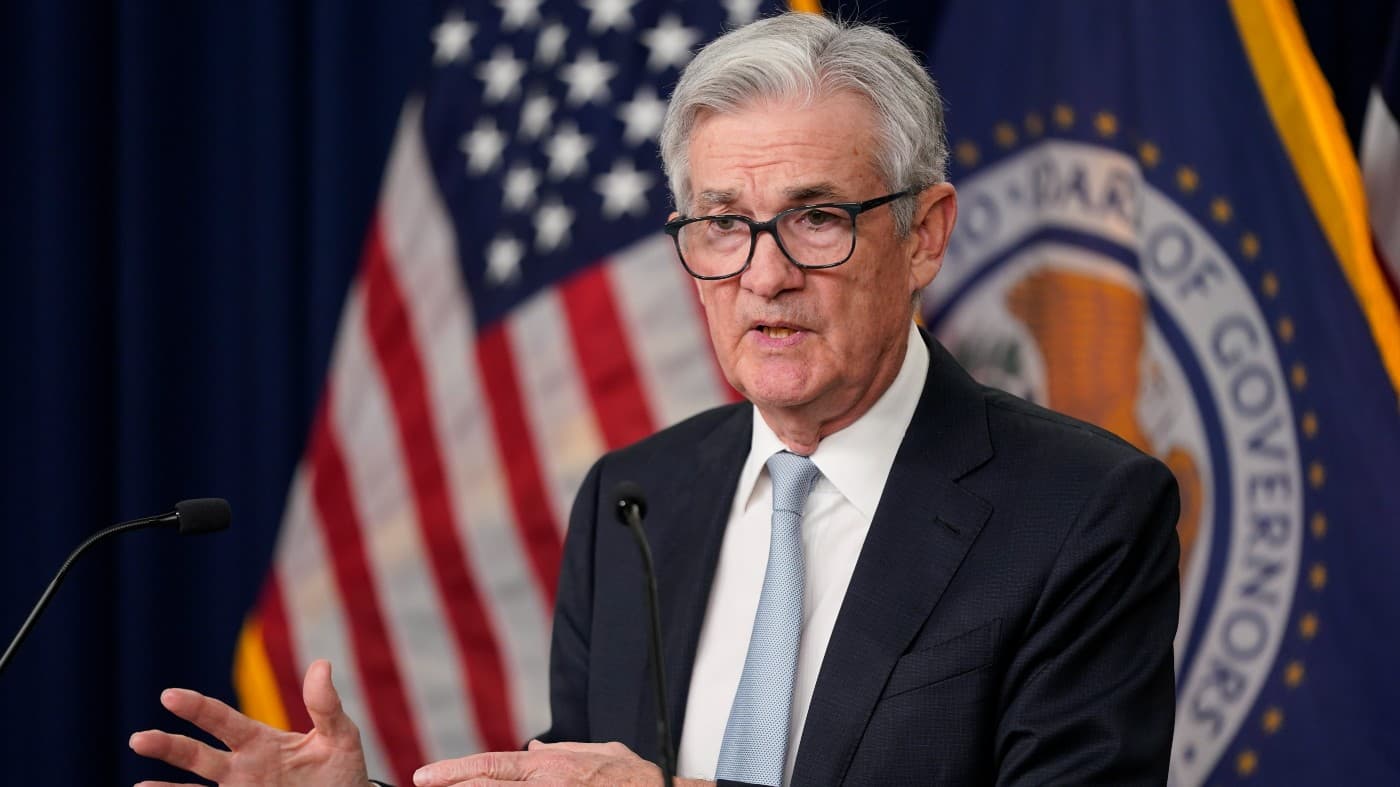
Number of rate cuts in 2026?
PM $56.50M · K 12.40M contractsWill no Fed rate cuts happen in 2026?
Kalshi: Will the Fed cut rates 0 times at emergency meetings?
Related contracts
Will no Fed rate cuts happen in 2026?
Kalshi: Will the Fed cut rates 0 times?
Same question, fine print differs
Will 1 Fed rate cut happen in 2026?
Kalshi: Will the Fed cut rates 1 time?
Same question, fine print differs
Related or unreviewed contracts may settle differently. Their gap is not an equivalent-contract comparison.
Saved prices; check contract rules.

Fed rate cut by...?
PM $6.74M · K 3.49M contractsAnother Fed rate hike in 2026?
Kalshi: Will the Federal Reserve hike rates by December 31, 2026?
Related contracts
Another Fed rate hike in 2026?
Kalshi: Will the Federal Funds Rate Decision be 25bp hike AND dissents be 0 for Dec 2026?
Related contracts
Fed rate cut by June 2027 meeting?
Kalshi: Will the Federal Reserve cut rates by June 30, 2027?
Related contracts
Related or unreviewed contracts may settle differently. Their gap is not an equivalent-contract comparison.
Saved prices; check contract rules.

How many Fed rate hikes in 2026?
PM $1.99M · K 613.8K contractsWill 2 Fed rate hikes happen in 2026?
Kalshi: Will there be exactly 2 Fed rate hikes in 2026?
Related contracts
Will 1 Fed rate hike happen in 2026?
Kalshi: Will there be exactly 1 Fed rate hike in 2026?
Related contracts
Will 3 Fed rate hikes happen in 2026?
Kalshi: Will there be exactly 3 Fed rate hikes in 2026?
Related contracts
Related or unreviewed contracts may settle differently. Their gap is not an equivalent-contract comparison.
Saved prices; check contract rules.

Fed Funds (EFFR) at end of Q4 2026
K 26.6K contracts
Predicted Fed rate under each Fed Chair
PM $161.7K
Fed funds rate after Jun 2027 meeting?
PM $2.01M · K 493.4K contractsWill the Fed’s upper bound reach 4.25% or higher before 2027?
Kalshi: Will the upper bound of the target range for the federal funds rate in effect at 11:59 PM ET on December 31, 2027 be above 4.25%?
Related contracts
Will the Fed’s upper bound reach 4.25% or higher before 2027?
Kalshi: Will the upper bound of the federal funds rate be above 4.25% following the Fed's Sep 15, 2027 meeting?
Related contracts
Will the Fed’s upper bound reach 4.25% or higher before 2027?
Kalshi: Will the upper bound of the federal funds rate be above 4.25% following the Fed's Dec 8, 2027 meeting?
Related contracts
Related or unreviewed contracts may settle differently. Their gap is not an equivalent-contract comparison.
Saved prices; check contract rules.
Market Insights
Price gaps of 2 pp+
0
Same-question pairs
0
No outcomes on this page have been reviewed as the same question on both platforms yet.
Price differences do not establish arbitrage. Check each pair's review, current order prices, fees and settlement rules.