
Which states will join the National Popular Vote Compact?
K 13.2K contracts
1
5
- Reported volume
- K 13.2K contracts
- Events
- 1
- Markets
- 5
Current odds
Snapshot from
As of Nov 22, 2026, 12:00 PM UTC, the highest-priced outcome on Kalshi is Wisconsin at 72%.
Kalshi
- Wisconsin72%
- Arizona71%
- Michigan60%
- Nevada59%
- Pennsylvania38.5%
Yes prices. They are not order quotes; check each platform's rules, fees and live prices before trading.
AI Analysis
Trader mode: Market mechanics, assumptions and risks
K 13.2K contracts
Reported volume · provider units
5
Saved contracts
0
Same-question pairs
Source snapshot: Nov 22, 2026, 12:00 PM UTC
This analysis was written from an earlier market snapshot, so its prices may be older than the odds above.
Snapshot observed Nov 17, 2026, 3:00 AM UTC. This analysis describes that snapshot and is not a live news update.
What the contract measures
This event asks which states will join the National Popular Vote Compact [1]. Each state market asks whether that state's legislation joining the compact will be enacted before the 2028 election. The rule text says that if such legislation is enacted before Nov 7, 2028, "then the market resolves to Yes" [1].
"Enactment" is a strict standard. It requires completing all constitutional and legal steps for the law to become binding. The rules state that "Legislative passage without completed executive action" does not count, and neither does "Provisional passage" or "Non-binding resolutions" [1]. The rules also say the compact itself takes effect only when member states hold at least 270 electoral votes, but a state counts once its own law is enacted [1].
Reading the snapshot
The saved data was observed at Nov 17, 2026, 3:00 AM UTC and retrieved at Nov 17, 2026, 5:07 AM UTC [1]. These are the times of the record, not a live feed. The sample includes all five saved Kalshi markets for this event, and the record does not mark the sample as partial [1].
The saved Yes prices are: Wisconsin 0.765, Arizona 0.725, Michigan 0.62, Nevada 0.44, and Pennsylvania 0.265 [1]. Each market is a separate contract, so these prices should be read one at a time. A price is a snapshot of trading at one moment, not an executable quote or a verified probability of enactment.
The provider reports 13,190 contracts of volume for the event [1]. This total is not a measure of liquidity or of how many people traded.
Timing also needs care. The market records list an end date of Nov 14, 2028, 3:00 PM UTC, but the rule text refers to Nov 7, 2028 [1]. The event's listed end time is not supplied. The evidence does not explain the gap between these dates. The rules also say a market will close early if the law is enacted [1].
What remains uncertain
The evidence is a single snapshot from one provider. It does not show current prices, current legislative status in any state, or any recent developments. The record does not explain why prices sit where they do, so no cause for any price should be inferred.
Because the data comes from one platform, no cross-platform comparison is possible. The record also states that including all saved markets "does not establish that the providers list every possible real-world outcome" [1]. Finally, the difference between the market end date and the rule date should be checked against the provider's own rules before relying on either date.
References
- Kalshi: Which states will join the National Popular Vote Compact?. Provider data observed Nov 17, 2026, 3:00 AM UTC.
Snapshot observed Nov 17, 2026, 3:00 AM UTC. This analysis describes that snapshot and is not a live news update.
What the contract measures
The five contracts come from one Kalshi event asking which states will join the National Popular Vote Compact. Each market asks whether a specific state will join before the 2028 election. According to the rules excerpt, a state counts once legislation joining the compact is enacted, and enactment requires completing all constitutional and legal requirements for the legislation to become binding law [1]. Passage by only some required bodies, provisional passage, and non-binding resolutions do not count [1]. The rules also state that "The effective date of the law is not relevant; only that it has been enacted" [1].
The wording differs across the rules and the listed close time. The rules text refers to "Before Nov 7, 2028" [1], while the saved market records list an end date of November 14, 2028 at 15:00 UTC. The source excerpt also says the listed end time is "not supplied" [1]. Readers should check the platform's contract page before relying on either date. The rules add that a market "will close and expire early if the law is enacted" [1].
Reading the snapshot
The provider observation time is November 17, 2026 at 03:00 UTC, and the source was retrieved at 05:07 UTC the same day [1]. These are snapshot prices, not executable quotes or verified probabilities. The Yes prices in the saved sample are:
- Wisconsin: 0.765 [1]
- Arizona: 0.725 [1]
- Michigan: 0.62 [1]
- Nevada: 0.44 [1]
- Pennsylvania: 0.265 [1]
The sample covers all five saved Kalshi markets for this event, and the sample is not marked as partial [1]. It does not establish that the provider lists every possible state or outcome. Each Yes price moves with its own contract. Comparing these numbers only shows how the market priced each state at that observation time. It does not indicate why prices differ, and it does not show how many traders hold each view. The reported volume of 13,190 contracts is Kalshi's own total for this event [1]. Volume is not liquidity or a count of participants.
What remains uncertain
The evidence does not include news about any state's legislation, the status of any bill, or any explanation for price changes. It also does not include the listed end time in the excerpt, a settlement history, or evidence on how well such markets have forecast outcomes. Because only one provider event is supplied, these prices should not be combined with other platforms or treated as a ranking across different contracts. A price gap between two states is not an arbitrage signal, since each contract has its own rules and close time.
References
- Kalshi: Which states will join the National Popular Vote Compact?. Provider data observed Nov 17, 2026, 3:00 AM UTC.
AI-generated analysis based on market data. Not financial advice.
Saved Nov 17, 2026 UTCThis article was written from an earlier market snapshot and may be out of date. Use the dated market data and provider rules above for current information.
Overview
The National Popular Vote Interstate Compact (NPVIC) is an agreement among a group of U.S. states and the District of Columbia to award all their electoral votes to whichever presidential ticket wins the overall popular vote across the 50 states and the District of Columbia, regardless of which ticket won more votes within an individual state or district [2]. The compact would take effect only when it would guarantee that nationwide popular vote outcome [2]. Under the contract rules, a state counts toward the market's Yes outcome once its law joining the compact is enacted, even though the compact itself takes effect only when member states hold at least 270 electoral votes [1]. The contract asks whether legislation joining the compact will be enacted before November 7, 2028 [1]. The rules define enactment as completion of all constitutional and legal requirements for the legislation to become binding law [1]. The mechanics differ by type of legislation. For standard legislation that requires executive approval, the rules require final passage by all required legislative bodies, followed by an executive signature, law taking effect without executive action, or a successful veto override, and satisfaction of any required waiting periods [1]. For legislation that does not require executive approval, final passage and completion of required waiting periods are the relevant steps [1]. The rules also say that passage by only some required bodies, provisional passage, non-binding resolutions and draft orders do not count as enactment [1]. The legal status of the compact is also contested. Wikipedia notes that there is ongoing legal debate about its constitutionality, including interpretations of the Compact Clause and states' power under the Presidential Electors Clause [3]. The contract rules address this by stating that enactment occurs when all requirements are completed, regardless of pending judicial challenges [1]. The saved market records in this set are five state-specific contracts under one Kalshi event, covering Wisconsin, Arizona, Michigan, Nevada and Pennsylvania. Each asks whether that state will join the compact before the 2028 election. The saved records list an end date of November 14, 2028, which differs from the November 7, 2028 date stated in the event's contract rules [1]. Prices for each contract are shown as Yes and No outcomes and are reported as provider snapshots.
Historical Context
The compact was introduced in 2006 [2]. Its stated design goal is to ensure that the candidate who receives the most votes nationwide is elected president [2]. Wikipedia describes the constitutional questions as ongoing [3].
Why It Matters
The contract measures whether legislation joining the National Popular Vote Interstate Compact is enacted in a given state before November 7, 2028 [1]. It is a question about enactment, not about when the compact takes effect. The rules state that the effective date of the law is not relevant and that only enactment matters [1]. A state's enactment would count even though the compact does not operate until member states hold at least 270 electoral votes [1]. The contract also specifies that it will close and expire early if the law is enacted [1]. Because the state-level contracts depend on the rule text, readers should check the wording of the specific contract rather than assuming it tracks the compact's operational status [1][2].
Snapshot context
The latest published provider snapshot for this topic was observed on 2026-11-17 at 03:00 UTC. It contains listings from Kalshi. Market descriptions and listed closing times define the contracts; they do not establish that the real-world outcome has occurred. This article does not include a separately verified news update. [1]
Frequently Asked Questions
Does a state count as joining the compact once its legislature passes a bill?
Not necessarily. Legislative passage without completed executive action does not count, and passage by only some required bodies does not count [1]. For standard legislation requiring executive approval, the rules require an executive signature, law taking effect without executive action, or a successful veto override, along with any required waiting periods [1].
Does a pending lawsuit prevent enactment from counting?
According to the contract rules, enactment occurs when all requirements are completed, regardless of pending judicial challenges [1].
Does the compact's effective date determine the outcome?
No. The contract rules state that the effective date of the law is not relevant and that only enactment matters [1]. The compact takes effect only when member states hold at least 270 electoral votes [1][2].
AI-written background. References identify the evidence used; Wikipedia links under Learn More are additional reading. Prices and provider rules are dated snapshots. This is not financial advice.
Related prediction markets
Prices are catalog snapshots and may have changed. Check each market's rules and observation time.

Will the National Popular Vote compact reach 270 electoral votes?
K 8.4K contracts
2026 Midterms: House popular vote margin of victory? (Directional)
K 9.24M contracts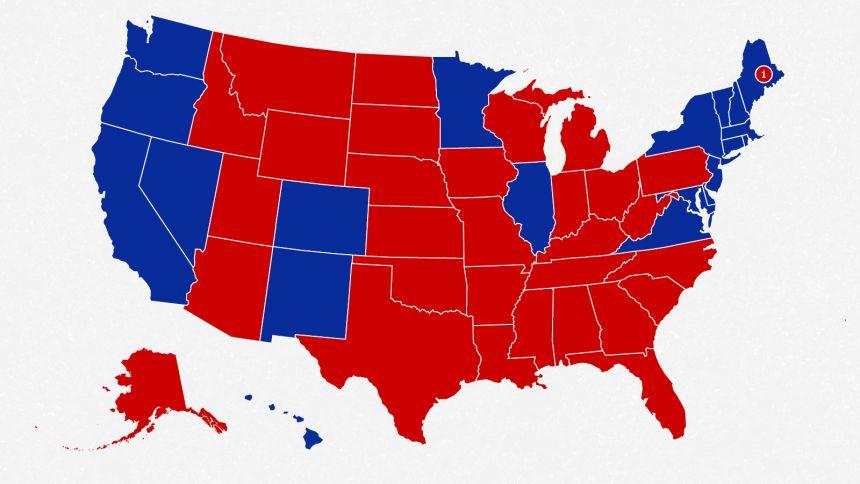
National Popular Vote Compact implemented before the 2028 election?
PM $5.9K
2028 popular vote margin of victory?
K 624.9K contracts
MO-05 House election: Emanuel Cleaver vote percent
K 5.7K contractsTexas Governor election: Greg Abbott vote percent
K 43.4K contractsMarket Insights
Price gaps of 2 pp+
0
Same-question pairs
0
No outcomes on this page have been reviewed as the same question on both platforms yet.
Price differences do not establish arbitrage. Check each pair's review, current order prices, fees and settlement rules.
