National Popular Vote Compact implemented before the 2028 election?
PM $5.9K
1
1
- Reported volume
- PM $5.9K
- Events
- 1
- Markets
- 1
Current odds
Snapshot from
As of Nov 22, 2026, 12:00 PM UTC, Yes is priced at 46% on Polymarket.
Polymarket
- Yes46%
Yes prices. They are not order quotes; check each platform's rules, fees and live prices before trading.
AI Analysis
Trader mode: Market mechanics, assumptions and risks
PM $5.9K
Reported volume · provider units
1
Saved contracts
0
Same-question pairs
Source snapshot: Nov 22, 2026, 12:00 PM UTC
Snapshot observed Nov 22, 2026, 9:00 AM UTC. This analysis describes that snapshot and is not a live news update.
What the contract measures
This contract asks whether, by November 6, 2028 at 11:59 PM ET, the states and the District of Columbia that have enacted the National Popular Vote Interstate Compact into law will collectively hold a majority of electoral votes. If they do, it resolves "Yes"; otherwise it resolves "No" [1]. The market counts only jurisdictions that have enacted the compact with the intent that it take effect for the 2028 presidential election. Electoral-vote totals use the apportionment in effect on the resolution date. A jurisdiction that has repealed or withdrawn from the compact is not counted, and injunctions or legal actions are not relevant to resolution [1].
The primary resolution sources are official state legislative records and the National Popular Vote organization's status page. A consensus of credible reporting may also be used [1].
Reading the snapshot
The snapshot was observed on November 22, 2026 at 09:00 UTC and retrieved at 09:23 UTC the same day [1]. It records a "Yes" price of 0.46 and a "No" price of 0.54 on Polymarket [1]. These are prices from one moment, not executable quotes or verified probabilities. The source does not explain why the prices are where they are, so this summary does not attribute any movement to a cause.
The listed end time is Nov 7, 2028, 4:59 AM UTC, which corresponds to the November 6, 2028 11:59 PM ET deadline in the rules [1]. This is the contract's closing time, not an announced event date, and the snapshot does not show whether the contract has resolved.
The provider reports a total volume of $5,887 for this event in US dollars [1]. Volume describes trading activity on this contract, not liquidity or the number of traders, and it should not be compared with figures from other platforms. The sample includes the only saved market for this event, and the evidence does not show whether other related markets exist.
What remains uncertain
The evidence does not show how many states have enacted the compact, which jurisdictions currently count toward the threshold, or whether any repeal or withdrawal has occurred. It also does not include recent reporting on the compact or any upcoming legislative action. The snapshot cannot confirm the market's eventual outcome.
Because this is a single snapshot from one provider, it describes only one moment on one platform. Different contracts with different wording or close times should not be compared directly, even when their prices differ.
References
- Polymarket: National Popular Vote Compact implemented before the 2028 election?. Provider data observed Nov 22, 2026, 9:00 AM UTC.
Snapshot observed Nov 22, 2026, 9:00 AM UTC. This analysis describes that snapshot and is not a live news update.
What the contract measures
The contract asks whether the National Popular Vote Compact will be in effect before the 2028 election. Under the listed rules, it resolves "Yes" if, by November 6, 2028, 11:59 PM ET, "the states and the District of Columbia that have enacted the National Popular Vote Interstate Compact into law collectively hold a majority of the electoral votes" [1]. Jurisdictions that repealed the compact or withdrew from it are not counted, and injunctions or other legal action are "not relevant for purposes of this market" [1]. Electoral-vote totals use the apportionment in effect on the resolution date [1].
The stated primary sources are official state legislative records and the National Popular Vote organization's status page, and "a consensus of credible reporting may also be used" [1]. The listed end time is Nov 7, 2028, 4:59 AM UTC, which corresponds to the November 6, 2028 deadline in the rules [1]. That end time is the contract's closing time, not a resolution that has occurred.
Reading the snapshot
The only market in this sample is a Polymarket contract. Its saved snapshot was observed at Nov 22, 2026, 9:00 AM UTC and retrieved at 09:23:16Z [1]. At that observation, the Yes price was 0.46 and the No price was 0.54 [1]. These are snapshot prices, not executable quotes, and they should not be read as verified probabilities. The two prices sum to 1.00 in this snapshot, so there is no separate spread visible in this data.
Polymarket reports a total volume of $5,887 for this event, in US dollars [1]. Volume describes trading activity on the platform, not liquidity or the number of traders.
Because there is one provider and one contract, there is no cross-platform comparison here. The sample includes all saved markets for this event, and the marketCoverage record marks it as not partial [1]. The evidence does not establish that these providers list every possible real-world outcome.
What remains uncertain
This snapshot does not show the prices at any later time, and it cannot tell a reader what the price is today. The evidence contains no information about why the price stands where it does, no count of participants, and no current status of any state's legislation beyond what the rules describe. Any reader comparing this contract with a differently worded market should check the resolution criteria, deadline, and resolution sources, since differences in wording or closing times can change what each price means.
References
- Polymarket: National Popular Vote Compact implemented before the 2028 election?. Provider data observed Nov 22, 2026, 9:00 AM UTC.
AI-generated analysis based on market data. Not financial advice.
Saved Nov 22, 2026 UTCOverview
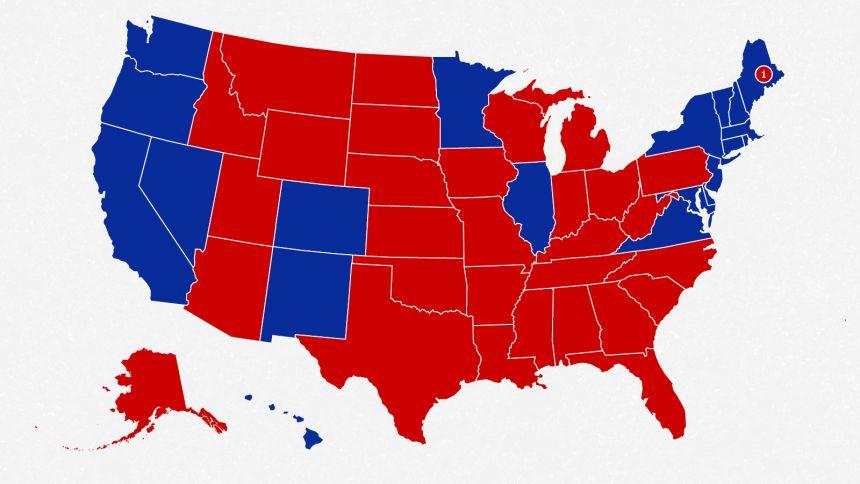
The National Popular Vote Interstate Compact (NPVIC) is an agreement among a group of U.S. states and the District of Columbia to award all of their electoral votes to whichever presidential ticket wins the overall popular vote across the 50 states and the District of Columbia, regardless of which ticket won more votes in each individual state or district [2]. The compact was introduced in 2006 and is designed to ensure that the candidate who receives the most votes nationwide is elected president. It would take effect only when it would guarantee that outcome [2]. The Polymarket contract asks whether the compact will be implemented before the 2028 presidential election [1]. The contract is tied to the mechanics of the Electoral College. Under the Constitution, each state's number of electors equals its congressional delegation, meaning its two senators plus its representatives. Each state appoints electors using procedures set by its legislature, and the Twenty-third Amendment gave the District of Columbia three electors [3]. A simple majority of electoral votes is required to elect the president and vice president [3]. The compact would redirect the electoral votes of its members toward the national popular vote winner, which is why the market measures whether enacting jurisdictions hold enough electoral votes to matter. The market's resolution depends on enactment, not on a national election result. Its rules count jurisdictions that have concurrently enacted the compact into law, with the intent that it be in effect for the 2028 presidential election [1].
Historical Context
The compact was introduced in 2006 as an interstate agreement among states and the District of Columbia [2]. The Electoral College it works alongside is formed every four years and is described in Article Two of the Constitution [3]. The evidence supplied does not identify which states or jurisdictions have enacted the compact, so this article does not describe the current enactment count.
Why It Matters
The contract measures whether, by the deadline in its rules, the jurisdictions that have enacted the National Popular Vote Interstate Compact into law collectively hold a majority of electoral votes [1]. The rules state that the market resolves to Yes if this threshold is met by November 6, 2028, at 11:59 PM ET, and to No otherwise [1]. The contract's listed end time is recorded as 2028-11-07T04:59:00 UTC, which reflects that deadline converted to UTC in the provider's data rather than a scheduled event [1]. The rules set specific boundaries. Electoral-vote totals are based on the apportionment of electors in effect on the resolution date, so the count does not use an earlier allocation [1]. A jurisdiction that has repealed the compact or withdrawn from it, so that it is no longer a member, is not counted [1]. Court injunctions or other legal action against the compact as a whole or against a state's implementation are not relevant to the market [1]. The primary resolution source is official state legislative records together with the National Popular Vote organization's status page, although a consensus of credible reporting may also be used [1].
Snapshot context
The latest published provider snapshot for this topic was observed on 2026-11-22 at 09:00 UTC. It contains listings from Polymarket. Market descriptions and listed closing times define the contracts; they do not establish that the real-world outcome has occurred. This article does not include a separately verified news update. [1]
Frequently Asked Questions
What must happen for the market to resolve Yes?
The market resolves Yes if, by November 6, 2028, 11:59 PM ET, the states and the District of Columbia that have enacted the compact into law collectively hold a majority of electoral votes [1].
Does a lawsuit against the compact affect the outcome?
No. The rules state that injunctions or other legal action against the compact as a whole, or against any state's implementation of it, will not be relevant for purposes of the market [1].
What happens if a state leaves the compact?
A jurisdiction that has repealed the compact or withdrawn from it, so that it is no longer a member, will not be counted [1].
Which sources decide how the market resolves?
The primary resolution source is official state legislative records and the National Popular Vote organization's status page. A consensus of credible reporting may also be used [1].
How are electoral votes counted for the contract?
Electoral-vote totals are based on the apportionment of electors in effect on the resolution date [1]. Each state's electors equal its senators plus its representatives, and the District of Columbia has three electors under the Twenty-third Amendment [3].
Does the market price show the likelihood of the outcome?
The market price is a snapshot of trading at the time it was recorded and is not a verified probability of the compact being implemented. Trading volume is reported by the provider in its own units and does not measure liquidity or the number of traders [1].
AI-written background. References identify the evidence used; Wikipedia links under Learn More are additional reading. Prices and provider rules are dated snapshots. This is not financial advice.
Related prediction markets
Prices are catalog snapshots and may have changed. Check each market's rules and observation time.

Which states will join the National Popular Vote Compact?
K 13.2K contracts
Will the National Popular Vote compact reach 270 electoral votes?
K 8.4K contracts
2026 Midterms: House popular vote margin of victory? (Directional)
K 9.24M contracts
2028 popular vote margin of victory?
K 624.9K contracts
Presidential Election Winner 2028
PM $745.95M · K 109.04M contractsWill Marco Rubio win the 2028 US Presidential Election?
Kalshi: Will Donald Trump endorse Marco Rubio in the 2028 presidential election before Mar 1, 2028?
Related contracts
Will Alexandria Ocasio-Cortez win the 2028 US Presidential Election?
Kalshi: Will the Democratic Socialists of America (DSA) national organization endorse Alexandria Ocasio-Cortez in the 2028 presidential election, including the Democratic primaries before Mar 1, 2028?
Related contracts
Will Jon Ossoff win the 2028 US Presidential Election?
Kalshi: Who will win the next presidential election? (Jon Ossoff)
Related contracts
Related or unreviewed contracts may settle differently. Their gap is not an equivalent-contract comparison.
Saved prices; check contract rules.

MO-05 House election: Emanuel Cleaver vote percent
K 5.7K contractsMarket Insights
Price gaps of 2 pp+
0
Same-question pairs
0
No outcomes on this page have been reviewed as the same question on both platforms yet.
Price differences do not establish arbitrage. Check each pair's review, current order prices, fees and settlement rules.