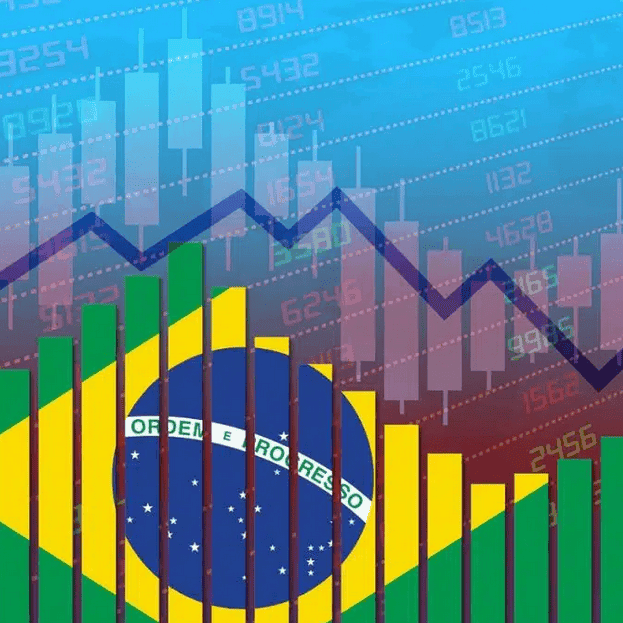
How high will Brazil inflation get this year?
PM $167.6K · K 19.4K contracts
2
20
How high will Brazil inflation get this year?
PM $167.6K · K 19.4K contracts
2
20
AI Analysis
Trader mode: Market mechanics, assumptions and risks
PM $167.6K · K 19.4K contracts
Reported volume · provider units
20
Saved contracts
0
Reviewed equivalent pairs
Source snapshot: Oct 18, 2026, 12:00 AM UTC
About This Event
Before 2027 If any Brazil annual inflation rate print is above X before Jan 1, 2027, then the market resolves to Yes.
This saved analysis is awaiting a background update. Its prices and claims may be outdated; compare them with the dated market data above.
Current Market Outlook
The market is pricing a 90% probability that Brazil's annual inflation rate will exceed 4.75% before 2027. That is not a close call. The market sees this as nearly inevitable. For context, Brazil's central bank targets inflation at 3.25%, with a tolerance band of 1.75% to 4.75%. A reading above 4.75% means inflation has officially breached the upper limit of the target range.
Key Factors Driving the Odds
Brazil's inflation problem is not hypothetical. The IPCA consumer price index hit 4.87% in January 2025, already above the 4.75% threshold. The February reading came in at 4.96%. The market is pricing a 90% chance that at least one monthly print will exceed 4.75% before 2027 because it already has happened twice this year.
The real driver is the Brazilian real. The currency has lost roughly 15% of its value against the dollar over the past 12 months. A weak real makes imported goods more expensive, and Brazil imports everything from fuel to electronics. The central bank has been raising the Selic rate aggressively, currently at 14.25%, but the pass-through from currency depreciation to consumer prices takes months to fully materialize.
Food prices are another factor. Severe drought in key agricultural regions pushed soybean and corn prices up 22% year-over-year. Meat prices followed. These are not transitory shocks. The La Niña weather pattern is expected to persist through late 2025, keeping pressure on crop yields.
What Could Change These Odds
The 10% chance the market assigns to inflation staying below 4.75% requires a sharp economic downturn. If Brazil enters a recession, demand destruction would pull prices down. That scenario would likely require the Selic rate to stay above 15% for an extended period, which the central bank has signaled it is willing to do.
The next major catalyst is the May 2025 COPOM meeting, where the central bank will release its quarterly inflation report. If the bank projects inflation falling below 4.75% by year-end, the market could shift. But based on current data, that projection would require a significant downward revision that seems unlikely given the real's trajectory.
AI-generated analysis based on market data. Not financial advice.
Saved Jul 28, 2026 UTCThis saved content is awaiting a background update. It may contain outdated claims; use the dated market data and provider rules for the latest available information.
Overview
Brazil's annual inflation rate, measured by the IPCA (Índice Nacional de Preços ao Consumidor Amplo), is a key economic indicator that has fluctuated significantly in recent years. This prediction market asks whether any monthly IPCA print will exceed a specified threshold before January 1, 2027. The Brazilian Central Bank (BCB) targets an inflation rate of 3.25% for 2024, 3.0% for 2025, and 3.0% for 2026, with a tolerance band of plus or minus 1.5 percentage points. Actual inflation has been above target in recent years, hitting 5.79% in 2023, 4.62% in 2024, and running at around 4.5% in early 2025. The market's outcome depends on the threshold set, which could be a high number like 10% or a lower one like 6%, reflecting different risk scenarios. Brazil's inflation dynamics are shaped by a mix of domestic and global factors. On the domestic side, the BCB's Selic policy rate, currently at 14.25% per year (as of March 2025), is one of the highest in the world and is used to cool demand. Fiscal policy also plays a role: the government's primary deficit and public debt, which exceeded 78% of GDP in 2024, can fuel inflation expectations if markets doubt fiscal sustainability. On the global side, commodity prices, especially for oil, soybeans, and iron ore, affect import costs and export revenues. The Brazilian real has depreciated against the US dollar by about 15% over the past two years, which directly raises the cost of imported goods. Recent developments include the BCB's aggressive rate hikes in 2024 and early 2025 to combat persistent inflation. The central bank raised the Selic from 13.75% to 14.25% between September 2024 and March 2025. Inflation expectations, as measured by the Focus survey of economists, have remained above the target ceiling for 2025 and 2026. Food prices, particularly beef and rice, have been a major driver, with the food-at-home component rising 8% year-over-year in early 2025. Energy prices, including gasoline and electricity, have also contributed, due to above-average rainfall affecting hydroelectric generation and global oil price volatility. People are interested in this topic because inflation directly affects household purchasing power, interest rates, and investment returns. For investors, a high inflation print could trigger further rate hikes, impacting bond yields and stock valuations. For consumers, it means higher costs for essentials like food and fuel. The prediction market offers a way to bet on specific outcomes, which can hedge against inflation risk or speculate on policy effectiveness. The question also ties into broader debates about the BCB's credibility, the government's fiscal discipline, and Brazil's economic resilience amid global uncertainty.
Historical Context
Brazil has a long history of high inflation, with annual rates exceeding 2,000% in the early 1990s. The Plano Real, implemented in 1994 under President Itamar Franco and Finance Minister Fernando Henrique Cardoso, introduced a new currency (the real) and strict monetary controls, reducing inflation to single digits by 1997. Since then, the BCB has used inflation targeting, starting in 1999, with a central target and a tolerance band. The target has been lowered over time, from 8% in 1999 to 3.25% in 2024. In the 2010s, Brazil experienced moderate inflation, averaging around 6% from 2010 to 2014, then spiking to 10.67% in 2015 due to fiscal imbalances and a severe recession. The BCB raised the Selic to 14.25% in 2015, and inflation fell to 2.95% in 2017. More recently, the COVID-19 pandemic caused a surge in global inflation, with Brazil's IPCA hitting 10.06% in 2021, driven by food and energy prices. The BCB responded with rate hikes from 2% in March 2021 to 13.75% in August 2022, bringing inflation down to 5.79% in 2023. Precedents for high inflation prints in the current cycle include the 10.06% figure in 2021. The question of whether inflation will exceed a given threshold before 2027 depends on whether the BCB's tight policy can contain pressures from fiscal spending, currency depreciation, and global commodity shocks. Historically, inflation in Brazil has been sticky, often requiring sustained high rates to bring it down.
Why It Matters
Brazil's inflation rate matters far beyond the number itself. For the 214 million Brazilians, high inflation erodes purchasing power, particularly for low-income households that spend a larger share of income on food and housing. In 2024, food inflation ran at 7% while overall inflation was 4.62%, meaning essentials became more expensive faster. This can increase poverty and inequality, as real wages lag behind price increases. For financial markets, Brazil's inflation determines the trajectory of the Selic rate, which affects global capital flows. Brazil is a major emerging market, and its interest rates influence bond yields worldwide. A surprise high inflation print could trigger a sell-off in Brazilian assets and a spike in the real-dollar exchange rate. For the government, higher inflation increases the cost of servicing public debt, which is partly indexed to the Selic. This can worsen fiscal deficits and reduce room for social spending. The prediction market allows participants to hedge or speculate on these outcomes, making it a practical tool for risk management.
Frequently Asked Questions
What is Brazil's current inflation rate?
As of March 2025, Brazil's annual IPCA inflation rate is around 4.5%, down from 4.62% in 2024 but still above the central bank's 3.0% target for 2025.
AI-written background. References identify the evidence used; Wikipedia links under Learn More are additional reading. Prices and provider rules are dated snapshots. This is not financial advice.
Related prediction markets
Prices are catalog snapshots and may have changed. Check each market's rules and observation time.

How high will CPI get this year?
K 91.2K contracts
How high will the price of fertilizer get this year?
K 70.4K contracts
How high will the 30-year mortgage rate get in 2026?
K 15.9K contracts
How high will inflation get this year?
K 564.1K contracts
How high will the 10Y US Treasury yield get by Jan 1, 2027?
PM $1.02M · K 11.0K contractsWill the 10-year Treasury yield hit 5.4% before 2027?
Kalshi: Will the 10Y U.S. Treasury yield be above 5.39% by Jan 1, 2027?
Related contracts
Will the 10-year Treasury yield hit 5.5% before 2027?
Kalshi: Will the 10Y U.S. Treasury yield be above 5.49% by Jan 1, 2027?
Related contracts
Related or unreviewed contracts may settle differently. Their gap is not an equivalent-contract comparison.
Saved prices; check contract rules.

How high will the 5-year US Treasury yield get in Oct 2026?
K 29.3K contractsMarket Insights
Price gaps of 2 pp+
0
Reviewed equivalent pairs
0
No currently reviewed equivalent pairs with both binary Yes prices are available.
Price differences do not establish arbitrage. Check each pair's review, current order prices, fees and settlement rules.