When will traffic at the Strait of Hormuz return to normal?
PM $23.10M · K 8.73M contracts
5
29
When will traffic at the Strait of Hormuz return to normal?
PM $23.10M · K 8.73M contracts
5
29
Current odds
Snapshot from
As of Nov 6, 2026, 12:00 PM UTC, Yes is priced at 9.5% on Polymarket, and the highest-priced outcome on Kalshi is Before Jan 1, 2029 at 69.5%.
Polymarket
- Yes9.5%
Kalshi
- Before Jan 1, 202969.5%
- Before Jul 1, 202862.5%
- Before Jan 1, 202853.5%
- Before Dec 1, 202748.5%
- Before Nov 1, 202747.5%
Yes prices. They are not order quotes; check each platform's rules, fees and live prices before trading.
AI Analysis
Trader mode: Market mechanics, assumptions and risks
PM $23.10M · K 8.73M contracts
Reported volume · provider units
29
Saved contracts
0
Same-question pairs
Source snapshot: Nov 6, 2026, 12:00 PM UTC
About This Event
Transit calls If the 7-day moving average of transit calls through the Strait of Hormuz as reported by the IMF PortWatch is above 60 before X 1, 2027, then the market resolves to Yes. Early close condition: This market will close and expire early if the condition is met. This market will close and expire early if the condition is met.
This analysis is awaiting a background update, so its prices may be older than the odds above.
Snapshot observed 2026-11-01T18:00:06.916Z. This analysis describes that snapshot and is not a live news update.
What the contract measures
These contracts ask whether the 7-day moving average of transit calls through the Strait of Hormuz, as reported by IMF PortWatch, reaches a set level. The Kalshi return-to-normal event uses a threshold of 60 and says the market "resolves to Yes" if the average is "above 60" before a given date [1]. The Polymarket December 31 contract resolves Yes if IMF Portwatch publishes an average "equal to or above 60 for any date between market creation and December 31, 2026" [2]. The wording differs in both the threshold test ("above" versus "equal to or above") and the time window ("before" a date versus "between market creation and" a date), so the contracts are not identical.
The Kalshi average-traffic event [4] asks a different question: whether the average exceeds thresholds from 30 to 120 in a window starting after July 6, 2026. Its prices should not be compared with the return-to-normal contracts.
Reading the snapshot
The provider observation time was 2026-11-01T18:00:06.916Z [1]. This is a past snapshot, not a current quote, and the prices are not executable quotes or verified probabilities.
For the Kalshi return-to-normal event, 12 of 17 markets are included. Within that partial sample, Yes prices run from 0.63 for the January 1, 2029 threshold to 0.19 for the April 1, 2027 threshold [1]. The included markets were selected by highest Yes price, so the omitted markets cannot be read as lower-priced.
On Polymarket, the December 31 contract shows Yes at 0.125 with a listed end time of 2027-01-01T04:59:00Z [2]. The October 31 contract shows Yes at 0.0005, but its listed end time of 2026-11-01T03:59:00Z falls before the observation time, and its status still reads active [3]. The November 30 contract shows Yes at 0.055, but no rule excerpt was supplied for it.
Different contracts with different wording and end dates should not be treated as an arbitrage opportunity because their prices differ.
What remains uncertain
The evidence does not explain why any price moved, and it does not report trader counts or volume. The Kalshi event excerpt lists no end time, and its text reads "before X 1, 2027," which does not clearly state a date, so the individual market titles are the only dated reference. Polymarket allows revisions to earlier IMF data points within the market window, and it describes early resolution and a 14-day data-publication rule [2]. Readers should check each contract's current status and rules directly before relying on any price.
References
- Kalshi: When will traffic at the Strait of Hormuz return to normal?. Provider data observed 2026-11-01T18:00:06.916Z.
- Polymarket: Strait of Hormuz traffic returns to normal by December 31?. Provider data observed 2026-11-01T18:00:06.916Z.
- Polymarket: Strait of Hormuz traffic returns to normal by October 31?. Provider data observed 2026-11-01T18:00:06.916Z.
- Kalshi: How high will average weekly Hormuz traffic get in 2026?. Provider data observed 2026-11-01T18:00:06.916Z.
AI-generated analysis based on market data. Not financial advice.
Saved Nov 1, 2026 UTCThis saved content is awaiting a background update. It may contain outdated claims; use the dated market data and provider rules for the latest available information.
Overview
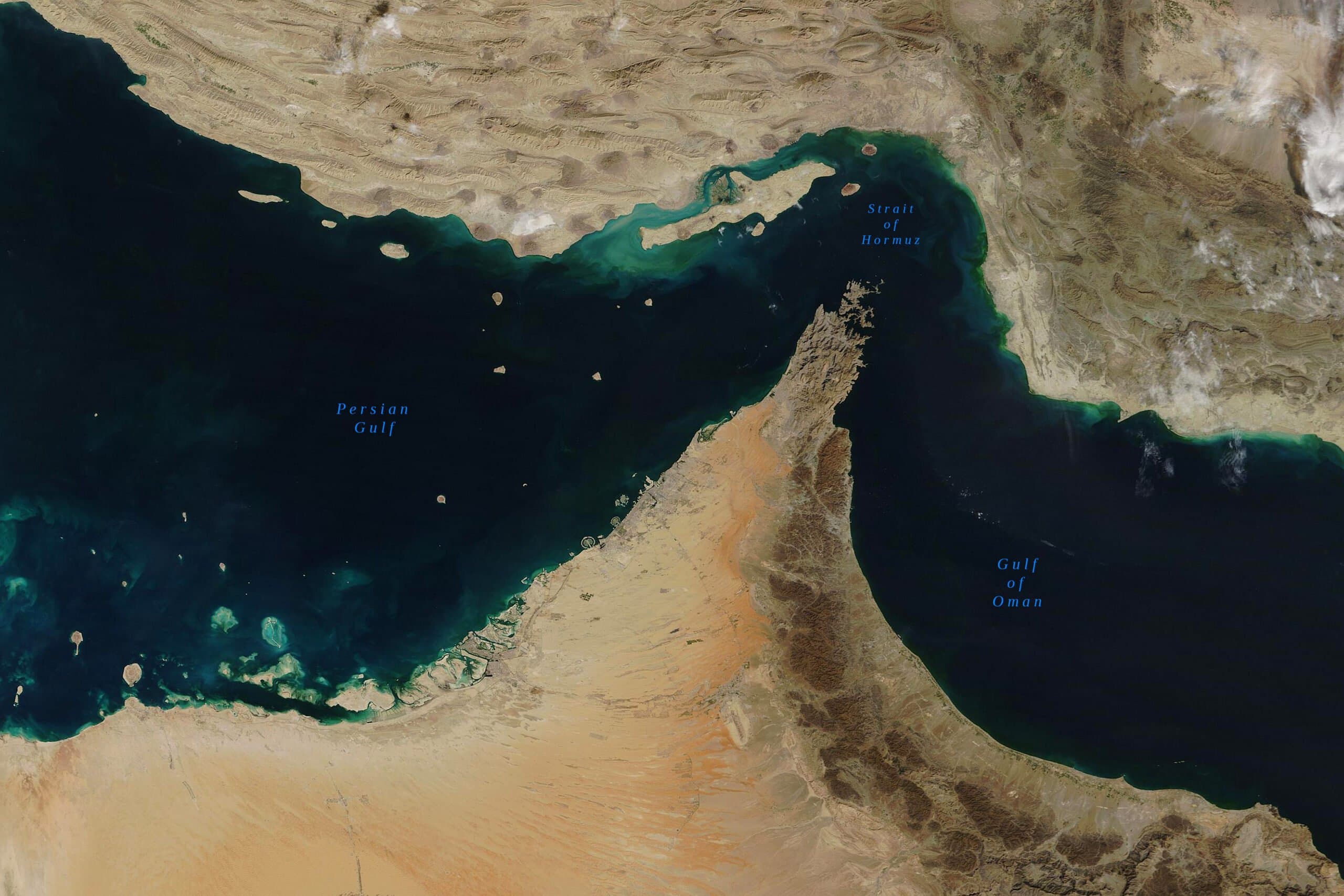
The Strait of Hormuz is a waterway between the Persian Gulf and the Gulf of Oman. Iran lies on its north coast, and the Musandam Peninsula of Oman, with a small part of the southwest of the peninsula under the United Arab Emirates, lies on its south coast. The strait is about 104 miles long and its width varies from about 60 miles to about 24 miles [5]. The strait matters to global energy trade. Before the 2026 conflict, about 25% of the world's seaborne oil trade and 20% of its liquefied natural gas passed through it [6]. Background reference material describes shipping as largely blocked by Iran since 28 February 2026, when the United States and Israel launched an air war against Iran [6]. The same background describes the Iranian Revolutionary Guard Corps issuing warnings against passage, boarding and attacking merchant ships, and laying sea mines in the strait [6]. The background also describes a United States blockade of Iranian ports from 13 April to 29 May 2026 [6]. The contracts in this topic do not ask whether the strait is open in a general sense. They ask whether a specific measure of traffic reaches a set threshold. Each contract uses the 7-day moving average of transit calls through the strait as reported by the IMF PortWatch [1][2][3][4]. The threshold is 60 in the contracts that use the phrase return to normal [1][2][3]. Under the Polymarket December 31 and October 31 contracts, a Yes result requires PortWatch to publish a value equal to or above 60 for any date between market creation and the stated final date [2][3]. The Kalshi return-to-normal contract resolves Yes if the same measure is above 60 before a stated date, and it includes an early close condition that ends the market once the condition is met [1]. The rules also explain how a result is reached. Daily transit calls include container, dry bulk, roll-on/roll-off, general cargo, and tanker ships, and ships not reported by IMF PortWatch are not counted [2][3]. Polymarket contracts resolve as soon as PortWatch publishes a qualifying value, or once data has been published for the final date and no qualifying value appeared [2][3]. Revisions to earlier data points made within the market's timeframe are considered, but they do not disqualify a previously published qualifying point [2][3]. The rules also allow a short extension for obvious clerical or data integrity errors, and they state that differences between PortWatch and alternative sources do not count as such errors [2][3]. The market snapshot in this article was observed on 1 November 2026 at 18:00 UTC and retrieved at 19:52 UTC. Listed end times differ across contracts. For example, one Polymarket October 31 contract lists an end time of 1 November 2026 at 03:59 UTC, while the December 31 contract lists 1 January 2027 at 04:59 UTC [2][3]. Kalshi listings for the return-to-normal event show dates in 2028 and 2029 for some thresholds [1].
Historical Context
Background reference material states that shipping through the strait has been largely blocked by Iran since 28 February 2026, when the United States and Israel launched an air war against Iran [6]. It also states that the IRGC retaliated with warnings, attacks on merchant ships, and sea mines, and that the United States blockaded Iranian ports from 13 April to 29 May 2026 [6]. These pages were retrieved on 1 November 2026, but they are background references and do not confirm the current state of the strait.
Why It Matters
Each contract measures traffic through the strait using the IMF PortWatch 7-day moving average of transit calls, with 60 as the threshold in the return-to-normal contracts [1][2][3]. Because the rules tie resolution to a published data series, the outcome depends on what PortWatch publishes within each contract's timeframe, not on news reports or general descriptions of the strait [2][3]. The Kalshi average-traffic contract uses a similar measure but sets different thresholds and a window running from after 6 July 2026 to before 1 January 2027 [4].
Snapshot context
The latest published provider snapshot for this topic was observed on 2026-11-01 at 18:00 UTC. It contains listings from Kalshi and Polymarket. Market descriptions and listed closing times define the contracts; they do not establish that the real-world outcome has occurred. This article does not include a separately verified news update. [1]
Frequently Asked Questions
What does the return-to-normal contract measure?
It measures whether the 7-day moving average of transit calls through the Strait of Hormuz, as reported by IMF PortWatch, is at or above the stated threshold of 60 within the contract's timeframe [1][2][3].
Which ships are counted?
The Polymarket rules say daily transit calls include container, dry bulk, roll-on/roll-off, general cargo, and tanker ships, and that ships not reported by IMF PortWatch are not considered [2][3].
Can a contract resolve before its final date?
Yes. The Polymarket rules state that a contract resolves as soon as PortWatch publishes a qualifying 7-day moving average at or above 60 [2][3]. The Kalshi return-to-normal rules include an early close condition once the condition is met [1].
What happens if data is revised?
Under the Polymarket rules, revisions made within the market's timeframe are considered, but they do not disqualify a previously published data point that qualified. Revisions made after the final date's data is published are not considered [2][3].
Does a contract price show the chance that traffic normalizes?
The supplied sources describe contract rules and listed prices but do not establish that a price is a verified probability. Prices shown in the snapshot are only market observations at a point in time.
AI-written background. References identify the evidence used; Wikipedia links under Learn More are additional reading. Prices and provider rules are dated snapshots. This is not financial advice.
Related prediction markets
Prices are catalog snapshots and may have changed. Check each market's rules and observation time.
Which month will Strait of Hormuz traffic return to normal?
PM $630.8K
Traffic through the Strait of Hormuz? (11/2 - 11/8)
K 130.5K contracts
Strait of Hormuz: highest single-day traffic (November 2026)
K 8.1K contracts
Peak traffic through the Strait of Hormuz? (11/2 - 11/8)
K 43.0K contracts
Peak Strait of Hormuz traffic day? (11/2 - 11/8)
K 47.7K contracts
Which countries will send warships through the Strait of Hormuz by December 31?
PM $61.1KMarket Insights
Price gaps of 2 pp+
0
Same-question pairs
0
No outcomes on this page have been reviewed as the same question on both platforms yet.
Price differences do not establish arbitrage. Check each pair's review, current order prices, fees and settlement rules.